- Make way for Dovyalis hebecarpa, aka the Ceylon gooseberry, your new favourite superfood for the week.
- US$6.5 million to breed better cucurbits. Maybe.
- Rise and fall of agrarian states influenced by climate volatility. Those who do not understand history etc.
- Bioversity urges crop wild relatives to avoid the fate of the dodo.
- Name that grape! An extraordinary online resource for Italian ampelography.
Nibbles: Seeds, Climate models, Stonehenge’s food, Loosely clustered grapes
- Deeper insights into how farmers get their seeds could make seed aid more effective shock, with added video goodness.
- Big data for smallholder farmers; CIAT’s boss writes the history.
- Meat for the masses and dairy for the deities. What the builders of Stonehenge ate, and where.
- If you thought grapolo spargolo was a pseudonym of the Prosecco grape variety Glera, you’re in good company. But wrong. “[M]any English-language bloggers have simply copied and pasted the erroneous information from the Wiki entry”. For shame!
Pocket pigs are back, and this time they’re for real
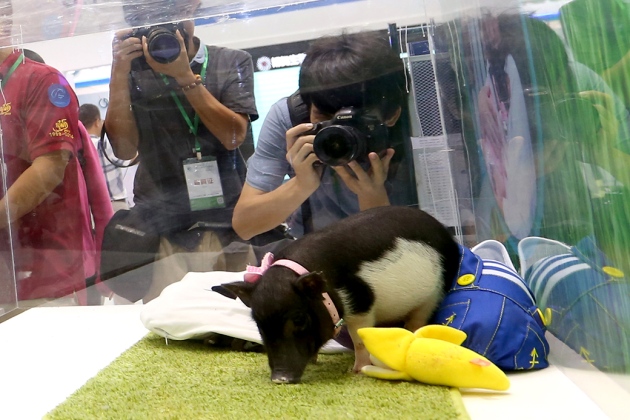
It’s one way to fund cutting-edge research: BGI, the Chinese genomics institute, is offering its micro-pigs for sale as pets.
[T]he institute quoted a price tag of 10,000 yuan (US$1,600) for the micropigs, but that was just to “help us better evaluate the market”, says Yong Li, technical director of BGI’s animal-science platform. In future, customers will be offered pigs with different coat colours and patterns, which BGI says it can also set through gene editing.
This website is known for its devotion to pocket pigs, but please, if you want one, don’t call us. Call Nature, which has all the details.
You’ll need pockets both large and deep:
The animals weigh about 15 kilograms when mature, or about the same as a medium-sized dog.
Nibbles: Pumpkin beer, Food security, SDGs, Wild rice, Grape, Wild Helianthus
- Pumpkin beer is an abomination, early, late or right on time.
- The best thing about India’s National Food Security Act is that it now includes millets and other “coarse” grains, which gets barely a mention in How secure is India’s National Food Security Act?.
- Calling BS on the SDGs.
- If they’re planting it, can it be truly “wild” rice? Cultivation vs domestication: discuss.
- AoB blog investigates a popular but little-known grape variety.
- What is it about crop wild relatives all of a sudden. Now it’s sunflowers.
That New Yorker story on heirlooms and Luther Burbank
 On Friday Luigi nibbled the New Yorker’s recent story What Comes After Heirloom Seeds?, singling out Luther Burbank rather than the more contentious issue of where plant breeding is headed. The New Yorker’s fact-checking is legendary, at least among a certain demographic, in which I number myself. So I want to draw attention to a single punctuation mark, which in my view is imbued with as much snidery as a punctuation mark can be.
Burbank’s prolificacy grew out of a creativity that could seem almost shameless. He was willing to cross just about anything that had leaves: a plum with an apricot (originally a plumcot, now a pluot); a tomato with a potato (a worthless novelty); a blackberry with an apple (no clue); a peach with an almond (!). Burbank’s theoretical validation came from Charles Darwin and his 1876 survey, “The Effects of Cross and Self Fertilisation in the Vegetable Kingdom,” which Burbank seems to have mistaken for a how-to manual. He called himself an “evoluter” of plants.
Can you spot it? Yup, it’s that exclamation mark after the peach X almond cross. At first, I took the whole paragraph to be an expression of the author wilfully showing off his ignorance. After all, the examples seem like pretty obvious crosses to me. So I did a little cursory fact-checking of my own. Seems he’s a gardener. No, wait, he writes about gardening; not the same thing at all.
Why the surprise at peach X almond then? Blowed if I know. So I’ll just science it to death.
Section Amygdalus and section Persicae are closer [to] each other than to any other sections.
What that means is that the peach and the almond were probably the most closely related of the crosses Burbank made, and thus probably the easiest and the least worthy of notice.
The quote is from Phylogeny and Classification of Prunus sensu lato (Rosaceae), by Shuo Shi, Jinlu Li, Jiahui Sun, Jing Yu and Shiliang Zhou, published in the Journal of Integrative Biology (2013) 55: 1069–1079. 1
I’m surprised the New Yorker wasn’t aware of it.