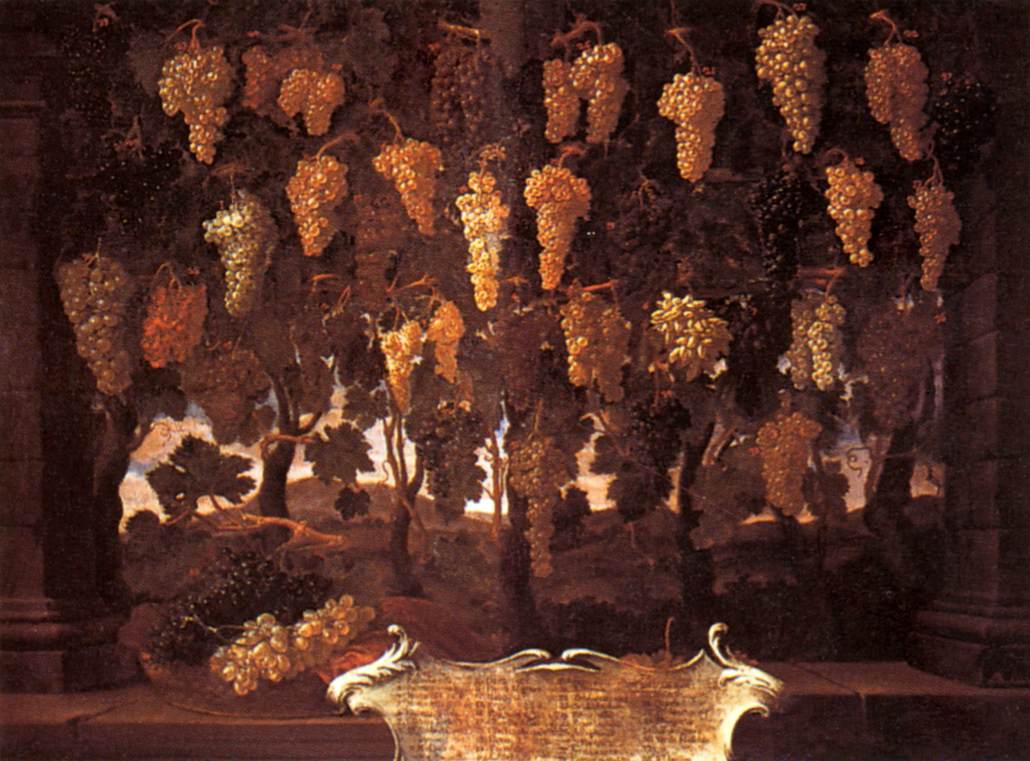
With thanks to Giuseppe for pointing out another fruit painter, I went looking for Bartolomeo Bimbi’s depiction of our current favourite grape, and found a reasonable version. I reckon that’s it fourth from the right in the third row down.
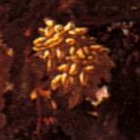 Unfortunately, on the version I found the names of the varieties, which I take to be somewhere within the escutcheon at the bottom of the painting, are illegible. Having looked at all the bunches hanging there, that’s the only one that does seem vaguely horn shaped. The original is in the Villa Medicea in Poggio a Caiano, about 15 km northwest of Florence, and if I’m ever in the area I’ll try and get a better look. Old paintings and manuscripts are clearly a good source of information for modern-day fans of diversity sleuthing, although I confess I rely on others more expert than me to do most of the legwork. A perfect example is Andrea Borracelli, whose website is full of this kind of information (and for which I am grateful).
From him, we learn that Galletta Bianca belongs to the group ‘Pizzutello’ for the characteristic shape of the berries, and was found in the area of Montepulciano, growing in family gardens. It is an old Tuscan variety … described in 1809 by Targioni Tozzetti as having “acini corniculatis flavescentibus” — horn-shaped, yellow berries. Galletta Bianca (there is also a black form), differs from the known Pizzutello white, is listed in the Catalogue of Betti (1851) and in the catalogue for the Public Exhibition of the Horticultural Society of Tuscany (1858). Low (1982) lists Uva Cornelia as a synonym for Galletta Bianca. Vine of medium vigour, with normal (?) productivity, limited to the provinces of Siena and Arezzo. It has an average percentage of fruit set, with the first fruiting shoot on the third or fourth bud, with two inflorescences per shoot, and has a normal tolerance to the most common parasitic diseases.
And I reckon that’s about all the sleuthing we’re going to do, unless, of course, something even more interesting turns up.
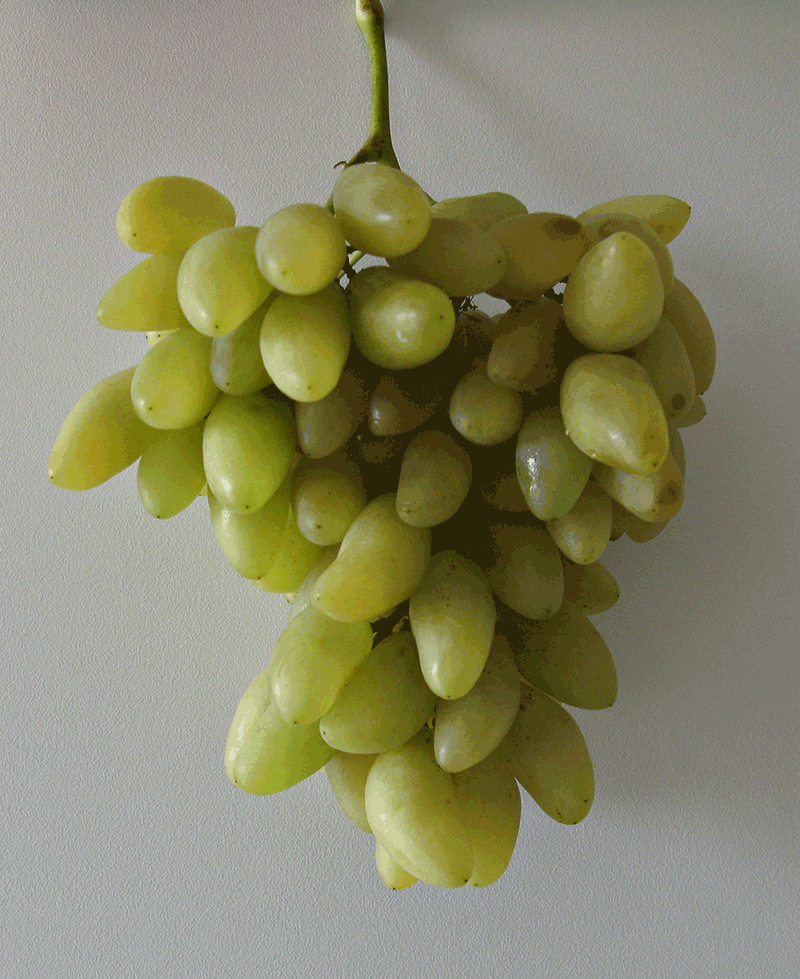
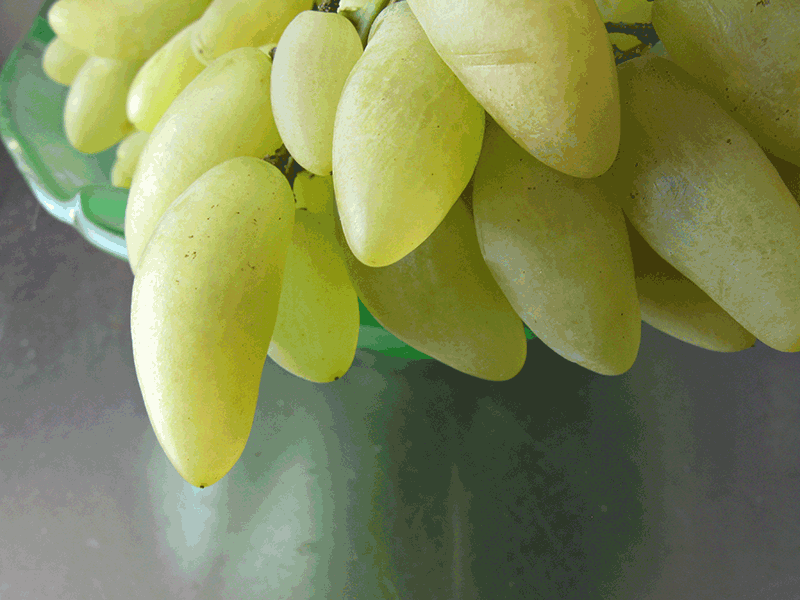
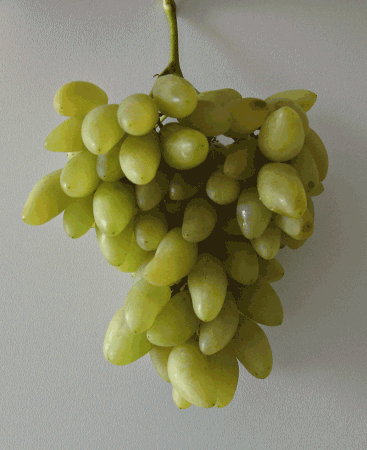
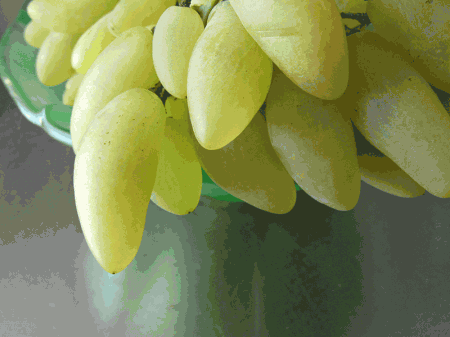
Just for comparison, here are a couple of my own pictures of pizzutello bought just up the road a little more than a month ago.
Bimbi, by the way, clearly had a great interest in diversity; he also painted a two-headed lamb for Grand Duke Cosimo III de’ Medici.