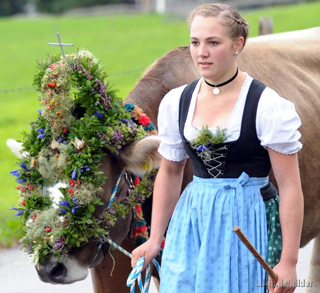
What goes up, must come down. Alpine farmers who take their livestock to higher pastures in the spring bring them down for the winter. The Human Flower Project shares the celebratory mood.
Brainfood: Breeding resistance, Pastures, Wheats, Dates, Conservation, Habitats, Old olives, Spinach selection, Maize breeding
- Cytological and Molecular Characterization of Homoeologous Group-1 Chromosomes in Hybrid Derivatives of a Durum Disomic Alien Addition Line. Getting tolerance to Fusarium head blight into durum wheat ain’t easy.
- Sustainable, low-input, warm-season, grass–legume grassland mixtures: mission (nearly) impossible? Apparently really difficult to find native North America legume forage species tolerant of both freezing and high temperatures, but people are looking. Gotta wonder if it’s a problem elsewhere too. Ethiopian highlands?
- Diversity of different farmer and modern wheat varieties cultivated in contrasting organic farming conditions in western Europe and implications for European seed and variety legislation. Strong selection for uniformity (for regulation) is not reflected in uniformity assessed on farm. And farmer varieties were good outside their region of origin.
- Glycaemic index of three Indian rice varieties. All three the same, high, GI. So, “There is an urgent need to study the GI of other commonly consumed rice varieties and to develop rice of a lower GI value”. Er, right.
- Glycemic indices of five varieties of dates in healthy and diabetic subjects. All five the same, low, GI and no difference in diabetics.
- Agricultural expansion and the fate of global conservation priorities. Conservation needs to think about agriculture.
- Which habitats of European importance depend on agricultural practices? 63 of them, mainly through grazing and mowing.
- Centennial olive trees as a reservoir of genetic diversity. Only about 10% of old trees matched current cultivars.
- Phenotypic Changes in Different Spinach Varieties Grown and Selected under Organic Conditions. There were phenotypic changes after just three seasons of selection, in one case resulting in a “new” variety.
- Open-Pollinated vs. Hybrid Maize Cultivars. Hybrids are not the only way to improve maize productivity, apparently.
- Plant breeding for harmony between agriculture and the environment. “Plant breeding can be a powerful tool to bring “harmony” between agriculture and the environment, but partnerships between plant breeders, ecologists, urban planners, and policy makers are needed to make this a reality.” I was just going to ask, why can’t we all just get along.
Don’t forget the open Mendeley group for the papers we link to here. Even if you don’t use Mendeley, you can subscribe to the RSS feed from the group and get stuff that way.
Nibbles: Baobab, Plant cuttings & carnivalia, Apples, Fodder, Range management, PNG blog, Cattle breeding, Food security questions
- Baobab: your favourite nutritious neglected species for the next 10 seconds.
- Nigel Chaffey’s fresh selection of Plant Cuttings is up.
- Which reminds me; don’t forget to submit to Berry go Round.
- Searching for lost apples in the Scottish Highlands. A job for mountain rescue?
- Why feed my cow? A more interesting question than it seems.
- Rangeland scientists take photos of their study sites shock. Applications for crop wild relatives? Bound to be.
- Glad to give my friend Seniorl Anzu at NARI in PNG a plug for his new(ish) blog, PNG-Agrinews.
- Wageningen solves that cow burping problem.
- Cambridge says I see your cow burps and raise you food security.
Nibbles: Polyculture, Melons, Cheese 2011, Australian medicinals
- Do polycultures have a role in modern agriculture? Well, do they? h/t The Scientist Gardener.
- Texas breeders go for better melons.
- “Children from the city who try this yogurt don’t like it, but they’re not healthy like my children!”
- Hotspots for Aboriginal traditional medicinal plants mapped to within an inch of their lives, thanks to GBIF.
Do count your chickens …
… and feed them, and tuck them up at night
 Regarding those kuroiler chickens, one of the things I’m pretty sure we discussed eruditely and at length was my firm recollection that a little bit of tender loving care would do more for chicken productivity than shiny new breeds, at least for poor village households. Turns out I wasn’t misremembering. A quick search turned up quite a few extra instances of research that makes that very point.
An FAO paper from 1997 points out:
In view of lessons from the past rural poultry improvement programmes, a new approach should aim at increasing flock productivity instead of individual animal productivity. The potential of the village chicken as a provider of food and income should be exploited. A combined approach is suggested, which must be accompanied by improved extension services and farmer training on good husbandry practices, namely: housing, hygiene, feeding and health control. Improvement techniques should be based on indigenous technologies and available local resources.
There’s more sound advice in a factsheet from FAO, which stresses the benefits to be gained by taking better care of young chicks and improving housing for the whole flock. Makes sense; if something else has eaten your birds, you’re not going to be able to.
An entire PhD thesis looks at Improvement of village chicken production in a mixed (chicken-ram) farming system in Burkina Faso. Of course I haven’t read it, but I did filch this from the abstract:
System analyses showed that both village chicken and sheep fattening could be used for improvement of livestock production and subsequent income generation at rural farm level. Furthermore, an integrated village chicken and ram-fattening farming system appeared to be a promising possibility for village chicken improvement. It allows to control village chicken scavenging and to reduce the high risks related to the free-range system. The studies demonstrated that regular supplementation with locally available feedstuffs as sorghum or local beer by-product can be used as feeding strategies to improve village chicken production.
The Poultry Hub links to a few other studies.
The point is that while new breeds are fine and dandy, especially for the intensive, commercial sector, villagers who keep chickens need information, knowledge and training, not shiny new breeds. And that requires extension services, and even if those don’t always work too effectively, we do know how to improve them.
Chickens represent one of the best options to improve the livelihoods of poor rural families, but bringing that promise home to roost requires plodding, unglamorous extension work, and that’s just not a priority any more.