Remember the big discussion about how to ensure that information about genebank accessions can be linked back to the accession itself? Our friend Dr Dag Endresen has written a handy guide to Digital Object Identifiers (DOIs) as they might be used by genebanks. In addition to explaining how the system works, he points out that it might be a good idea for one organization to fork over the roughly USD1000 to register a top-level DOI name such as genesys. (Bioversity? The Trust? The Treaty? Is anyone listening?) That would not stop any other genebank flush with cash from registering their own domain, and it would provide something to the data providers at genebanks in return for their data. Dag discusses some other options on his blog, and I’m sure there’ll be lots of discussion there, or here, or some other place. Either way, the sooner some similar system is adopted, the sooner we can trace our collective way out of genebank database hell and satisfy the needs of those who want to link data to accessions.
Farmers take on Monsanto
At the end of March a group of individuals and organizations associated with organic food sued Monsanto in the United States District Court, Southern District of New York. The full suit is available from the Public Patent Foundation, which “Represents the Public’s Interests Against Undeserved Patents and Unsound Patent Policy” and which brought the suit on behalf of the 60 plaintiffs. There is also a PubPat press release and many summaries around the web, for example at Baker Creek Heirloom Seeds. Monsanto responded on a company blog.
David’s claim against Goliath is intended to ensure that Monsanto cannot sue for patent infringement should one of its genes turn up in seeds or plants produced by organic or heirloom growers in the US.
The merits of the claims are not my concern, and I was reluctant even to note the lawsuit here, because any discussion of GMOs rapidly deteriorates into the same old same old, but talking it over with colleagues it is clear that there is a fundamental issue of agricultural biodiversity at stake.
Farmers may choose to grow GM varieties for all sorts of reasons. As the GM varieties spread they edge out pre-existing varieties, as “improved” varieties always seem to do. In technically-advanced farming systems, those pre-existing varieties are likely to be improved themselves, rather than the farmer landraces we normally bang on about here, but that doesn’t make them any less valuable. Farmers who want to grow those varieties rather than GM varieties will be hard pressed to find them. Seed merchants who want to produce those varieties rather than GM varieties may be reluctant if there’s any chance of cross-fertilisation and a visit from corporate heavies, as will the farmers when they come to market their harvest.
The issue here is not the safety or otherwise of GMOs. It is not about the way Monsanto behaves (although it is possible that if Monsanto behaved differently, the suit would not be needed). It is about being able to grow what you want to grow.
Nibbles: SEARICE, R&D, Sustainable intensification, Biofortification, Chillies, Safe movement, Mangoes, Weeds, Berries, Blueberries, Cerrado
- SEARICE explains its approach to seed sovereignty and farmer participation.
- Nature on IFPRI’s report on agricultural R&D in Africa. Not pretty.
- Resilience Science on the UN Special Rapporteur’s sustainable intensification thing.
- The Gates Foundation is on a nutritional roll; most of yesterday’s posts are available from this round-up.
- New Mexico gets all protectionist about its chillies.
- IITA explains how it provides healthy germplasm. Various different interesting stories in there, stick with it.
- Farmer conservation power in India.
- How to control invasive species. Eat more weeds.
- Presentation on Trends in global nutrition and health: Local fruits and their potential importance for nutrition and health as seen at Pavlovsk berry meeting.
- Speaking of berries…
- The cerrado (and its crop wild relatives) is in trouble. We talked about this, weren’t you paying attention?
UG99 resistant varieties
In case you’re not following the discussion here on knowledge management, here’s a map of the wheat varieties resistant to UG99.
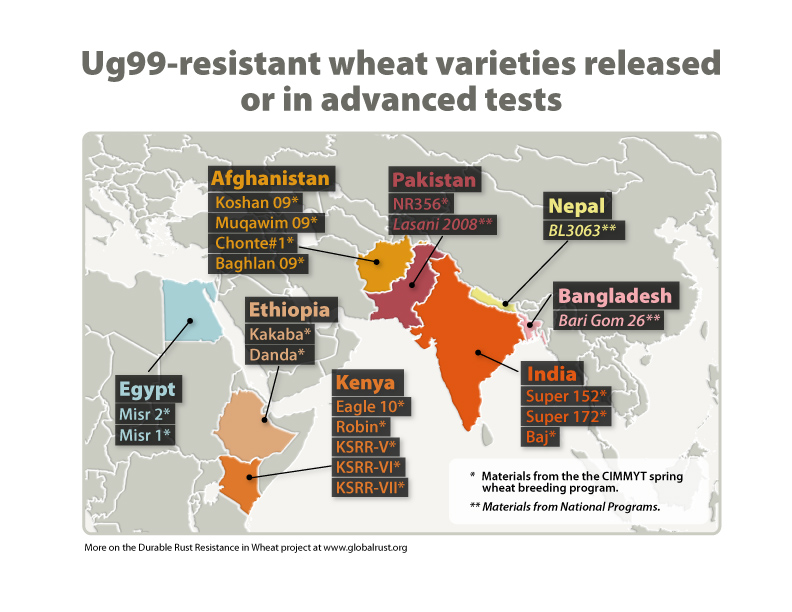
If you use Google to search for images of “UG99 resistance” it is right up there, near the top, and several versions are available…
Religion, diet and nutrition
We tend not to set too much store by religion around these parts, so a letter in response 1 to The Economist’s recent pieces on nutrition piqued our interest. It read, in part:
In the March issue of their magazine, the Church of Jesus Christ of Latter-Day Saints reported on a food initiative which has taught many members to garden, even in small, urban spaces, and with whatever containers they can find. Started in 2009, these people have gone on to teach others in their communities how to increase their nutritional intake—and self-reliance—with just seeds, soil and sunlight.
Let me Google that for you. Better yet, having Googled it, let me fillet out the article in question and make it available all on its own. Turns out that not only are Mormons keen on urban and container gardening for diversity and nutrition, they’ve been so for quite a while. A former US secretary of Agriculture, Ezra Taft Benson, was President of The Church of Jesus Christ of Latter-day Saints, and set out a very familiar vision of how to prepare for the Days of Tribulation:
Get together with others and seek permission to use a vacant lot for a garden, or rent a plot of ground and grow your gardens. Some elders quorums have done this as a quorum, and all who have participated have reaped the benefits of a vegetable and fruit harvest and the blessings of cooperation and family involvement. Many families have dug up lawn space for gardens.
That sounds like a modern manifesto to me. Of course, there’s an appeal to authority too:
President Brigham Young said, “If you are without bread, how much wisdom can you boast, and of what real utility are your talents, if you cannot procure for yourselves and save against a day of scarcity those substances designed to sustain your natural lives?”
One to ponder. Meanwhile, I wonder whether those members of the Mormon faith who heeded their presidents’ advice saw any impact on their nutrition?