Diversifying Crops May Protect Yields in the Face of a More Variable Climate

That’s the headline on a note from the American Institute of Biological Sciences, which publishes the excellent BioScience. Resilience in Agriculture through Crop Diversification: Adaptive Management for Environmental Change, a review by Brenda Lin of the CSIRO in Australia, pulls together lots of studies 1 from lots of places and lots of species (and varieties) to come to the conclusion that, yes, indeed,

Understanding the potential of increasing diversity within farm systems is essential to helping farmers adapt to greater climate variability of the future. By adopting farm systems that promote ecosystem services for pest and disease control and resilience to climate change variability, farmers are less at risk to production loss and are more generally resilient to environmental change.

Thanks Eve.

One view of plant patents and other forms of intellectual property rights

Let’s say you go to a restaurant and have a lemon cheesecake. You love it, so you reverse engineer it in your mind and make it at home to serve a Tupperware party. As soon as the party starts, jack-booted thugs arrive wielding guns and drag you away as a criminal for stealing a recipe. The cook is dragged away, same as a real thief or murderer.

That is the short version of what has happened to the food and agriculture industry over the last 30 or so years

Jeffrey A. Tucker, of the Ludwig von Mises Institute, explains “agri-patents”.

Not exactly how I would describe the way things stand, but then, I haven’t had to tussle with the jack-booted thugs of the intellectual property rights owners. Not even in a movie. 2 Nor, I suspect, has the author of the piece, whose logic, I have to confess, I found somewhat hard to follow. Plant patents etc. are “not an evil of the market; they are an evil of government intervention,” and as such “have handed socialists the best case they’ve ever had to rail against capitalistic exploitation”. Maybe there’s another way of looking at these things?

Ancient wild relatives

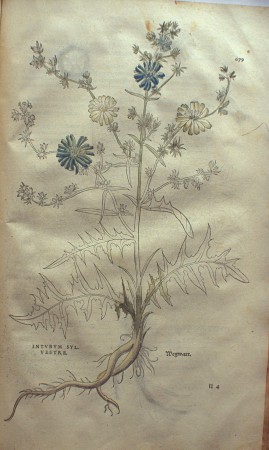
While we’re on the subject of radicchio diversity, old Roman medicines and the like, we were pleased to be sent a link to Renaissance Herbals, a collaboration between the Smithsonian Institution and the Biblioteca Nazionale Centrale di Roma. There are some lovely images to peruse and use, like this one, of wild chicory, Cichorium intybus.:

One could complain, of course, that the links between the illustrations and other sorts of information are non-existent. But hey, you can’t have everything.

Radicchio diversity

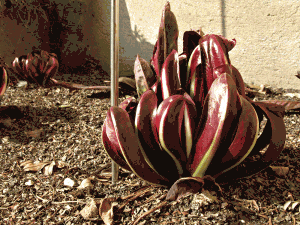
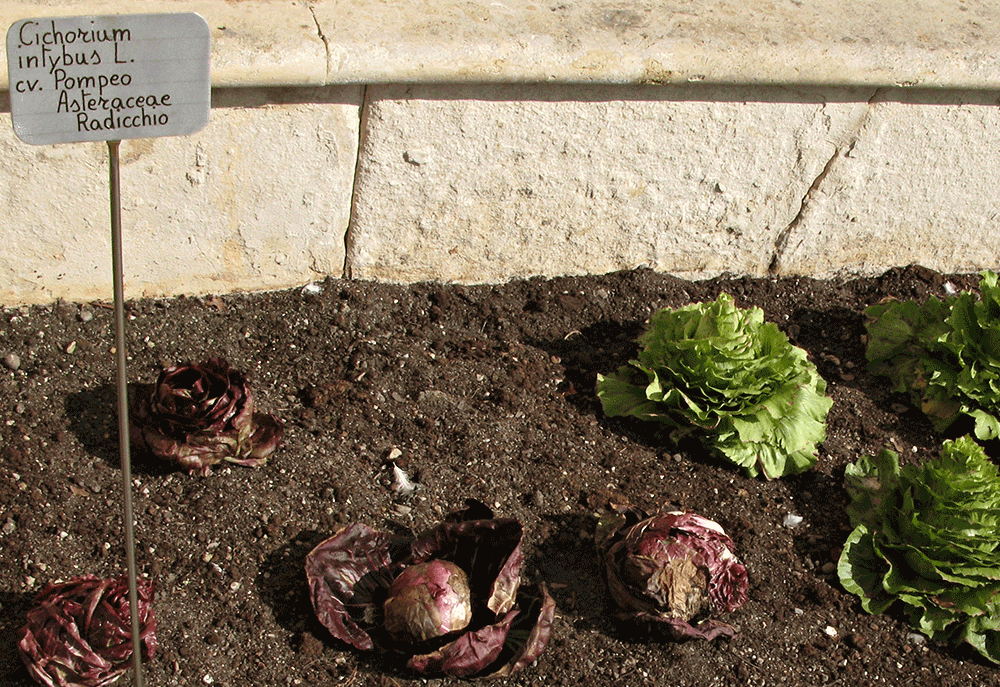
Following in Luigi’s footsteps, the botanic gardens at Padua beckoned. The oldest botanic gardens in the Old World (Wikipedia is wrong; the New has older) they have operated continuously in the same place since 1545. A freezing February day was not ideal to see plants, and precious few of the labels denoted anything directly edible as food. I was not, however, entirely disappointed, for in a sunny bed in the lee of a building was a display of perhaps the region’s most famous crop: radicchio.
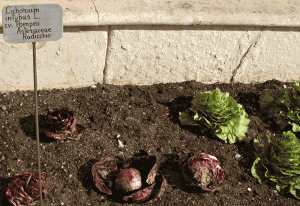
The picture above shows an old local variety, Variegato di Castelfranco, and Otello, a modern cultivar. Which, naturally, sent me scurrying to discover more about their history and breeding. There isn’t, actually, a huge amount. One study, of which I’ve seen only the abstract, examined DNA diversity of the five major types. Turns out that if you compare pooled bulk DNA from six individuals of each type, the different types are easy to distinguish. If, on the other hand, you look at DNA from individuals, the distinctions disappear. The variation within a single type is much greater than the variation among the different types. This, the researchers say, indicates that the types have maintained their “well-separated gene pools” over the years. An earlier paper (available in full) had come to a similar conclusion about the populations, with what seems like an ulterior motive: 3

The molecular information acquired, along with morphological and phenological descriptors, will be useful for the certification of typical local products of radicchio and for the recognition of a protected geographic indication (IGP) mark.

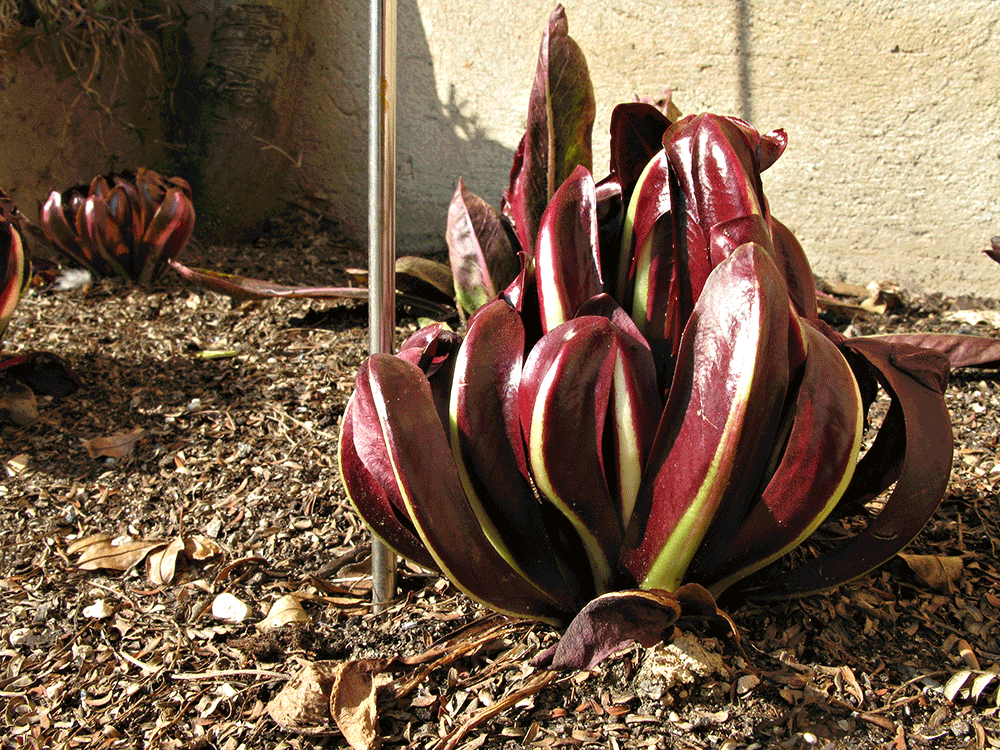
And lo, it came to pass. Four types (I think early and late Rosso di Trevisos are included in one designation) got their Protected Geographical Indication in 2008 and 2009. That’s late — tardivo — in the photograph below.