Following in Luigi’s footsteps, the botanic gardens at Padua beckoned. The oldest botanic gardens in the Old World (Wikipedia is wrong; the New has older) they have operated continuously in the same place since 1545. A freezing February day was not ideal to see plants, and precious few of the labels denoted anything directly edible as food. I was not, however, entirely disappointed, for in a sunny bed in the lee of a building was a display of perhaps the region’s most famous crop: radicchio.
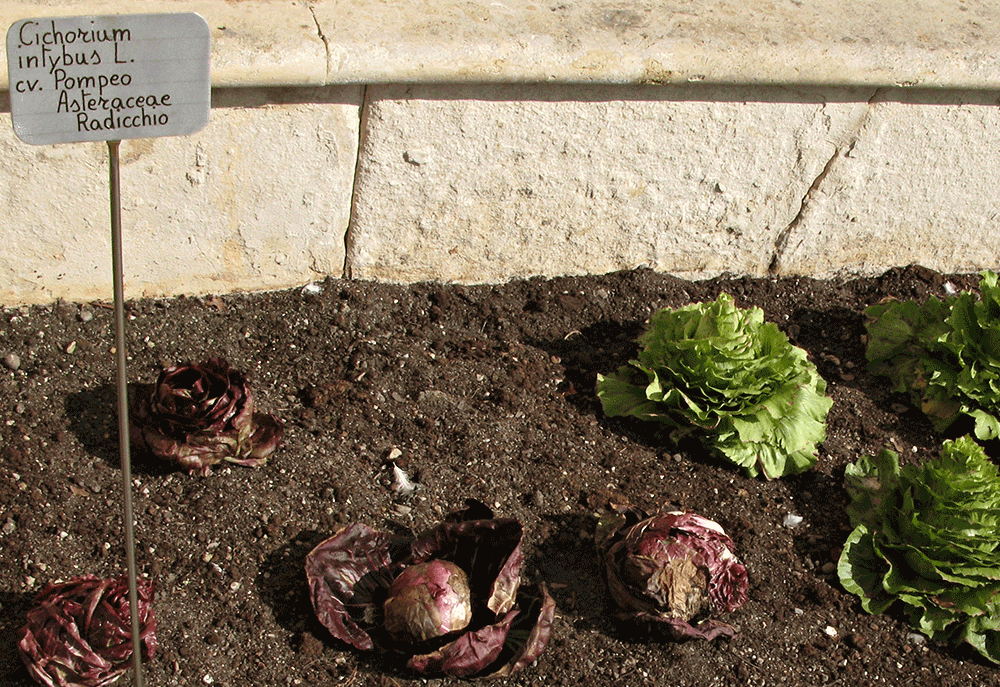
The picture above shows an old local variety, Variegato di Castelfranco, and Otello, a modern cultivar. Which, naturally, sent me scurrying to discover more about their history and breeding. There isn’t, actually, a huge amount. One study, of which I’ve seen only the abstract, examined DNA diversity of the five major types. Turns out that if you compare pooled bulk DNA from six individuals of each type, the different types are easy to distinguish. If, on the other hand, you look at DNA from individuals, the distinctions disappear. The variation within a single type is much greater than the variation among the different types. This, the researchers say, indicates that the types have maintained their “well-separated gene pools” over the years. An earlier paper (available in full) had come to a similar conclusion about the populations, with what seems like an ulterior motive: 1
The molecular information acquired, along with morphological and phenological descriptors, will be useful for the certification of typical local products of radicchio and for the recognition of a protected geographic indication (IGP) mark.
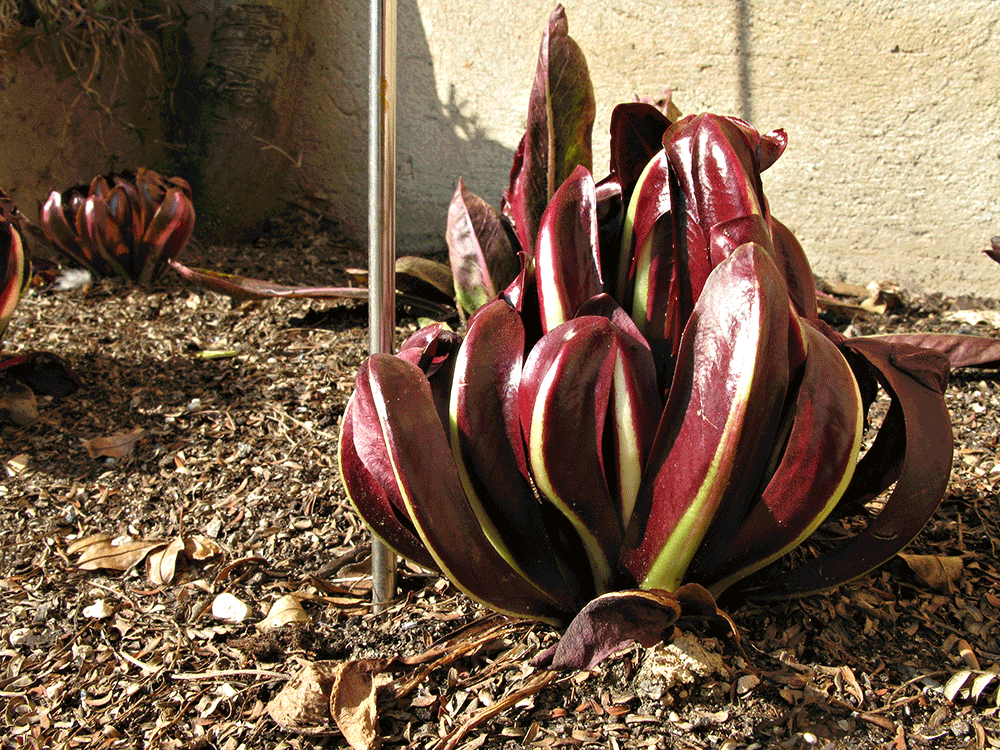
And lo, it came to pass. Four types (I think early and late Rosso di Trevisos are included in one designation) got their Protected Geographical Indication in 2008 and 2009. That’s late — tardivo — in the photograph below.
 Ismail Abdel Galil (left), founder of the looted Egyptian Deserts Gene Bank, has told