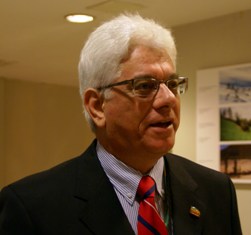
 Ismail Abdel Galil (left), founder of the looted Egyptian Deserts Gene Bank, has told SciDev.net that he is hopeful that the EDGB will be able to recover some of the genebank’s material that was duplicated at the Millennium Seed Bank at Kew. Galil confirmed that most of the material was not duplicated, not even at the National Gene Bank in Giza, which was not looted.
SciDev.net’s report, more than three weeks after the news broke, here, adds some information to sketchy details we had before. The looting of the Desert Research Center in Cairo was carried out by “mobs,” while “Bedouin groups in the Sinai region, angered by the Mubarak government’s policies towards them, went on the rampage” and attacked the EGDB. According to Hazem Badr, SciDev.net’s reporter,
DRC chairman Ibrahim M. Nasr … estimated the losses at the facilities in Cairo and North Sinai at around US$1.3 million. That figure does not include the desert plant gene bank, some of which has been irretrievably lost.
Galil, who founded the desert genebank in 1996, had been honoured by Bioversity International as one of the Guardians of Diversity in the Mediterranean at a celebration in Rome in May 2009. Unfortunately the genebank’s “efficient operations and state of the art technology,” cited in the award, were no match for looters.