Yes indeedy. A new international year has begun, the International Year of Family Farming. Could be fun to keep a vague eye on, especially to see how it includes — or excludes — these family farmers. And do families who farm quinoa now get a second bite at the cherry of global awareness?
Nibbles: Intensive livestock, Genetic erosion, Genetic diversity … in India, NUS, Domestication, Seminars, Nutrition, Prince of Wales
With sincere apologies for the lack of service. It’s just been that kind of week. For both of us.
- “[H]ow a powerful and intransigent agriculture lobby has successfully fought off attempts to reduce the harmful environmental and health impacts of mass livestock production.” Say it isn’t so.
- “[A] planet that has lost 75% of its plant genetic diversity between 1900 and 2000.” Mythbusters? FAO don’t need no stinkin’ mythbusters.
- Here’s a little historical context for ya, on Seed Collection and Plant Genetic Diversity, 1900–1979
- Striving to gain insights into agro-biodiversity through surveys in Bijapur, India will doubtless add, er, something.
- Round up the usual NUSpects:
- And the unusual: Alpine rice, aka Microlaena stiphoides, a newly domesticated grass down under.
- You want more on domestication? AoB blog has you covered, with pointers to wheats and the artichoke cardoon nexus.
- A little learning … Is a wonderful thing?
- Functional agrobiodiversity in North-West Europe: What does the future hold? 11 December, Brussels.
- Improving agriculture’s impact on under-nutrition: What do we know and what do we need to know? 27 November, London.
- EndingHunger Online University. Seriously, everyone’s an expert now.
- Cynical, moi? Not compared to the guy who wrote Implausible results in human nutrition research. Definitely one to cut out, boil lightly, season, and eat.
- Speaking of cynics, “The Prince of Wales writes passionately about the future of farming and the countryside in this week’s Country Life, which he has guest-edited on the occasion of his 65th birthday.”
You really can’t make this stuff up.
Nibbles: Climate change communications, Seedmap, Ancient chili peppers, African AnGR, Buffaloberry, Ancient coconuts, Water-based map
- “Too many journalists overlearned the point that you have to report both sides.”
- Like at scidev.net, which tries to do the even-handed thing for seedmap.org.
- Ancient spicy beverages – oldest use of chili peppers to date?
- Workshop report on conservation and use of African animal genetic resources.
- The new superfood for the next five minutes: Shepherdia argentea, better known (huh?) as buffaloberry.
- Coconut palms are past their prime, it says here.
- Speaking of which, here’s a little something for lovers of old maps: The United Watershed States of America. The site will make your eyes bleed; focus on the maps.
Afghan farmers pull off a poppy hat trick
A tweet caught my eye the other week.
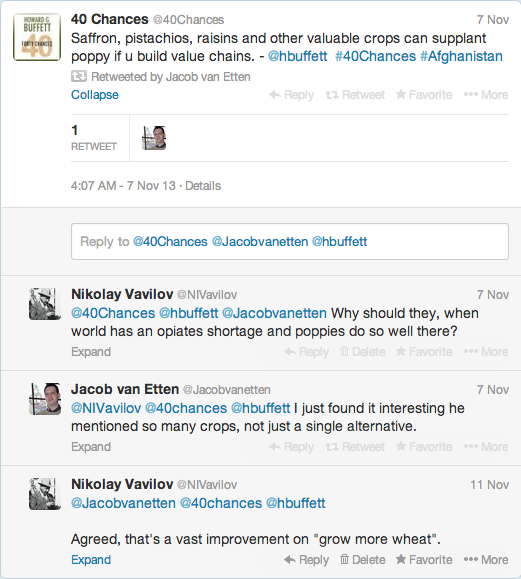
40 Chances is the title of a project (and book) by Howard G Buffett, who has taken some interesting approaches to agriculture for development as he spends some of his dad’s money.
I don’t follow 40 chances, but our pal Jacob does. Our conversation is self-explanatory, if a little curt, and although I’m grateful to Jacob for opening my eyes to the point Buffett seems to be making — that there might be several diverse alternatives to poppies — nothing to write here about.
Then, a week later, I see an article in Foreign Policy explaining that Afghanistan’s harvest of opium in 2013 was 49 percent up on 2012. “This is the third consecutive year of increasing cultivation,” according to Jean-Luc Lemahieu, outgoing director of the UN Office on Drugs and Crime, which reported some numbers earlier this week. And the area under cultivation is up 36%.
Ah, the conflicts. Production is up, per hectare, but that’s a bad thing? Because drugs are bad. But only if they’re grown in Afghanistan. Not if they’re grown in Didcot, England, or Tasmania, or France, or Turkey, or India …
I’ve belaboured the point often enough here. There are well-thought out schemes for legalising Afghanistan’s poppy production. And as an aside, the US helped Turkey to transition to legal opiate production by guaranteeing to buy a 80% of its legal opium from India and Turkey.
So, just noting here that in case saffron, pistachios etc don’t work out either, there are alternatives.
Nibbles: Crop rotation, Nutrition, Rice podcast, Climate change meet, Sustainable diets seminar
- “Always rotating, regardless of prices, is close to optimal.” Not what you think. Or maybe it is. Robust economic reasons for not planting the same annual crop two years running.
- Got any data about nutrition and biodiversity? FAO wants them.
- Fuller and McCouch on the origins of rice. Audio goodness only.
- The first of many video updates on #COP19. Gonna be a long couple of weeks.
- And no, I don’t think a UN Nutrition and Sustainability Seminar will help much in that respect, but you can follow that too at #sustfoodsystems. Or is it #sustdiets?