- Search the UK’s living plant collections for errant edibles and their wild relatives.
- Independent origins for aromatic rice varieties?
- I’ll see your rice varieties, and raise you independent cattle domestication in China.
- The scent of a truffle, love it or leave it.
- Improving the yam, with flow cytometry and satellite markers to discover how many chromosome sets they have.
- Going back to nature for the best in cultivated shiitake. With video goodness.
- The @gricultural Revolution, from CTA. Too cute, too loud, too long. With even more video goodness.
- “Local Farmer Grows Beans from the Basque Region.” I guess he’s not local to the Basque region, then, or it wouldn’t be remarkable. Yet more video goodness. Aside: I’ve grown alubias de Tolosa and they are wonderful, but I never was elected a member of the confraternity.
- You want even more video goodness? Here’s some on resilience in coffee farming.
Featured: Dead Souls Revived
Theo is unrepentant about picking on the dead souls in the wild leeks drawer, and throws down the gauntlet:
How many of the one point four million accessions in Europe actually exist, how many are alive, how many of these are available for distribution (sufficient seed), and how many of these are actually distributed on request? And what should we aim at in this regards?
We should organise ourselves, identify the difficulties and try to take them away — as a community. We can’t do that by pretending everything is perfect. Let’s get some clothes for the emperor!
And Lorenzo is ready with needle and thread.
Nibbles: Fungi, Beer, Cupuaçu, Tearless onions, Melaleuca, Tomatillo, Seed takeover, Katy Perry’s seeds, Bruges fries, EU ag
- They got an awful lot of fungi in Norwegian wood.
- Waiter, there’s a mushroom in my beer.
- Kew seed scientist discovers the taste of the Amazon.
- That “tearless onion” is good for the heart story? The article is behind a paywall, so I don’t know how the boffins suppressed lachrymatory factor synthase. And frankly, I don’t really care.
- A new guide to Melaleuca species. Be still my beating heart.
- The world’s oldest tomatillo clocks in at 52.2 million years.
- French seed company Vilmorin buys 25% of Zimbabwe’s Seed Co. Ltd. What could possibly go wrong?
- “Katy Perry’s latest album, Prism, is Number One in Australia, but that hasn’t stopped the country from declaring it a potential biohazard.” Can anyone explain the significance of this story? Or who Katy Perry is?
- On the whole, I’d rather be at the frites museum in Bruges.
- “Clearly, when it comes to agriculture, productivity matters.” Here comes the science.
Nibbles: Book, Sorghum, Plant breeding, Quinoa, Herbal medicines, Compensation, New varieties, Beers
Here’s a bunch of better-late-than-never links, some of which will be good this time next year.
- A new book on Plant Genetic Resources and Climate Change.
- I expect it covers sorghum, which NPR calls the “camel of crops”.
- Wonder whether they’ll cover sorghum at the Tucson Plant Breeding Institute course in January 2014. h/t Crops for the Future.
- Last week’s International Congress on Quinoa. Pretty sure our invitation got lost in the mail.
- As was our invitation to Kew’s one-day symposium on herbal medicines and food supplements.
- Annals of Botany explains how compensation may underly the benefits of genetic diversity – in Arabidopsis. (And thanks for the shout-out.)
- ICRISAT struts its stuff in Nigeria with new varieties of groundnut and millet. As ever, we ask: who’s looking after the old varieties?
- Diverse beers for Halloween – one to cut out and keep.
Cemeteries reveal the secrets of pre-agricultural prairie soil
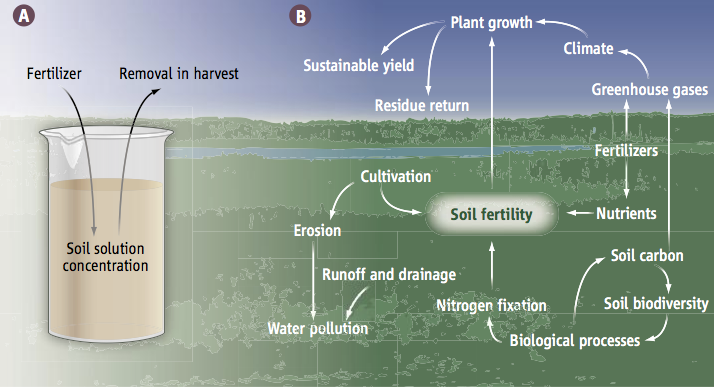
If a picture were worth a thousand words I would stop right now. But it isn’t, so I can’t. An explanation:
Exhibit A, on the left, caricatures, but only a bit, the worldview of many of those responsible for funding and carrying out research into agricultural productivity. Exhibit B, on the right, a slightly more nuanced view, lifted from an article by Mary C. Scholes and Robert J. Scholes in this week’s Science. 1 Scholes and Scholes are commenting on a paper by Noah Fierer and his colleagues in the same issue, which specifically addresses the little label in the lower right: “Soil biodiversity”.
Fierer’s paper 2 asks what the effect of agriculture might have been on the microbial diversity of soils in the tallgrass prairie of North America. There’s not that much left now, but they managed to sample 31 sites, “found primarily in cemeteries or nature preserves”. And they subjected DNA from the samples to some high-throughput DNA sequencing and analysis. The bottom line conclusion is that tallgrass prairie soils are very complex and that this complexity would be expected to affect all sorts of soil cycles, especially nitrogen and carbon.
Scholes and Scholes put those results into context, pointing out that
We have forgotten the lesson of the Dust Bowl: Even in advanced economies, human well-being depends on looking after the soil. An intact, self-restoring soil ecosystem is essential, especially in times of climate stress.
The diversity that Fierer and his team uncovered is strongly linked to functional diversity, independently measured. Prairie soils are particularly rich in Verrucomicrobia, “bacteria specialized for low-nutrient conditions, [which] are lost from the cultivated soils, making the soils less able to supply nutrients other than those provided as fertilizer”. And that’s the key to the bigger picture. Scholes and Scholes point out that:
[I]mproved technology—including the unsustainably high use of fertilizers, irrigation, and plowing—provides a false sense of security.
We need to stop thinking simplistically about the role of inorganic fertilisers and start to consider the soil in which our food grows.
An agricultural soil ecosystem that more closely approximates the close and efficient cycling in natural ecosystems, and that also benefits from the yield increases made possible by biotechnology and inorganic fertilizers, is needed to increase agricultural production to the levels that will be required while minimizing its adverse effects. Integration of the insights, innovation, and best practice from agronomy, ecology, soil biology, chemistry, physics, plant breeding, and natural resource governance is the only viable route to both feeding the world and keeping it habitable.
In other words, we have to do it, but it isn’t going to be simple. Knowing a bit more about what makes prairie soils both productive and self-sustaining may help the process of restoring degrading lands and preventing future degradation.