Here we go again: UK genebank threatened

Prospect, a “union for professionals” in the UK reports that the University of Warwick plans to close HRI Wellesbourne, home of a Genetic Resources Unit that is effectively the vegetable genebank for the UK. None of the reports I’ve seen mentions the genebank specifically, and it is only one aspect of HRI’s activities that will be sorely missed if it is discontinued.

The debacle has not yet made it into the mainstream press — unlike the flap over the apple collection at Brogdale, with it’s right royal connections — although I happen to know that HRH Prince Charles has received seeds from HRI, whether he knows it or not. Nor is the genebank mentioned in any of the specialized reports I’ve seen. But this is the place that holds the bulk of the UK’s vegetable seed diversity, old and new, and that was established at least in part in response to the perceived genetic erosion taking place as the UK signed up for EU legislation on seeds. I believe the idea was first mooted by Lawrence Hills, who also founded the Henry Doubleday Research Association. 1 The Ministry of Agriculture bought the idea but not the originator, placing the genebank instead at Wellesbourne, a few miles from where the HDRA eventually came to have its headquarters.

What now? The UK Government doesn’t seem to have said anything publicly, and its funding for HRI Wellesbourne is set to fall from GBP 5 million annually to just GBP 200,000 by 2012, one probably reason why the University is seeking to close the place. I can’t see a White Knight coming to the rescue this time, not for a bunch of vegetables. We can but watch and wait.
Corn genome

We’ve been almost silent on the massive effort this past week announcing the full sequence of the corn (maize) genome, mostly because we don’t actually have that much to contribute. Corn News Central this past week has been James and the Giant Corn; here’s his summary post. One of the things he linked to was a video of Patrick Schnable, one of the lead scientists, explaining what they did, how they did it and why they did it — at least in part — in under 4 minutes. I think it’s instructive.

I’m looking forward to reading about how the full sequence illuminates the domestication of corn, which I’ve read it does.

How to feed the world, Economist-style

Today’s Economist has a Leader and two articles about feeding the hungry, one on Monsanto and one on markets. Not surprising, coming hard on the heels of this week’s World Food Summit.

There’s also this at the Economist blog, a neat information-rich video that explains IFPRI’s view of climate change (including differences in prediction between two models) and the consequences for global food supply. 2

Of course one could quibble with details, but the bigger quibble is with the Economist’s own double-vision. Or do I mean blindness? The Leader has a headline of How to feed the world and Business as usual won’t do it as a snappy sub-head. But the solutions it offers — GM drought-resistant crops, access to markets — are business as usual.

As speaker after speaker at the World Food Conference reminded us ad nauseam, the problem of global hunger is not about quantity of food, it is about availability and affordability. And as we’ve written before, it would be a doddle to grow all the food the world will need in 2050 on a small fraction of the land currently occupied by agriculture. The Economist’s “solutions” do nothing to help the poorest rural farmers, who want to minimize risk, not maximize production. Nor do they want to sit about waiting for a shipment from somewhere or other. They need research that will help them make better use of agricultural biodiversity. But as long as economists build their models on foundations of old data (and to be fair, what else are they to do?) it will never make sense to them to invest in a new approach.

What is needed is for someone — donor or private foundation — to back a hunch.

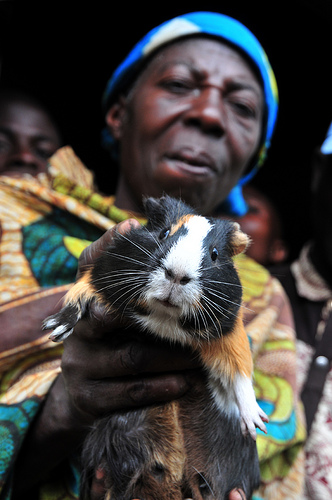
Cavies in Congo

What next? Cane rats in Colombia?

Guinea pig keepers in the North Kivu Province of Democratic Republic of Congo.

This picture really made me sit up and take notice when I saw it at CIAT’s Flickr photostream. I had absolutely no idea that people in Kivu, DR Congo, kept guinea pigs as mini-livestock, and a simple Google search turned up almost nothing of relevance. I went a bit deeper, and unearthed an article — Think big with minilivestock — in Spore from February 2008. That told me that in Kivu women often breed guinea pigs to provide their children with animal protein, which is otherwise not available to these most vulnerable members of the household. The article also says:

Throughout Central and West Africa and as far east as DRC and Tanzania, as well as in Haiti (Caribbean), small-scale guinea pig farming based on a few animals contributes to food security. It is a relatively easy activity, aside from problems caused by inbreeding which can eventually affect the health and weight of animals.

But it doesn’t tell me how this started, or what CIAT’s involvement might be. Can someone from CIAT or FAO please enlighten me?

And while we’re on the subject of introduced mini-livestock, has anything moved the other way? Luigi assures me that grasscutters (aka cane rats, Threonomys spp.) are delicious, but I’m pretty sure he didn’t taste them in Colombia.