- “New study warns that climate change could create agricultural winners and losers in east Africa.” Any other possibilities?
- “Researchers to perform sex change operation on papaya.” Bang goes a bunch of sexual diversity.
- Inherited wealth is good for farmers, better for herders, lousy for hunters.
- AGCommons is a CGIAR project to deliver information to farmers in Africa. Watch their new video, with added Andy Jarvis goodness.
Berry go Round 21
Beetles in the Bush hosts the latest edition of Berry go Round, the blog carnival dedicated to plants, and fungi, and things that eat plants and fungi. We found some good stuff there.
- Setting seed in synchrony may be a mistake.
- Wild grapes can be delicious … but be careful.
- A rainbow of pumpkins. Jeremy says: “no pigs in sight, thank goodness.”
Plucky pocket pigs party in a pumpkin

Nibbles: Phones, Faeces
- Cell phones become handheld tools for global development. Agriculture — and Jacob — need you.
- Vermicomposting of source-separated human faeces for nutrient recycling. Aren’t heavy metals a problem?
Reviving an old rice for sake’s sake
“Use it or lose it” is a frequent refrain among those who want to conserve genetic resources. We strive to point out that nothing is ever useless, we just haven’t discovered the uses yet. Sometimes, though, the use is well-known. Brewers, especially the more traditional types, often swear by specific varieties of their raw material. Golden Promise, a famous malting barley, is spoken of fondly by bearded men in sandals clutching a pint of warm cloudy brew. So I shouldn’t be surprised that the same is true of Nihonshu (日本酒). A long article at The Japan Times explains how sake makers are increasingly trying to use traditional old rice varieties.
Wataribune was used in 1939 to develop the now-dominant Yamada Nishiki strain. It had been widely used in sake making for centuries but fell into near-extinction around 50 years ago. Though it was rumored to yield brews of great depth and complexity, it was notoriously difficult to grow. The plant’s tall stalks made it vulnerable to typhoons, while its long growing season exacerbated the risks. [Takaaki] Yamauchi proposed an initiative to revive the strain, but few farmers were willing to gamble on such an uncertain enterprise.
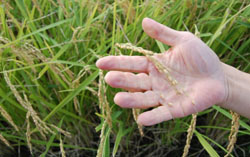 The article goes on to describe how the master brewer eventually found 14 grams of Wataribune rice in the genebank at the National Agricultural Institute in Tsukuba, and parlayed that into a range of award-winning sakes. The photo, by article author Melinda Joe, shows how easily Wataribune rice grains fall from the ears of the stalk, making it a challenging rice strain to work with. There’s a lot more in the article, about rice varieties in sake and about ordinary Japanese people who are spearheading a movement towards more regional diversity in rice, including groups that reclaim and regenerate abandoned rice paddies.