Perennial kales in Ecuador

Where did that come from, I asked myself, as we looked around the home garden of an agrotourist lodge near Cotacachi in Ecuador. No, not the wonderful neotropical fruits, or the fiery Brugmannsia, or the tree they called guava that looked to me like a carob; certainly a legume of some sort. 1 Not any of the exotica that were at home here, but this thing, a brassica looking for all the world like a small tree.
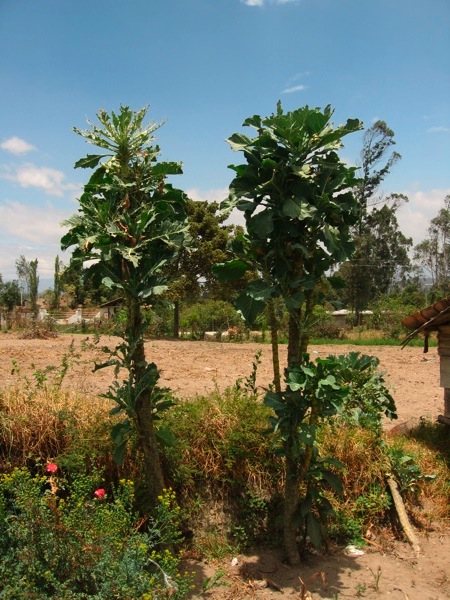
Perennial_Kale.jpg

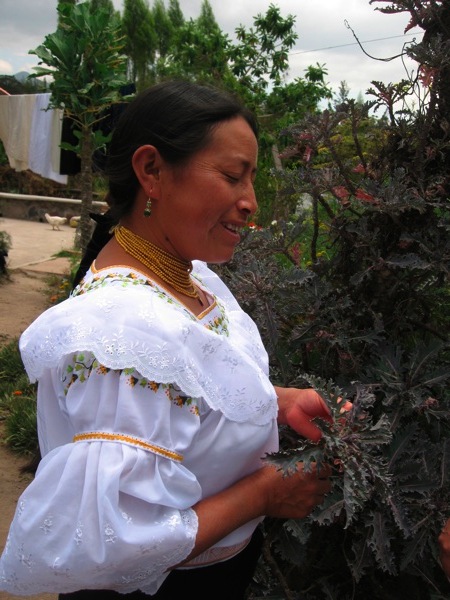
To me it looked like one of the perennial kales, or even the Jersey Walking Stick Cabbage that I’ve grown in the UK and seen in Basque country and parts of Portugal. On the other side of the path was a red-leaved variety that had a much more dissected leaf, a little like Red Russian kale but again growing like a tree.

Fortunately the lady of the lodge, Dona Digna, who has every reason to be proud of the accomplishments of her community, was there with us, and even more fortunately I had the services of an expert translator. 2 I asked how they used it, and was told that they picked individual leaves as needed, and that now it was not good at all, much too tough. OK, well then how do you get tender leaves? In the spring, we make new plants. How?
Digna.jpg

At which Digna snapped off a branch of the red kale and said that you just plant a stem in the ground. So it never has flowers? No, never.

So it really is a perennial brassica, not one of the walking stick types, which do flower and set seed. But that’s as far as I could go in my investigation. I have no idea how long the local people have been growing it, where they first got it from, or what they think of it. But it was fun to see something truly exotic in Ecuador. And maybe it could add a datapoint to a study that revealed a high degree of duplication among perennial kale accessions.

How do you improve child nutrition and livelihoods of rural families?

Sometimes it is hard to tell whether what seems like good news is indeed either good or news. So it is with a recent press release from Compatible Technology International, a non-profit based in St. Paul, Minnesota, USA. CTI is sharing a grant of US$673,000 from the McKnight Foundation with ICRISAT (The International Crops Research Institute for the Semi-arid Tropics) and Sokoine University of Agriculture in Tanzania. But what is the grant for?

A release from CTI points out that malnutrition is widespread in Malawi and Tanzania, the target countries, and that “the need is urgent to develop and harvest improved, nutritious foods using locally available crops such as groundnuts (commonly called peanuts)”.

Sounds like they may be planning to use “locally available crops” to deliver more diverse diets and thus better nutrition and health, music to my ears.

But how? And what kind of crops? There really isn’t much more in the release. Some guff about reducing post-harvest losses, a non-specific objective to “improve the nutrition of rural households, particularly children”, selling “groundnut-based food products” in local markets to raise incomes, and other good stuff, but, as the children of Malawi and Tanzania might say, no real meat.

CTI’s expertise seems to be “designing food and water technologies that are sustainable and appropriate to local cultures” and that too is surely a good thing, especially as one of the other objectives of the project is to “reduce the intense daily labor typically endured by women”. Maybe they’re just flogging peanut-butter machines., though I doubt it.

I realize I’m being overly negative here. But the headline on the release is Compatible Technology International Project to Enhance Child Nutrition and Livelihoods of Rural Families in Malawi and Tanzania. Ignore the first four words; most other readers will. I think I’m still entitled to ask just how they plan to do that, even of a simple press release. Please CTI, ICRISAT, Sokoine — anyone — enlighten us.

Revisiting domestication

One of the crucial pieces of evidence in studies of cereal crop domestication is the DNA mutation that keeps seeds attached to their stalk. 3 Staying attached — not shattering — is important because it allows people to harvest the seeds much more easily. You can gather bundles out in the field, carry them back to the village and do the processing there. If the seeds shatter, you have to harvest early, before they are fully ripe, and thus risk not getting their full food value or do all the processing out in the field or else risk losing much of the harvest on the way back to the village.

The loss of shattering is thus a crucial step in the process from cultivation to domestication.

The shattering mutation itself is extremely rare. In rice, for example, all types of rice share essentially the exact same mutation, crucial evidence that in rice it occurred only once, and then spread from Japonica types back into the wild and from them into the Indica types, domesticated a little later.

Now, we (and others) occasionally play the game of why aren’t any new species being domesticated. Sometimes the answer is that too many people are too satisfied with the few crop species that support humanity. Other times, it is that it is just too hard or too time-consuming, especially if one is hanging around waiting for a non-shattering mutation to arise. Mostly, both.

But hey! We know the gene that is mutated in domesticated rice, and wheat, and sorghum, and maize, and other species too, probably. And we know the nature of the mutation. And we know that the more we know, the easier it is to find out about new species. So, what if some smartypants isolated the gene from an as-yet-undomesticated species, say Coix , mutated it so it no longer functioned to shatter the seeds, and stuck it back in? 4 Then just give loads of samples to loads of farmers and let them get on with the business of selection.

Could we engineer a post-cambrian explosion of crop diversity?

Progress in perennial wheat

We’ve always had a bit of a soft spot for perennial cereals, eagerly anticipating the day when the Land Institute’s farmer-breeders harvest ready-made muesli from their perennial polyculture on the prairies. Recent research confirms that perennial wheat is slowly coming closer in reality and simply as a concept for conservative farmers to contemplate.

As a concept, it could gain traction in Australia thanks to a desk-study that looked at the economic potential of perennial cereals there. Savings can be made in fertilisers, herbicides, tillage and sowing costs, but are they enough to offset yield penalties? Lindsay Bell and colleagues plugged a perennial wheat into a farm model called MIDAS (Model of an Integrated Dryland Agricultural System). They made various assumptions about the yield penalty that perennial wheat might labour under, the quality of the wheat, and whether it might offer grazing to livestock.

In areas where wheat is in any case not very profitable, then if the quality remains the same perennial wheat is profitable even if the yield is only 60% to 75%. If quality is lower, suitable only for feed markets, then the yield must be at least 85%. Factor in feed and things become even more interesting. On a mixed farm that raises sheep as well as wheat, a dual-purpose perennial grain that offers forage, especially early in the growing season, can “greatly increase whole-farm profitability” according to the study. Even if grain yield is only 40% of annual wheat, a perennial wheat would be worth including on 12% of the farm area. The study points out that “this demonstrates that there is capacity to trade-off grain yield for forage production from a perennial cereal”. 5

Other benefits can be factored in too. In some parts of the US, research is focused on perennial wheat because the permanent cover and particularly the root system would slow soil erosion in sensitive areas. Reports of a recent field visit at the University of Michigan, which recently won a US$1 million grant to develop perennial wheat, stress this aspect of a permanent crop. In an aside that article says that “fields could be used to graze livestock between harvests”.

I wonder whether they’re aware of this research thrust on some of the cattle ranches I’ve visited in Texas? Farmers there sow wheat only to provide forage for cattle and don’t really care whether they get a grain harvest from it or not. A half-decent perennial crop would surely be valuable for them.

There are all sorts other factors that could tip the balance in favour of perennial cereals. One that’s become especially relevant lately is carbon sequestration. Those perennial root systems are doubtless capable of plucking buckets of CO2 out of the atmosphere. It would be nice to think that maybe some of the climate change funds sloshing around might find their way into this kind of research and maybe even pay farmers to grow perennial cereals.

Nibbles: Légumes oubliés, Mazes, Poultry, Business, Roquefort, Herb, Evolution, Benin, Egyptian pigs, New York food, Cabbage pest control, Cider making