No veggies. But why not?

Blogging comes more or less full circle with Jessica’s letters from Niger. Jessica Bliss is a Peace Corps volunteer in Niger. She has even less internet access than the other front-line people we occasionally link to. But she writes letters home. Using pen and paper and postage stamps; imagine that! And her parents blog them. 1 Beats handing a tattered envelope around.

Anyway, in her latest, Jessica puts the food crisis in perspective; the perspective of “her” villagers. She says that “with the exception of onions and the occasional powdered tomato and okra that they put in sauces, people don’t eat many veggies. (This might change here: working on it!)”

Two questions:

  1. Why not? Is it because there really isn’t enough water? Or is it that there just isn’t a cultural tradition of growing and eating plants?
  2. What can she be working on? I hope we’ll find out soon enough.
Nibbles: Vine, Food, Soil, Malnutrition squared, Coca

Psst! Wanna breed corn?

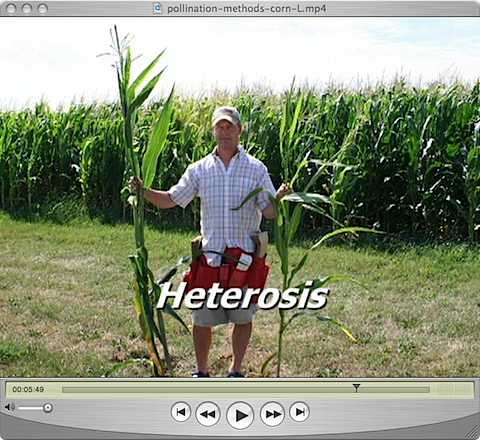
Karl J. Mogel from Inoculated Mind dropped us a note: “as part of my graduate school research, I’m making educational videos about plant breeding, and I just uploaded the first of them to my program’s website. Please consider linking to it in one of your blog posts.”

My pleasure!

So, off I went to the University of Wisconsin Madison’s web site to see. 2 I couldn’t actually see a video there, but no matter, there were instructions for how to deal with that problem, and pretty soon I found myself watching Karl’s effort.

heterosis.png
It’s really good.
There’s lots of diversity on display and you’ll learn about much more than just pollination. I learned, for example, that nowadays the commercial production of hybrid corn seed uses a specialized detasselling tractor to cut the male flowers off the plants that are destined to grow the hybrid seed. There are genes that make the male flowers sterile, and they used to be used in almost all corn breeding, but Karl told us that although these male sterility genes are used in breeding other crops, they are “not as extensively used in maize”. He didn’t mention that the reason is that the widespread use of a single cytoplasmic male sterility gene was the underlying factor behind the dreadful epidemic of southern corn leaf blight that devastated maize growers in 1970 and 1971. All the corn had the CMS gene, which also conferred susceptibility to southern corn blight.
The other thing that wasn’t mentioned was that if you fancy doing a bit of corn breeding, even mass selection rather than specific hybrid crosses, you need to save seeds from around 100 plants each time, otherwise you end up with inbred seed that doesn’t do very well.
Go to it, and let us know how you get on.

Climate change and Africa

Image2.gif I haven’t read Climate change and poverty in Africa: mapping hotspots of vulnerability, and nor am I likely to find the time to do so any time soon. But judging from the write-up at Eldis this paper from the African Journal of Agricultural and Resource Economics will be of interest to those who find this sort of thing interesting. The paper “uses a broad-brush analysis at the continental level to identify areas or ‘hotspots’ that are already vulnerable and likely to suffer substantial impacts as a result of climate change.”

The authors conclude that these results argue against large ‘magic bullet’ approaches and favour smaller, better targeted local approaches and interventions. Considerable future work is needed to refine the hotspots analysis and increase the resolution of impact studies, and thus contribute to a better understanding of the issues facing millions of people who depend on natural resources for their livelihood.

I wonder how that squares with other approaches to vulnerability in Africa, like the models of our pal Andy Jarvis and those of David Lobell?