Will Ecuador benefit from wild tomato genes?

A tweet alerted me to a story about the value of genes in crop wild relatives.
The source headline is “Galapagos tomato provides key to making cultivated tomatoes resistant to whitefly,” and though it reads like a press release 1 I have so far been unable to run down the original. I did, however, locate the event of note.

By now, Syarifin Firdaus should have successfully defended his graduate thesis on Whitefly Resistance In Tomato and Hot Pepper, which was due to take place today and which I imagine created all the interest.

My interest stemmed from the Twitterer’s question: “Will Ecuador benefit?”

The blurb for Firdaus’ talk makes it clear that after sampling almost 100 genebank accessions, wild Solanum galapagense had the strongest resistance and this seemed to be down to a single gene on chromosome 2. But it also pointed out that resistance was found in two other wild Solanum species, and in several Capsicums.

With these results, introduction of the resistance into modern tomato varieties is feasible and within a few years the first commercial, resistant tomato cultivars are expected on the market.

And that is a good thing not so much because whitefly damage the crop, but because they transmit virus diseases that are really harmful.

The release, which lists all the private sector companies involved in the research, strongly suggests that it will be genes from S. galapagense that will be bred into commercial varieties “within two years”. It also says that “resistance was also found in China, Indonesia and Thailand,” presumably in local tomato varieties rather than wild relatives.

Will Ecuador benefit? I seriously doubt it. Other wild relatives from Ecuador (and elsewhere) have already donated genes worth millions of dollars to the tomato industry, and no precedent has been set.

Should Ecuador benefit? Hard to see why. It isn’t as if S. galapagense (which until relatively recently was treated as a form of S. cheesmaniae, a well-established source of good tomato genes) has been maintained by farmers since time immemorial.

Best yet, tomato isn’t even listed on Annex 1 of the International Treaty on Plant Genetic Resources for Food and Agriculture. Solanum section tuberosa, sure; Solanum melongena, you bet. But Solanum lycopersicum and its wild relatives, outta luck.

Of course, the genetic resource in question might just be covered by the Convention on Biological Diversity, which offers Ecuador and its supporters a glimmer of hope, but I wouldn’t hold my breath.

What I really want to know is why S. galapagense is resistant? What are the insect pests on the Galapagos that exerted such strong selection pressure? Perhaps @WayOfThePanda can find out.
The glories of the harvest

The Big Picture, a wonderful round-up of great photographs hosted by The Boston Globe, takes a look at the harvest.

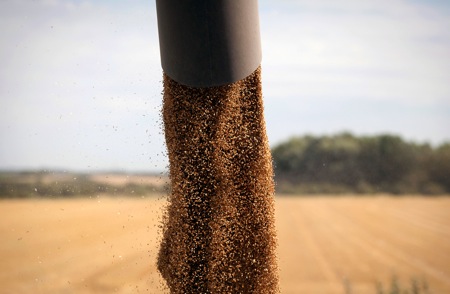
Wheat being harvested.
Wheat grain is poured into a truck on a farm in Great Wilbraham, United Kingdom on July 18, 2012. (Simon Dawson/Bloomberg)

Harvest is a time of plenty, when the season’s hard work is rewarded by bounty. Many of the rhythms of our lives are shaped by the gathering of crops, even if most of us now live in cities. Worldwide, festivals and rituals mark the passage from growing season to harvest, with indigenous and popular practices making fall in the Northern Hemisphere a festive time. This year sees a reduced harvest in much of the world as extreme weather decimated many regions. Half of the United States is in prolonged drought, as well as much of Europe. In India, the monsoon is 20 percent off the annual average. Food prices are expected to rise by 2013 as demand taxes supplies, and later the price rises will transfer to the meat industry as costs of feed for livestock are passed on. Gathered here are images of farms industrial and traditional, crops critical and obscure, and harvest festivals among drought and bounty.

All the images are just stunning, and a reminder of both the similarities and the differences of cultures around the world.

How vanilla is like Chanel No. 5

The Food Programme, on BBC Radio 4, has been running a little miniseries on spices: cloves, vanilla and mustard. I haven’t yet heard mustard, but cloves and vanilla were interesting, not least because I had no idea vanilla was thriving in Uganda, thanks to Ndali farm and Lulu Sturdy. The programme even prompted Luigi to wonder whether his MiL might be able to grow vanilla in Kenya.

What really caught my attention, though, was when someone called Niki Segnit enthused that:

Vanilla is the Chanel No. 5 of the flavour business.

First of all, I have absolutely no idea what that means. Secondly, I wondered whether she actually knew how right she was, in at least one respect. Ylang-standing readers of this blog will remember that Chanel No 5 “is a blend of entirely synthetic aldehydes, and has been since its launch in 1921“. And vanillin? That was one of the first important flavours to be synthesised, in 1876.

Somehow, I doubt that that is what was meant.

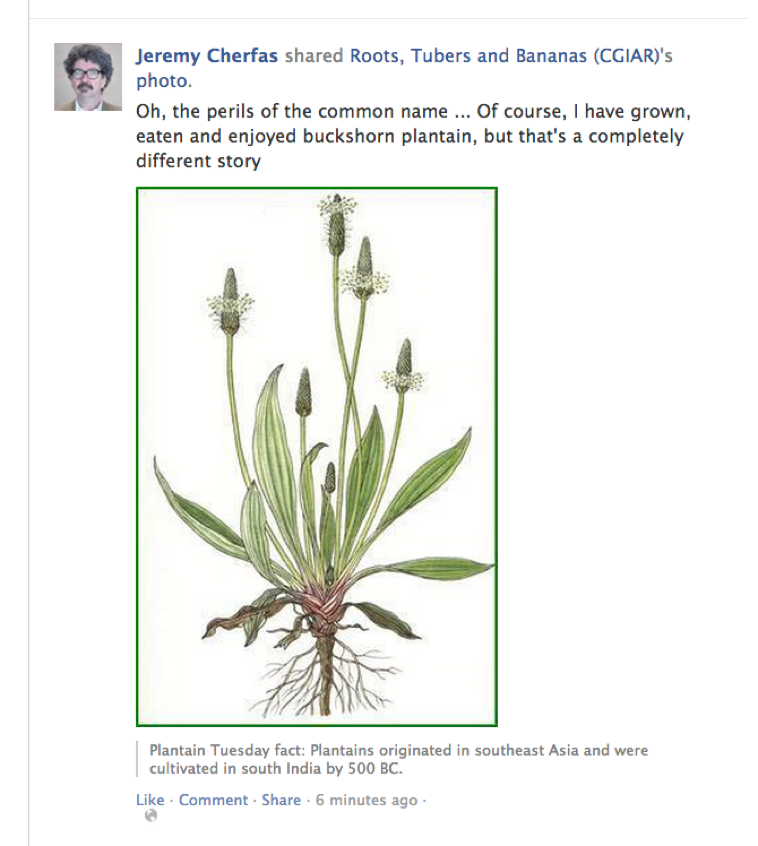
When is a plantain not a plantain?

Corner a Musa-wallah over a pint of sorghum brew, and ask them to tell you the difference between a banana and a plantain. Seven will get you eleven you’ll be no wiser when they eventually finish frothing. So turn instead to the CGIAR Research Program on Roots, Tubers and Banana’s Facebook page, for true enlightenment.

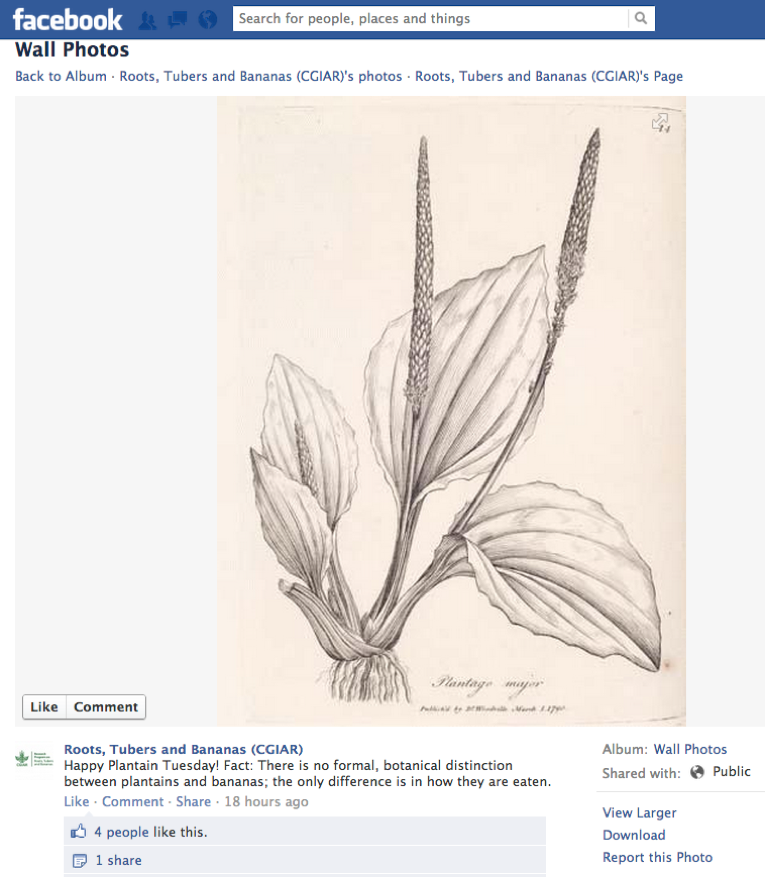
Yesterday, you see, was Plantain Tuesday. So what do we learn?

That’s right! 2 “There is in fact no formal, botanical distinction between plantains and bananas; the only difference is in how they are eaten”. So stick that in your cooking bananas, Dr Musa-wallah.

And there’s more.

“Plantains originated in southeast Asia and were cultivated in south India by 500 BC”. Triffic. What about bananas, then?

Hang on, though, I know what you’re thinking. Those two pictures don’t look much like any bananas you’ve ever seen. And you would be right about that. But hey, it’s only Facebook. Who cares whether the information is accurate?