Superwheat: not another comic hero

BBC Radio 4’s Farming Today this morning had visited the John Innes Centre to hear all about superwheats, promising yields of 15 t/ha as opposed to the current (UK) average of about 8t/ha. Intrepid reporter Anna Hill couldn’t supress a little chuckle as she gazed in awe at 5 foot (150 cm) tall plants towering over her, each ear enclosed in a little plastic bag.

The John Innes Centre is looking in wheats from thousands of years ago for traits to feed the 9 billion, traits that might have been left behind because they weren’t incorporated into the pool when modern wheat breeding began.

There’s a lot there to take issue with. The researcher 1 described landraces as having developed “almost naturally,” which rather downplays the role of farmers in both selecting and maintaining the characteristics of their landraces. It also gives the lie to the idea that these landraces are thousands of years old. I don’t know exactly when they were collected, but I’d be willing to bet is was less than 100 years ago, at most.

Then there’s the whole idea of going back to landraces in search of forgotten traits as if this was some Eureka-style breakthrough in breeder thinking. John Innes’ breeders are hardly the first to have thought of this. In fact CIMMYT went one better, and actually recreated modern wheat by re-hybridizing the parental species, broadening considerably the genetic base for breeders.

(Those breeders, by the way, have just published a summary of the yield gains in their elite spring wheat programme over the past 15 years (1995-2009). Average annual gains across 919 environments in 69 countries are of the order of 0.65%. Of course, that’s no reason to be complacent — the trend may be slowing — but still … 2)

And finally, the bit that really made me squirm was when Anna Hill put Alford (if it was he) on the spot by asking what traits he was looking for, and whether he had found anything, and the poor researcher was left to utter pleasantries about transport systems, and leaf area, and robust plants and disease resistance and photosynthesis and “it’s very complicated”. It all seemed to reflect a press release in search of a story.

Anyway, listen for yourself.
Collecting manual for plant genetic resources updated and online

Collecting plant genetic diversity is one of those great fat handbooks essential for anyone interested in, er, collecting plant genetic diversity. New it’ll set you back USD230. What’s more, the information in that dead-tree edition is truly ancient, much of it dating back to before 1995. But here’s good news. A brand-spanking new (and almost complete) version is available for your online edification, and our very own Luigi Guarino remains one of its editors. Old information has been updated. New information has been included. The whole thing can be downloaded (and printed, if you must). What’s more, “the editors invite your comments”.

What are you waiting for?

Agro-business flourishes in Mali

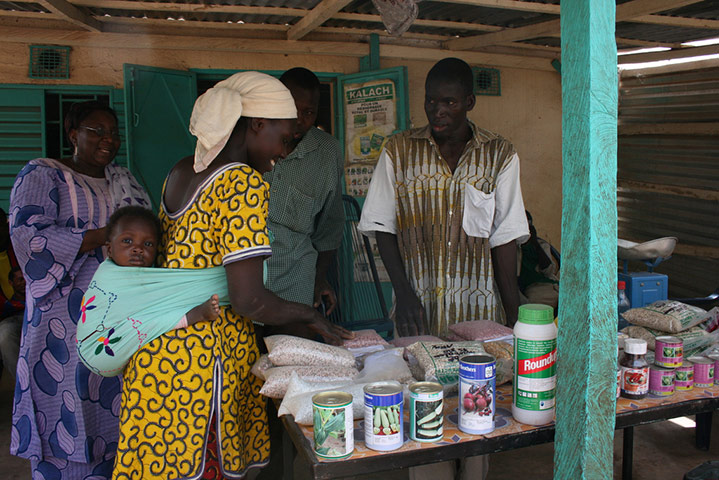
“By selling these seeds in small packets at local markets as well as in her shops, these are more accessible and affordable for resource-poor women farmers.”

One picture is worth a thousand words, they say. The one up there is the last in a series of images on The Guardian’s Global Development blog.

Mali’s first woman seed entrepreneur Maïmouna Coulibaly has launched an agribusiness which brings tasty and nutritious seed varieties on to the market. ‘When the seeds are good, so are the yields. But people need to like the taste to buy it at the market. When we do food tastings we find out what works,’ she says

The whole slideshow promotes the new and improved varieties that Maïmouna Coulibaly is selling because they are so much better than local varieties. But how about that product placement? Wonder what that’s worth?

An opportunity to see plant breeding history

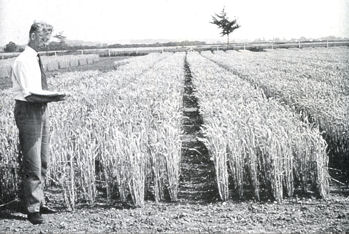
Francis Lupton with the first UK semi-dwarf wheats, from JIC
The John Innes Centre in Norwich, England, is celebrating what would have been the centenary of the Plant Breeding Insitute, established in 1912 at Trumpington outside Cambridge. And they’re doing it with a one-day conference — tomorrow! — that looks jolly interesting.

Even more interesting, frankly, is a living exhibition

… made up of some of the 130 varieties that, over the last century have driven UK agriculture. ‘Yeoman’ wheat, introduced in 1916, was a landmark variety, showing that high-yielding, good baking-quality wheat could be bred and successfully grown in Britain. ‘Proctor’ barley led to a tripling of UK barley production. ‘Maris Piper’ potatoes were introduced in 1963 to be resistant to nematodes and are still a leading potato variety today. By the time of its privatization almost 9 in 10 of the varieties of cereal crops being grown in the UK had been developed by PBI.

That will surely be a sight to see. I wonder, though, whether the John Innes Centre could be persuaded to have some of the resultant crops analyzed for their nutrient content. Varieties bred at different times, and grown side by side under experimental conditions, are sorely needed to investigate declines in nutrition.