- Duration of agriculture and distance from the steppe predict the evolution of large-scale human societies in Afro-Eurasia. Large, complex human societies arise where there is a long history of agriculture and war; and not, interestingly, where potential productivity is highest.
- Diet, Mobility, Technology, and Lithics: Neolithization on the Andean Altiplano, 7.0–3.5 ka. It seems the rise of large, complex societies arose in the Andes is associated with the change in projectile technology from atlatl to archery.
- Three-dimensional X-ray-computed tomography of 3300- to 6000-year-old Citrullus seeds from Libya and Egypt compared to extant seeds throws doubts on species assignments. Meanwhile, across the Atlantic, people were snacking on watermelon seeds.
- From the earliest farmers to the first urban centres: a socio-economic analysis of underground storage practices in north-eastern Iberia. You can track socioeconomic changes in ancient Iberian cultures (c. 5600–50 BC) via the size and morphology of their grain silos. No word on projectile technologies nor watermelons though.
- Re-evaluating Scythian lifeways: Isotopic analysis of diet and mobility in Iron Age Ukraine. Meanwhile, back on those steppes, 700-200 BC, some people were relatively settled, with their agro-pastoralism and millet agriculture, while others moved. So much for warlike nomads. Must have had watermelons by then, surely.
- Why were New World rabbits not domesticated? Because they’re solitary, dispersed and there’s too many different types. Most North American evidence of management comes from Teotihuacan, ~AD 1–550.
- Estimating the age of domestic fowl (Gallus gallus domesticus L. 1758) cockerels through spur development. In Britain, Iron Age and Roman cockerels died way too old to have been kept for meat, and were thus probably also used for rituals and cockfighting. No word on the Killer Rabbit of Caerbannog.
- The earliest water buffalo in the Caucasus: shifting animals and people in the medieval Islamic world. The water buffalo came to Azerbaijan with Islam in the 7-9th centuries.
- Collagen fingerprinting traces the introduction of caprines to island Eastern Africa. Goats from the 7th century CE, sheep a couple hundred years later. No word on water buffaloes.
- An illustrated review on manifestation of pome fruit germplasm in the historic miniatures of ancient Persia. 14-18th century Persian artists had a thing for pears, quinces and apples, and drew them very accurately.
Nibbles: Quinoa info, Hybrid rye, New tobacco, GMOs
- If you’re into quinoa, you’re probably going to need this directory.
- Hybrid rye is becoming a useful participant in maize-soybean rotations in the Corn Belt where giant ragweed is a problem.
- New insect-trapping wild tobacco species described from Australia.
- Biotechnologist and social scientist in conversation about genetic modification and gene editing.
Boffins unravel mandarins
I was just going to include the paper Diversification of mandarin citrus by hybrid speciation and apomixis in a forthcoming Brainfood, but the very different approaches taken in the two articles on the paper that I have seen convinced me to give it a bit more space.
The piece in The Packer has very much the industry take, and highlights the contribution of the University of Florida authors: this new information will make breeding easier, including to fight citrus greening.
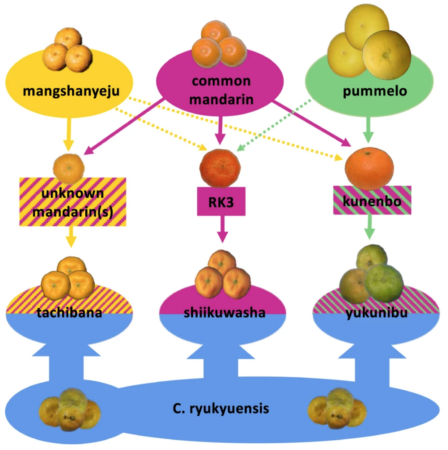
On the other hand, the press release from the Okinawa Institute of Science and Technology makes much more of how the paper unravels the origin of shiikuwasha and tachibana, which are culturally important citrus fruits in Japan, though not very significant economically.
Something for everyone.
Nibbles: Training materials double, Tree platform double, Wild rabbit, Economic value
- Crawford Fund training materials for high schools include discussion of genebanks.
- And that would go quite well with this graphic novel on natural selection in Mimulus from Health in Our Hands.
- There’s a Global Tree Knowledge Platform from ICRAF…
- …which could probably be usefully mashed up with the restoration platform Restor.
- The Sumatran striped rabbit makes a rare appearance. On Facebook.
- The World Bank makes the economic case for all of the above. Well, maybe except the Sumatran rabbit.
Smallholders still produce a lot of food
Hannah Ritchie of the indispensable Our World in Data has just come out with a useful summary of the data on how much food small and family farms produce. And one of the main points she makes is that those are two very different things. The bottom line is that smallholders (those farming 2 ha or less) account for 29% of the world’s agricultural production, at least as far as kilocalories are concerned 1, and family farms produce about 70-80%.
As rightly pointed out by Dr Ritchie, FAO has in the past said that small-scale farmers produce up to 70% of the world’s crops, a statistic that has been widely repeated. This is clearly wrong. However, to be fair to FAO, they have recently walked that back a bit, and their latest headline number is about a third. Which is still quite a lot really, and don’t forget that there are other things that small farms are good at.