Transitioning to agriculture on Peruvian coast 5000 years ago.
International Day of Biodiversity
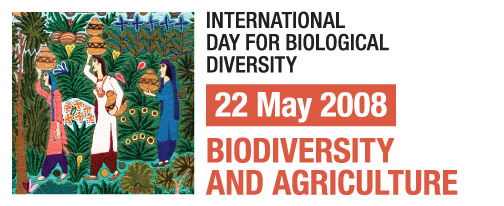
Every year since 2002 there’s been an International Day of Biodiversity, each time with a different theme. This year the celebrations on May 22 will revolve around “Biodiversity and Agriculture.” We’ll have to think of something special to do here…
Farmers and hunter gatherers in Africa
The human genetics of farming transition in Central Africa. Lots more here.
Neolithic origins
The birth of Egyptian farming.
A modest proposal
That last but one post of Jeremy’s got me thinking. How do we find out if Arachis ipaensis is still at that locality? I mean, short of mounting a fully-fledged expedition of groundnut experts at vast expense, that is. One way might be to ask a local person to check for us. Ok, a wild peanut species might not be the best thing to try this with, but you get the idea. Problem is, how do we identify a local person who knows that area?
Then I remembered something Jeremy sent me recently. WikiLoc is a website to which you can upload your favourite walk or cycle ride as a GPS track. You can then view all these in a number of different ways, including in Google Earth. So I gbiffed (sensu Cherfas, 2008) the localities of wild Arachis species and viewed them in Google Earth together with all the tracks from South America available on WikiLoc.
Well, of course, none of the trails was anywhere near the locality of A. ipaensis. But I did find others that came near — or very near — the localities of other species. Check this one out, for example:
It’s a 32 km circuit around Piribebuy in Paraguay, and it was uploaded by someone called Yagua. It takes about 4 hours to walk it. And it so happens that a specimen of Arachis glabrata was collected along Yagua’s favourite trail, around its southeastern corner:
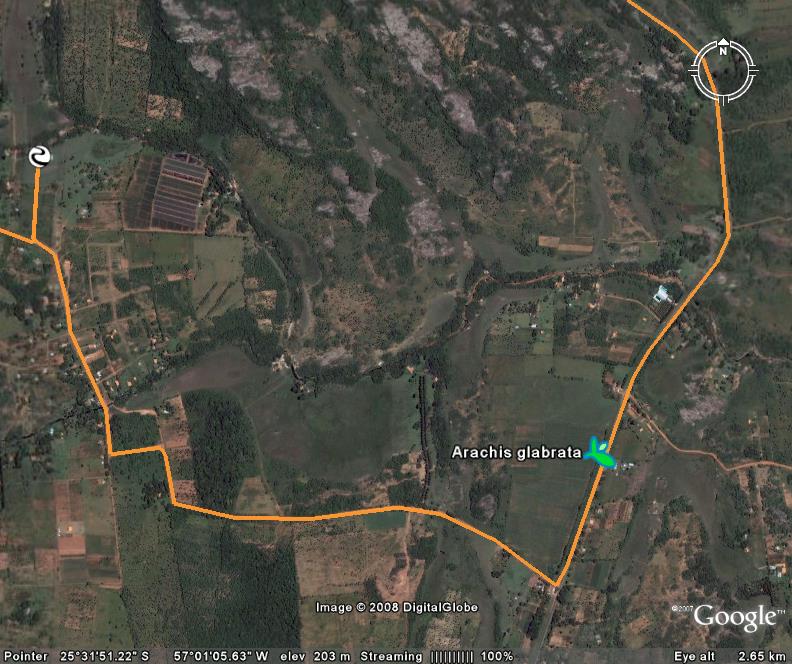
Now, I don’t think A. glabrata is a particularly significant component of the groundnut genepool, but say, for the sake of argument, that it had been. Couldn’t we ask Yagua to keep an eye on it for us? Multiply by the more than 10,000 tracks on WikiLoc and pretty soon you’re talking about a real global network of agrobiodiversity monitors. But maybe we should test the idea out with a somewhat more — ahem — charismatic plant. And imagine if germplasm collectors start adding their tracks to WikiLoc.