- An analysis of genetic diversity actions, indicators and targets in 114 National Reports to the Convention on Biological Diversity. It is not well done, but the authors were surprised to see it done at all.
- Essential indicators for measuring site‐based conservation effectiveness in the post‐2020 global biodiversity framework. Remote sensing will save us. But see above.
- Pervasive cropland in protected areas highlight trade-offs between conservation and food security. Remote sensing (et al.) in action.
- Conserving intraspecific variation for nature’s contributions to people. Well, yeah. But can remote sensing help?
- SeedExtractor: An Open-Source GUI for Seed Image Analysis. Somebody mention intraspecific variation? Here’s a way to cope with seed variation.
- The processed food revolution in African food systems and the double burden of malnutrition. There’s bad processing, and good processing, even the bad processing has some upsides, but really we should try to have only good processing.
- Expression of internal reproductive barriers in a germplasm bank accession of the wild potato Solanum chacoense Bitter in three ex situ regeneration cycles. Ne < N.
- Effects of Iron and Zinc Biofortified Foods on Gut Microbiota In Vivo (Gallus gallus): A Systematic Review. Biofortified foods are good for gut health. In chickens.
- Experimental evidence of microbial inheritance in plants and transmission routes from seed to phyllosphere and root. Plants get their microbiome from the seeds whence they came, not just the environment.
- A stable antimicrobial peptide with dual functions of treating and preventing citrus Huanglongbing. From a wild relative, natch.
- Wheat rust epidemics damage Ethiopian wheat production: A decade of field disease surveillance reveals national-scale trends in past outbreaks. Boom-and-bust is alive and well.
- Honey bee hives decrease wild bee abundance, species richness, and fruit count on farms regardless of wildflower strips. And the good news just keeps on coming.
- Pollination strategies in the face of pollinator decline. The really good news is that plants may adapt to pollinator decline.
- Genomic Selection for Any Dairy Breeding Program via Optimized Investment in Phenotyping and Genotyping. You don’t need more money, you just need to reallocate some of the phenotyping money to genotyping, genotypers say.
- Runs of homozygosity provide a genome landscape picture of inbreeding and genetic history of European autochthonous and commercial pig breeds. Local breeds around Europe have similar genetic structures.
Nibbles: Millets 2023, Pygmy hog, Iraqi seeds, Botanicals, Business, EU
- Watch out for the millets renaissance.
- This small wild pig is already having a renaissance.
- Can you help with the renaissance of some Iraqi vegetable seeds?
- Alpine botanicals will be having anything but a renaissance. Genebanks anyone?
- No way to call the uptick in interest in biodiversity in the financial industry a renaissance. I’m not even sure it’s an uptick, actually. Absinthe, anyone?
- Will the EU’s Farm to Fork plus biodiversity strategies lead to an environmental renaissance?
Nibbles: Bean atlas, Community seedbanks double, Canadian stamps
- New edition of the Atlas of Common Bean Production in Africa still doesn’t have localities of genebank accessions.
- Community seed banks have genebank accessions in Kenya and India.
- Canadian stamps have crabapple varieties that are probably genebank accessions somewhere.
Rooting for consumers
The International Journal of Food Science + Technology has a special issue out that sounds extremely interesting. Here’s how the introductory editorial, led by Dominique Dufour, describes it.
“Consumers have their say: assessing preferred quality traits of roots, tubers and cooking bananas, and implications for breeding” special issue, brings together new knowledge about quality traits required for roots, tubers and bananas (RTB) varieties to successfully meet diverse user preferences and expectations, along the variety development and RTB value chains (production, processing, marketing, food preparation, consumption). Key RTB crops in sub‐Saharan Africa are cassava, yams, sweetpotatoes, potatoes and bananas/plantains. They are mainly consumed directly as boiled pieces or pounded in the form of smooth, not sticky, and stretchable dough. They are also stewed, steamed or fried. Cassava, the most widely grown RTB, is generally boiled, stewed or steamed in Eastern and Southern Africa, and in West and Central Africa is usually processed directly into derivative products, e.g. whole root fermentation through retting or heap fermentation; fermentation/dewatering of the mash. Biophysical and social knowledge presented in this issue help elaborate goals for both the processing unit operations (food scientist control) and variety traits (breeder control).
In a perfect world, I’d do a deep-dive Brainfood on the whole thing, but that’s looking highly unlikely at the moment, so let me whet your appetite with this nice illustration from the paper “Cyanogenic, carotenoids and protein composition in leaves and roots across seven diverse population found in the world cassava germplasm collection at CIAT, Colombia.”
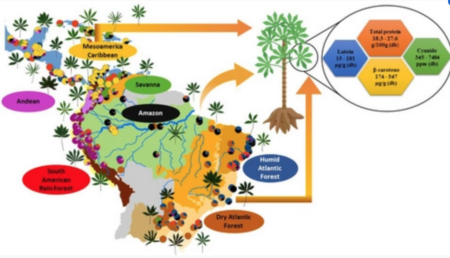
All the papers are open access. Anyone out there want to help me out with a dedicated Brainfood? Maybe go halves?
Brainfood: Extra livestock edition
- Resilience and livestock adaptations to demographic growth and technological change: A diachronic perspective from the Late Bronze Age to Late Antiquity in NE Iberia. The changing balance between sheep, cattle and pigs through time was driven by socio-economics more than environment.
- Heat stress will detrimentally impact future livestock production in East Africa. 4-19% of livestock production will have more heat to cope with.
- Pastoralism in the highest peaks: Role of the traditional grazing systems in maintaining biodiversity and ecosystem function in the alpine Himalaya. A ban on grazing would be counter-productive.
- The evolving interface between pastoralism and uncertainty : reflecting on cases from three continents. Adaptive herd management, livelihood mosaics, persisting mobility, reticular territories, and articulated social networks have been enough, but for how long more?
- Redefinition of the Mora Romagnola Pig Breed Herd Book Standard Based on DNA Markers Useful to Authenticate Its “Mono-Breed” Products: An Example of Sustainable Conservation of a Livestock Genetic Resource. Fraudsters beware.
- Estimating the genetic diversity of Pacific salmon and trout using multigene eDNA metabarcoding. DNA was recovered from the water, for pity’s sake.