- Collections of banana and mangoes in the Canary Islands.
- No word about catfish with those bananas.
- Interview with the wonderful Rowen White, Seedkeeper from the Mohawk community of Akwesasne.
- NPR series on agricultural land, courtesy of the no less, though differently, wonderful Dan Charles.
- Harvard lectures on statistical analysis of social sciences data.
- FAO tells us “How the world’s food security depends on biodiversity“.
Brainfood: Niche modelling, Post-2020 double, CC & productivity, Wild cacao, Popcorn data, Regulations, Duplicates, Oz ag, Kenya diversity, Stressed wheat, DUS, Connectivity, Population differentiation
- ntbox: an R package with graphical user interface for modeling and evaluating multidimensional ecological niches. Yes, another one, deal with it.
- Global targets that reveal the social–ecological interdependencies of sustainable development. The post-2020 framework should not have separate targets for social and ecological outcomes.
- Integrating agroecological production in a robust post-2020 Global Biodiversity Framework. Case in point?
- The Historical Impact of Anthropogenic Climate Change on Global Agricultural Productivity. We’ve lost a decade of productivity growth since 1961.
- Exploring the diversity and distribution of crop wild relatives of cacao (Theobroma cacao L.) in Colombia. Habitat protection needed.
- The Global Popcorn Project. Here comes the data! And more.
- Editorial: Leeway to Operate With Plant Genetic Resources. Research Topic on ABS, biosafety and IPR regulations and how they affect use of PGR.
- SNP Markers and Evaluation of Duplicate Holdings of Brassica oleracea in Two European Genebanks. Out of 10 pairs of accessions with similar names in the Russian and Nordic genebanks, 5 showed genetic differences, and 3 of these also morphological differences.
- History of crop introductions, breeding and selection in Australia: The 140 years from 1788. But at what cost?
- The welfare effects of crop biodiversity as an adaptation to climate shocks in Kenya. Crop diversity mitigates income variability risk caused by climate.
- Genetics of yield, abiotic stress tolerance and biofortification in wheat (Triticum aestivum L.). Well that seems sorted then.
- Is plant variety registration keeping pace with speed breeding techniques? No?
- Global Cropland Connectivity: A Risk Factor for Invasion and Saturation by Emerging Pathogens and Pests. Nice maps of ease of movement among different cultivation areas of vegetatively propagated crops. Could be used to model movement of genetic resources as well as of pests/diseases?
- Global patterns of population genetic differentiation in seed plants. More population differentiation for tropical, mixed‐mating, non‐woody species pollinated by small insects, and lower for temperate, outcrossing trees pollinated by wind. Could perhaps be mashed up with this fragmentation database.
Nibbles: Yunnan mushrooms, Torres Is bananas, Boxgrove, Gluten trends, Apple rootstocks, USDA horticulture job
- There’s a sort of mycological culinary hotspot in Yunnan… Yeah, I thought that too.
- Signs found of old banana cultivation in Australia. Well, kinda. As in not as old as in PNG, and not mainland Australia.
- Really, really old horse butchery site in southern England excavated. When the Brits ate horses. Well, kinda.
- New wheat is pretty much like old wheat, gluten-wise at least.
- Breeding better apple rootstocks at USDA. A hitherto somewhat neglected aspect of apple genetic conservation and improvement.
- Speaking of USDA, here’s another job.
Famous British apricots abroad
So Plant Heritage tweeted a few days ago about the genera that are missing from the UK’s National Plant Collections.
The Missing Genera Campaign asks people with a passion for plants to put together a National Plant Collection of their own and join the Plant Heritage community in growing, sharing and saving plants.
One of the missing plants is the apricot, so I quickly checked on Genesys to see whether anyone else around the world has British apricots stashed away. Turns out there are two apricot varieties of British origin that are conserved in genebanks that publish their data on Genesys, a fact that I posted on Twitter too. Because, why not?
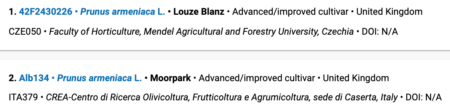
And that second one turns out to be rather special. As Plant Heritage quickly informed me, the Moor Park apricot is mentioned by Jane Austen in Mansfield Park, which was published about the time of the Battle of Waterloo.
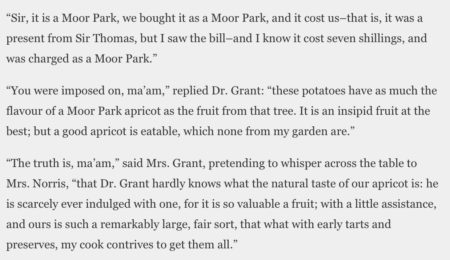
Interestingly, the Moor Park apricot in Genesys is being conserved in Italy. But there must be other specimens in the UK, surely?
Wanainchi wanaenda shagz
Jeremy’s latest newsletter expounds eruditely on, among other things, some recent articles on durian, Australian grasses and a heirloom pepper that we Nibbled here way too briefly. Always worth a read. Jeremy also gave me the go-ahead to reproduce here his piece on coping with Covid-19 in Kenya, which reminded me, as if I needed reminding, of what my assorted nephews and nieces are going through. Not to mention the mother-in-law. Here it is.
Deep insights from Oyunga Pala, a Kenyan currently in the Netherlands, prompted by how Covid is encouraging many Kenyans to return from the cities to small rural land holdings where they hope to create a basis for food security. Pala contrasts what he knows of small-scale agriculture in Kenya with what he is learning and what he sees all around him in the Netherlands.
Small-scale farming in Kenya accounts for 75 per cent of the total agricultural output and meets 70 per cent of the national food demand, so I know I am part of an important constituency. The challenge of my generation, those with access to land under 3 ha in size, is to craft a new farming philosophy that is built on progressive ideas through investigation, dialogue and exposure to alternative sources of knowledge grounded in the African experience. We need more philosophers and fewer technical experts to redefine what we call sustainable farming. Africa’s own knowledge systems and philosophy in agriculture are held in the memory of a generation that is dying out and dismissed as backward. Yet my grandmother’s practices resonate with those of emerging natural farming systems around the world that espouse new ideas grounded in the environmental, social and historical realities of the non-western world.
Seems to me to echo what other people are saying about AGRA, the Alliance for a Green Revolution in Africa.
Well worth your time, as are the articles Pala links to. I know nothing about Elephant, the online publication, but it looks like a good source of interesting news.