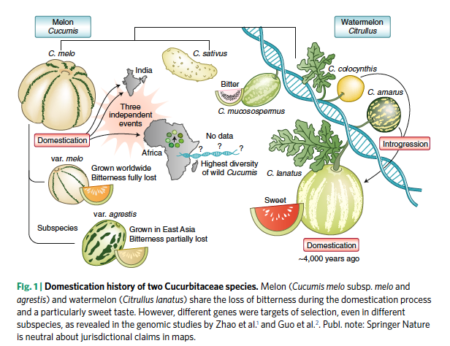
- Global modeling of nature’s contributions to people. Declining where the need is greatest. And that’s not even taking CWR into account.
- Farmer’s Varieties in India – Factors affecting their preferential prevalence and the current status of their legal protection. Open-pollinated crops are missing out.
- The bracteatus pineapple genome and domestication of clonally propagated crops. Domestication and early improvement as the result of a single clonal propagation event.
- Transposons played a major role in the diversification between the closely related almond and peach genomes: Results from the almond genome sequence. Including the sweet kernel phenotype.
- Genome-wide association mapping of date palm fruit traits. Fruit color and sugar composition changed in parallel.
- Genetic diversity and population structure of the Mediterranean sesame core collection with use of genome-wide SNPs developed by double digest RAD-Seq. Three genetic groups, but not geographically based.
- Ongoing accumulation of plant diversity through habitat connectivity in an 18-year experiment. You need those corridors.
- Meta‐analysis of the differential effects of habitat fragmentation and degradation on plant genetic diversity. You really do.
- In search of alternative proteins: unlocking the potential of underutilized tropical legumes. Beyond soybeans. I always liked Bambara groundnut.
- A scalable scheme to implement data-driven agriculture for small-scale farmers. Fancy maths put to some good use in Colombia. But what if it tells you to grow more coca?
- The evolution of crops that do not need us anymore. They’re called weeds.
Nibbles: How-to trifecta, Indigenous maps, ITPGRFA, SeedLinked, Tequila
- The Center for Plant Conservation has Best Plant Conservation Practices to Support Species Survival in the Wild. With online forum goodness.
- A little bit down-market, there’s What Are Seed Banks: A Complete Guide.
- How Do We Preserve the Vanishing Foods of the Earth? Good question, and nice article, but there’s surely more to the answer than what it says.
- Like indigenous people.
- And the Plant Treaty. Here’s two provocative briefing papers on that from the African Centre for Biodiversity in the run-up to the Governing Body meeting in November.
- Oh, and breeding. Even crowd-sourced breeding.
- Let the tequila industry show you what to do, in fact.
Let me count the ways…
How Do We Preserve the Vanishing Foods of the Earth? https://t.co/z5O68gtSVN
— AgroBioDiverse (@AgroBioDiverse) October 20, 2019
Click on the tweet, or here, to see some of my answers. Add yours in the comments below, if you’re not on Twitter.
Brainfood: Neolithic dairy, Wheat phenology, Carob origin, Malawi diets, Maize evolution, Bean domestication, Human evolution & diets, Chickpea pre-breeding, Food trade, Scaling up conservation, Apple leaves, Winged bean nutrition, White clover pedigrees, Bushmeat
- Milk of ruminants in ceramic baby bottles from prehistoric child graves. Neolithic sippy cups. Cute.
- Heat and Drought Stress Advanced Global Wheat Harvest Timing from 1981–2014. 2.5 days per decade.
- A strong east–west Mediterranean divergence supports a new phylogeographic history of the carob tree (Ceratonia siliqua, Leguminosae) and multiple domestications from native populations. No evidence of an eastern refugium.
- Value chains to improve diets: Diagnostics to support intervention design in Malawi. You can modify existing social protection interventions to optimize diets (including increasing diet diversity) by enhancing public- and private-sector linkages.
- Contemporary evolution of maize landraces and their wild relatives influenced by gene flow with modern maize varieties. Landrace genetic diversity actually increased due to introgression from modern varieties.
- Ancient genomes reveal early Andean farmers selected common beans while preserving diversity. Because they applied weak selection. Can breeders learn from this? Also, is it similar for maize?
- Reconstruction of nine thousand years of agriculture-based diet and impact on human genetic diversity in Asia. Changes in diet through domestication and processing have left signatures on the human genome.
- Transgressive segregations for agronomic improvement using interspecific crosses between C. arietinum L. x C. reticulatum Ladiz. and C. arietinum L. x C. echinospermum Davis species. For things like pod number, earliness and tolerance to cold.
- Linking global crop and livestock consumption to local production hotspots. China is the largest consumer of primary crops, and the third largest consumer of livestock. The Corn Belt, cerrado, Europe and E. China feeds it, and the world.
- How conservation initiatives go to scale. With great difficulty.
- Morphometrics Reveals Complex and Heritable Apple Leaf Shapes. It’s mainly about aspect ratio.
- Nutrient and Antinutrient Composition of Winged Bean (Psophocarpus tetragonolobus (L.) DC.) Seeds and Tubers. The best, and worst, among 50 accessions. Spoiler alert: it depends on the nutrient, and on whether you prefer the seeds or tubers.
- Identification of Founding Accessions and Patterns of Relatedness and Inbreeding Derived from Historical Pedigree Data in a White Clover Germplasm Collection in New Zealand. 15,000 accessions trace to about 175 founders.
- Poverty not taste drives the consumption of protected species in Madagascar. Let them eat domestic livestock meat.
Rethinking reforestation
One of the reforestation papers we blogged about a few months back is coming in for some criticism.
In the original study, ecologist Thomas Crowther of the Swiss Institute of Technology in Zurich and his colleagues first used a machine learning algorithm to predict where additional trees could naturally grow, based on climatic conditions under which existing forests are known to exist. Then, his team used a handful of published estimates on the carbon stored in existing forests to estimate how much carbon those additional trees could lock in once they reach maturity. After taking into account the carbon that would be trapped in the soil, leaf litter, and dead wood associated with the trees, they arrived at their 205 gigaton estimate.
That’s a trillion trees on almost a billion hectares. Just google those figures to get an idea of the impact the paper had.
Anyway, now researchers are finding holes in the methodology. My reliably pernickety friend Eike Luedeling is objecting to the figure used to convert canopy cover to amount of carbon sequestered, and to how the availability of land for reforestation was estimated. Others are suggesting that the effect of new forests on the surface albedo should have been factored in. But perhaps the main objection is higher-level.
Several groups of scientists took particular issue with the paper’s original statement that global tree restoration is “our most effective climate change solution to date,” an assertion one of the critics called “dangerously misleading” as it implies trees are the unique solution to climate change. Land, and how we use it, can be a big part of the solution to climate change, as outlined highlighted in a recent report by the Intergovernmental Panel on Climate Change. But those strategies only “buy us time” while people cut greenhouse gas emissions, which is arguably the most powerful climate change mitigation strategy, says Luedeling.
Needless to say, the authors are countering vigorously. You can read all the toing and froing in The Scientist.