- Nevis has 44 kinds of mango, including Amory Polly, which could actually be Amrapali आम्रपाली.
- A twitter thread on “hogs, ferality, and race in American history.” If that doesn’t make you click nothing will.
- “Can sweet potatoes reduce widespread vitamin A deficiency in Africa?” Guess.
- The end of kava as we know it?
- Making linen.
- Better scientific posters? Here’s hoping.
- Pigenonpea pre-breeding lines hit the bigtime.
- Mapping fires from space. Part of an early warning system for crop wild relatives?
- Roundup of how some breeders are preparing crops for climate change.
- No expiration date on yeast.
- A couple of European crop diversity projects: DYNAVERSITY and ReSEED.
Rapid calculation of threat status online
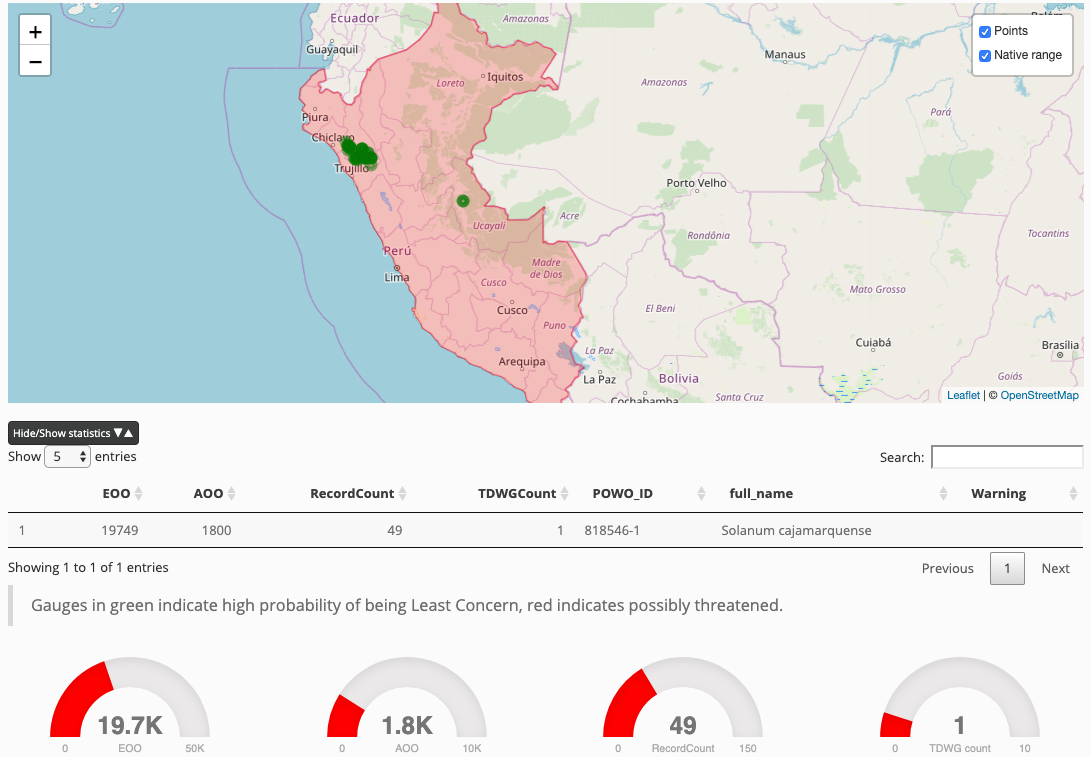
Do you need to get a quick idea of the threat status of a species in the wild? Well, there’s now an online tool that does it for you in a jiffy: Rapid Least Concern. You just type in a species name or import a batch of names, and the thing goes off to GBIF and returns with a bunch of records which it then uses to calculate 4 different indicators, including Area of Occupancy (AOO) and Extent of Occurrence (EOO). It also gives you a map. Here’s the result for Solanum cajamarquense, a wild potato relative. Looks like it could be in trouble…
A diversity of soil biodiversity maps
Nibbles: Crop map, Breeding, CePaCT, African coconut, Cacao & vanilla, Malaysian fruits, Basmati, Rice saving, Grapevine diversity, Wild foods, Cornell hemp genebank, Potato breeding course, Chinese aquaculture, Chinese trees, Plant identification, Menu language, Shepherding, US forests, Global fires, Red Listing, MERL, Pea gin
- Nice vintage map of global crop distribution, starring wheat.
- CIMMYT DG on the glories of plant breeding, starring wheat (p. 6).
- Australia supports Pacific genebank. No wheat in sight.
- Saving coconut. No, not in the Pacific.
- The history of chocolate and vanilla. The crops, not the ice cream.
- Speaking of ice cream: maybe someone should try making some out of these tasty endangered fruits before it’s too late.
- Speaking of tasty: basmati.
- Speaking of rice: this guy has 1420 varieties.
- Hey, it’s not about the taste: it’s the ethics too, stupid. But, being wine, it’s also about the taste.
- Speaking of ethics: what good is forest conservation if it stops people accessing wild foods.
- At least one senator gets it.
- You’ve got a few weeks to register for a potato breeding course. Using CWR, no less.
- Amazing pics of Chinese aquaculture.
- Chinese efforts to save ancient trees. No connection with above at all. And no pics.
- Google will identify your plants. Of course it will.
- Speaking at Google: a linguist (Dan Jurafsky) on menus.
- Next generation shepherding in South Africa. No sign of Google, though. For now.
- Interactive atlas of US forests. There goes the afternoon. Imagine if if ever got mashed up with the global fire atlas.
- Automated Red List assessments. Wow.
- The MERL has an exhibition on the history of farming. One of my favourite museums, one of my favourite topics. My cup runneth over.
- Gin made from peas. Sometimes I hate farming.
Brainfood: Food system, Ethiopian durum, Enset, Legume seeds, Salinity, Ryegrass genomics, Weeping lovegrass genomics, Pest occurrences, Golden Rice, Cattle origins, Pollinator & diversity, Production shocks, Production & diversity
- Transforming agricultural land use through marginal gains in the food system. A nudge here, a nudge there, pretty soon you’re talking about a revolution.
- Exploitation of diversity within farmers’ durum wheat varieties enhanced the chance of selecting productive, stable and adaptable new varieties to the local climatic conditions. Some landraces are pretty good.
- Enset in Ethiopia: a poorly characterized but resilient starch staple. Some local crops are pretty good.
- Market‐led options to scale up legume seeds in developing countries: Experiences from the Tropical Legumes Project. Ah yes, PPPs.
- Global mapping of soil salinity change. A billion hectares and increasing. We’re going to need all the above.
- Integrating a newly developed BAC-based physical mapping resource for Lolium perenne with a genome-wide association study across a L. perenne European ecotype collection identifies genomic contexts associated with agriculturally important traits. “Clearly this is not an end-point for L. perenne genomics…” Ok, call me when you get there.
- A high-quality genome of Eragrostis curvula grass provides insights into Poaceae evolution and supports new strategies to enhance forage quality. “Understanding and subsequently manipulating the genetic drivers underlying apomixis could revolutionize agriculture.” Ok, call me when you get there.
- Many unreported crop pests and pathogens are probably already present. Especially in China, India, southern Brazil and some countries of the former USSR.
- Compositional Analysis of Genetically Engineered GR2E “Golden Rice” in Comparison to That of Conventional Rice. Only difference is beta-carotene. But that was never the issue.
- Ancient cattle genomics, origins, and rapid turnover in the Fertile Crescent. aDNA shows origin from multiple populations, and separate introgressions from aurochs, then an influx of zebu bulls from the Indus Valley in the Bronze Age. Basically a Zeus-and-Europa scenario.
- Global agricultural productivity is threatened by increasing pollinator dependence without a parallel increase in crop diversification. Agricultural diversification going up weakly, possibly undermining pollinators, while proportion of pollinator-dependent crops increasing strongly.
- Food production shocks across land and sea. There are shock hotspots, and overall the frequency of shocks is going up. Whatever can be done?
- National food production stabilized by crop diversity. I wonder.
- The SDG of zero hunger 75 years on: Turning full circle on agriculture and nutrition. No longer just calories.