- Going hyper-local with your brewing yeast.
- Protecting sweet potato the Colombian way.
- Land sharing is good for you. The paper is in a Brainfood, see if you can find it…
- Fooling trees into chilling. Until the breeders do their stuff anyway.
- Maybe they’re all working on Ugni blanc.
- A rose is a rose is a mutant.
- Sheep combat. You heard me.
- COVID-19 and food security: no need for panic yet.
- But if you’re stuck at home, these online museum tours might come in useful. And remember you can do the same with genebanks.
Questioning the questioners
Farmer input is essential to tackling global challenges of climate change, rural poverty and nutrition. A new data collection tool aims to build the biggest open-access dataset of its kind for development and research.
That sounds great. Nice to see, in particular, clusters of survey questions on dietary diversity and wild foods.
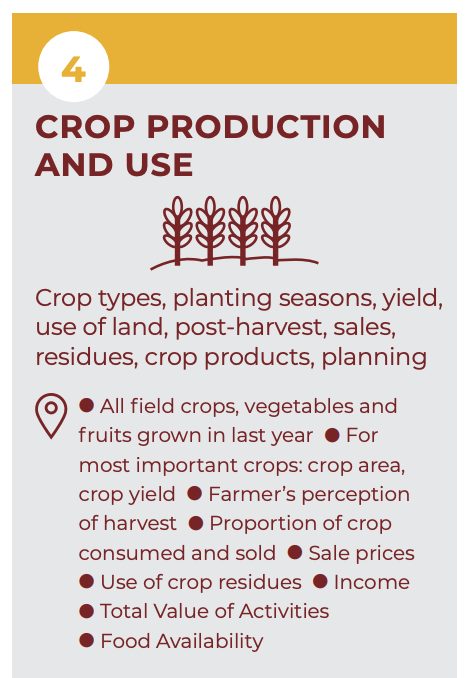 But where are the questions on intraspecific crop diversity? Surely it’s interesting to ask farmers how many different landraces/varieties of each crop they grow? Am I missing something among the over 700 questions?
Ok, there’s an additional module on adoption of modern varieties. But is that really enough? Looking forward to hearing from my friends at the Alliance.
Brainfood: Gap analysis, Faba re-collecting, Selfing, Perennials, Seed longevity, QMS, Fish cryo, Chicken domestication, Wheat evolution, Crossing over, Heat stress, Spinach, Mungbean, Wild chickpea, Satoyama
- A gap analysis modelling framework to prioritize collecting for ex situ conservation of crop landraces. Kinda proud it only took me 30 years to get this done. For comparison, this is where we were 15 years ago. Seems like a lifetime. Well, a career.
- Serendipitous In Situ Conservation of Faba Bean Landraces in Tunisia: A Case Study. Comparison between newly collected and genebank materials reveals overlap. The above is thus unnecessary. Life comes at you fast.
- Why Self-fertilizing Plants Still Exist in Wild Populations: Diversity Assurance through Stress-Induced Male Sterility May Promote Selective Outcrossing and Recombination. Stress makes plants incels.
- Roadmap for Accelerated Domestication of an Emerging Perennial Grain Crop. Instead of making wheat perennial, make a perennial wild relative of wheat domesticated.
- An SNP based GWAS analysis of seed longevity in wheat. Could increase seed longevity by just over 10%. Hardly seems worth it.
- Quality Management Practices of Gene Banks for Livestock: A Global Review. 30% of 90 genebanks have a QMS, 15 involving formal certification, but mainly for material entering, not leaving.
- Cryopreservation of fish gametes: A remarkable tool for breeding conservation. No doubt QMS coming soon.
- The wild species genome ancestry of domestic chickens. Not just Red Junglefowl, Charles.
- Genome‐wide sequence information reveals recurrent hybridization among diploid wheat wild relatives. Kinda like chickens? No, not really, but almost.
- Molecular and genetic bases of heat stress responses in crop plants and breeding for increased resilience and productivity. We’re this close. This close to a breakthrough, I tell you.
- A review on the genetic resources, domestication and breeding history of spinach (Spinacia oleracea L.). Gonna need more wild relatives.
- Mungbean Genetic Resources and Utilization. Gonna need more wild relatives.
- Population genetic variability and distribution of the endangered Greek endemic Cicer graecum under climate change scenarios. Serendipity has its limits.
- Counting on Crossovers: Controlled Recombination for Plant Breeding. Increasing recombination could be especially useful when doing crosses with wild relatives (see above).
- Nature-oriented park use of satoyama ecosystems can enhance biodiversity conservation in urbanized landscapes. Abandoned satoyama can still do some good.
How many rice varieties are there in India?
Prior to the green revolution in the 1960s, India was home to more than 100,000 rice varieties, encompassing a stunning diversity in taste, nutrition, pest-resistance and, crucially in this age of climate change and natural disasters, adaptability to a range of conditions.
Ok, I’ll bite. That’s from a recent blog post from UNEP. Let’s assume that what they mean by “varieties” is farmers’ landraces. How do they know how many there are?
Fortunately, there’s a link in the post, which takes you to a 2009 piece by Dr Debal Deb, from the Centre for Interdisciplinary Studies, India.
Until the advent of the Green Revolution in the 1960s, India was believed to have been home to about 110,000 rice varieties (Richharia and Govindasamy 1990), most of which have gone extinct from farm fields. Perhaps a few thousand varieties are still surviving on marginal farms, where no modern cultivar can grow. In the eastern state of West Bengal, about 5600 rice varieties were cultivated, of which 3500 varieties of rice were shipped to the International Rice Research Institute (IRRI) of the Philippines during the period from 1975 to 1983 (Deb 2005). After an extensive search over the past fourteen years for extant rice varieties in West Bengal and a few neighboring states, I was able to rescue only 610 rice landraces from marginal farms. All others–about 5000–have disappeared from farm fields. The 610 extant rice varieties are grown every year on my conservation farm, Basudha. Every year, these seeds are distributed to willing farmers from the Vrihi seed bank free of charge.
Ok, so we’ve gone from “was home” to “was believed to have been home.” “Richharia and Govindasamy 1990” is Rices of India, by R.H. Richharia and S. Govindasamy, published by the Academy of Development Science, Karjat. I couldn’t find it online, though it’s cited a few times on Google Scholar, but Dr Deb does provides a helpful note:
The only reliable data are given in Richharia and Govindasamy (1990), who estimated that about 200,000 varieties existed in India until the advent of the Green Revolution. Assuming many of these folk varieties were synonymous, an estimated 110,000 varieties were in cultivation. Such astounding figures win credibility from the fact that Dr. Richharia collected 22,000 folk varieties (currently in custody of Raipur University) from Chhattisgarh alone – one of the 28 States of India. 1
Ah, so it was actually 200,000, but 110,000 after you account, somehow or other, for synonyms. If you want another data point, this is what that FAO publication quoted at the end said about numbers of varieties, though for Asia as a whole:
The quality preferences of rice consumers have resulted in a wide diversity of varieties specific to different localities. Although the exact diversity cannot be gauged, it is estimated to be around 140,000 different genotypes.
But there’s more. The recently retired head of the IRRI genebank, Dr Ruaraidh Sackville Hamilton, had this to say in 2006:
The M.S. Swaminathan Research Foundation in India claims that India alone has 100,000 traditional varieties still in use by farmers around the country, and another 300,000 that have become extinct… India’s 100,000 may be an overestimate, but, even if it is, it’s probably not too wildly out. If the small Southeast Asian countries each have 10,000, India could easily have more than 50,000.
But note that’s 100,000 varieties in use now, not “until the advent of the Green Revolution.”
So which is it? How many rice varieties are there in India? Don’t get me wrong, I’d really like to know. I just don’t think we can, at least just now. What we can be fairly confident about, though, is the number of samples in genebanks. For example, IRRI has 16,746 rice accessions from India. NBPGR, India’s national genebank, has 86,011. Oh look, that makes about 100,000.
LATER: I don’t want to spoil the story, but I just remembered that Bob Rhoades estimated there were once 30,000 rice traditional varieties in India.
Nibbles: Simran on Svalbard, Egyptian cotton, AgroecologyNow, Breeding trifecta, Rum, Potato double, Banana map, Climbing beans, Vegetable relatives, Cashew industry, Mongolian herders
- Simran Sethi’s Svalbard speech. See everything below for other examples of the importance of agricultural biodiversity.
- Egypt did not take good care of its cotton germplasm, and it went badly for them.
- AgroecologyNow has regular updates. Great name, by the way.
- Breeding for salt tolerance.
- Breeding for photosynthetic rate.
- Breeding as both science and art? Not entirely convincing, but ok.
- Making the most of sugarcane. Yeah, you guessed it, rum. There’s certainly an art to that.
- Not sure what brought on another humble-bragging potato piece, but I’m not complaining. Two pieces, in fact.
- Hey, we’re going to have a world banana map soon. Yes, another one. But this one will be different…
- Beans are climbing the list of important African crops. See what I did there?
- Vegetables have wild relatives too.
- Arizona has some interesting foods, old and new. Including vegetables.
- Cashew is the new avocado.
- Blockchain for Mongolian cashmere? I can’t rule it out.
- Sorghum is set to take over the South. Of the US, that is.