It’s Meyer time!

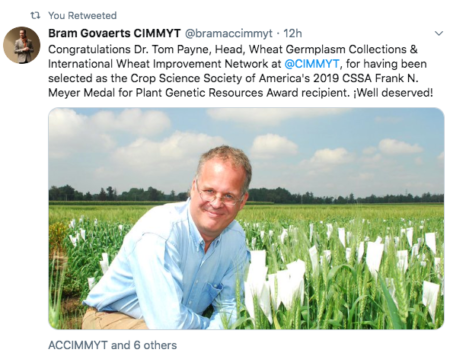
There’s nothing on the website yet, but it looks like Dr Tom Payne, genebank manager at CIMMYT, has been awarded the Frank N. Meyer Medal for Plant Genetic Resources for 2019. This is richly deserved. Congratulations to Tom, who joins a very illustrious club.
Tom will no doubt celebrate in the newly refurbished lobby of the genebank.

Brainfood: More than yield, Cotton breeding, Chickpea genome, Mutations & domestication, Holy Grail, Restoration, Watermelon diversity, Language diversity, Ocimum diversity, Clean cassava, Neolithic feasting, Amazonian agriculture, Sharecropping

Nibbles: Dog & bone, Giant maize, Edible Archive, Myanmar diversification, Colombian community seedbank, Sorghum grande, Coconut exhibit, Chinese ag history, African domestication, Japanese citrus, RivieraLigure DOP, Cactus candy, Hazelnut resistance, American crop rethinks, Public sector engagement

How to succeed at development

And speaking of that particular Brainfood, looking back at it I noticed that three of the papers could perhaps be mashed up. They looked at the impacts of proximity to protected areas, proximity to oil palm plantations and agricultural intensification on different key development outcomes 1. Bringing all the results together suggests that for communities to do really well they need to:

  • be near protected areas
  • be near oil palm plantations
  • have decent access to markets and tourists (i.e. roads)
  • intensify their agriculture from either a very low or a quite high initial level

I now want some GIS whizkid to pinpoint where all these conditions coincide for a veritable perfect storm of well-being.

Stunting as a smoke alarm

Remember that paper on stunting that we included in Brainfood a couple of weeks ago? It was called What Does Stunting Really Mean? A Critical Review of the Evidence, and the answer to the question in the title was, to put it bluntly: not as much as many think.

Why is that important? Well, because “[s]tunting is commonly believed to cause serious problems, including delayed child development, reduced productivity and earnings in adulthood, higher incidence of chronic diseases including obesity or cardiovascular problems, difficult childbirth, and poor birth outcomes such as low birthweight.” But it turns out that this is not entirely true, and “this subtle misinterpretation could harm the global nutrition agenda.”

That’s from a blog post by one of the authors on the IFPRI website, which also includes a handy video explanation of the subtleties involved. Here’s the bottom line: stunting is not so much the fire as the smoke alarm.