- The mango whisperer.
- Conserving the Khola chilli.
- Going back to Fiji for this fundraising meeting next week. Follow along on Twitter.
- Are we on the Titanic?
- Vintage cookbooks galore. If we’re going down, might as well go down in style.
- Jeremy’s podcast on cereal cultivation’s 3-step program for spreading around Eurasia.
Vavilov revisited
Jeremy has an interview with Martin Jones on the latest Eat This Podcast. Dr Jones, Pitt Rivers professor of Archaeology at the University of Cambridge, was an author of the paper on the prehistoric globalization of cereals that we blogged about here a couple of weeks back. Well worth a listen.
Brainfood: Goat genotyping, Chinese goats, Ag & nutrition, Biodiversity & yields, Gendering interventions, Fe biofortification effects, Apple in vitro, Chestnut diversity, Seed collecting, Wild potato evaluation, Veggie kits, Soil biodiversity, Sea urchins, Poinsettia
- AdaptMap: exploring goat diversity and adaptation. Strong geographic structuring.
- Insights into the genetic diversity of indigenous goats and their conservation priorities. “…if one breed could survive in changing conditions all the time, the straightforward approach is to increase its utilization and attraction for production via mining breed germplasm characteristic.” If…
- Leveraging agriculture for nutrition in South Asia: What do we know, and what have we learned? To do its part for nutrition, agriculture needs to play nice with other sectors. Here comes the evidence base.
- A global synthesis reveals biodiversity-mediated benefits for crop production. Service-providing organisms really do provide services.
- Intensifying Inequality? Gendered Trends in Commercializing and Diversifying Smallholder Farming Systems in East Africa. Commercialization good for men, diversification good for women. Maybe do both? And more on commercialization.
- Iron biofortification interventions to improve iron status and functional outcomes. Cognitive performance improved, but no effect on iron deficiency or anaemia. So complicated.
- In vitro tissue culture of apple and other Malus species: recent advances and applications. Lots of tinkering still needed.
- Mediterranean and Northern Iberian gene pools of wild Castanea sativa Mill. are two differentiated ecotypes originated under natural divergent selection. One xeric, the other mesophytic. Satisfyingly uncomplicated.
- Guidelines for seed collection of Araucaria angustifolia (Bertol.) Kuntze: A genetic, demographic and geographic approach. Watch out for fragmentation.
- Screening of wild potato genetic resources for combined resistance to late blight on tubers and pale potato cyst nematodes. 5% of about 1000 very resistant. Another 1000 to go.
- Connecting genebanks to farmers in East Africa through the distribution of vegetable seed kits. Distributing 42,000 seed kits with 183,000 vegetable seed samples in 5 years generates lots of questions.
- Role and management of soil biodiversity for food security and nutrition; where do we stand? We stand uncertain is where we stand.
- Genetic Approaches to Improve Common Bean Nutritional Quality: Current Knowledge and Future Perspectives. Not as nutritious as it could be.
- Trophic Cascade in Seaweed Beds in Sanriku Coast Hit by the Huge Tsunami on 11 March 2011: Sea Urchin Fishery as a Satoumi Activity Serving for Increase in Marine Productivity and Biodiversity. Human-intervention-encourages-biodiversity shock. In other news, Japan has a sea urchin fishery.
- Molecular evidence for repeated recruitment of wild Christmas poinsettia (Euphorbia pulcherrima) into traditional horticulture in Mexico. Fancy genotyping shows plants in gardens were transplanted from the wild. Why not just ask the gardeners though?
The crop wild relatives of North America are done
Congratulations to Colin and all the authors and editors.
https://twitter.com/ColinKhoury/status/1106278018618716162
The wheat in Spain grows all over
The researchers were also able to group Spaniards into five genetic clusters. On a map, these groups form five strips running north to south. Those strips line up neatly with history.
I wonder if you’d get a similar pattern looking at crops, say wheat. There’s lots of material in genebanks to play around with.

LATER: Thanks to David Marshall for pointing out that work has been done on barley.
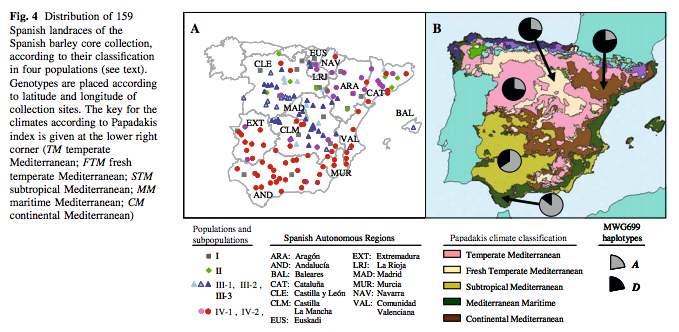
It just needs someone to compare the patterns now. And repeat for other crops.