- Value chains for baskets of products to diversify production and consumption.
- Video lecture on watermelon domestication.
- “…global agricultural productivity needs to increase at an average annual rate of 1.73 percent to sustainably produce food, feed, fiber, and bioenergy for 10 billion people in 2050.
- Maybe crop wild relatives can help? Kenyan media thinks so. This is the project in question, though you wouldn’t know it from the article.
- Somewhat one-sided account of ex situ rice conservation in India. People are looking into some of the claims…
- The Native American Seeds Protection Act of 2019 explained. Fingers crossed.
- Latest newsletters: the European PGRFA network & Genesys.
Wheat diversity for health
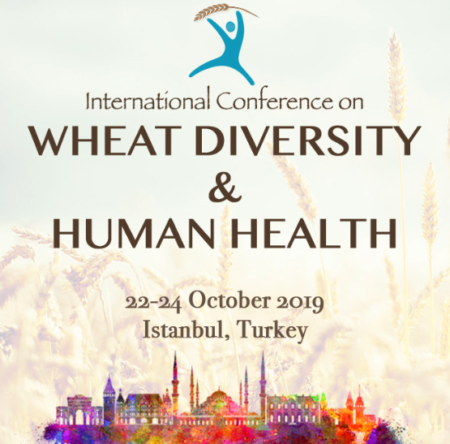
The objective of this conference is bringing the Wheat researchers and the Human Health community together to exchange information and discuss strategies for improving the health benefits of wheat by exploiting diverse genetic resources, modern breeding, genomics, and sustainable production and processing technologies.
You had me at Weißbier.
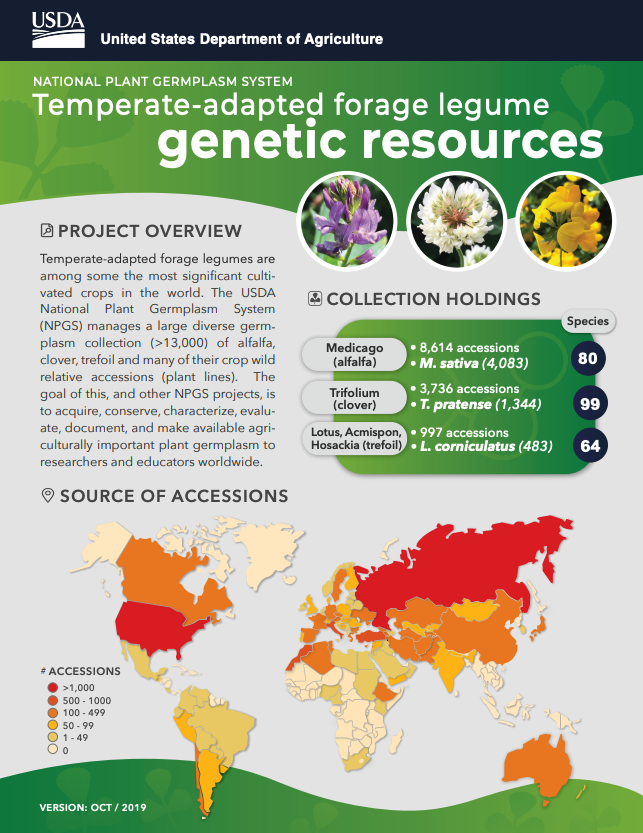
Temperate forages at the NPGS
We just got hold of a very neat infographic summarizing the work of the USDA’s National Plant Germplasm System on the Management of Temperate-adapted Forage Legume Genetic Resources and Associated Information.
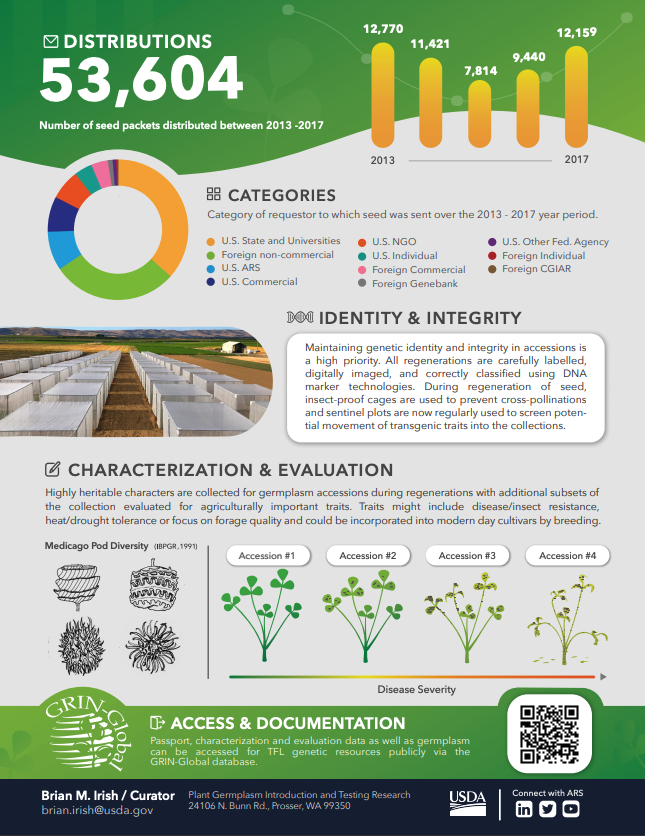
If you were to scan that QR code, you’d get here, and be able to select and order material from the USDA’s GRIN-Global site.
Here’s the distribution of over 6000 USDA-held accessions of Medicago, Trifolium and Lotus with geographical coordinates according to Genesys.
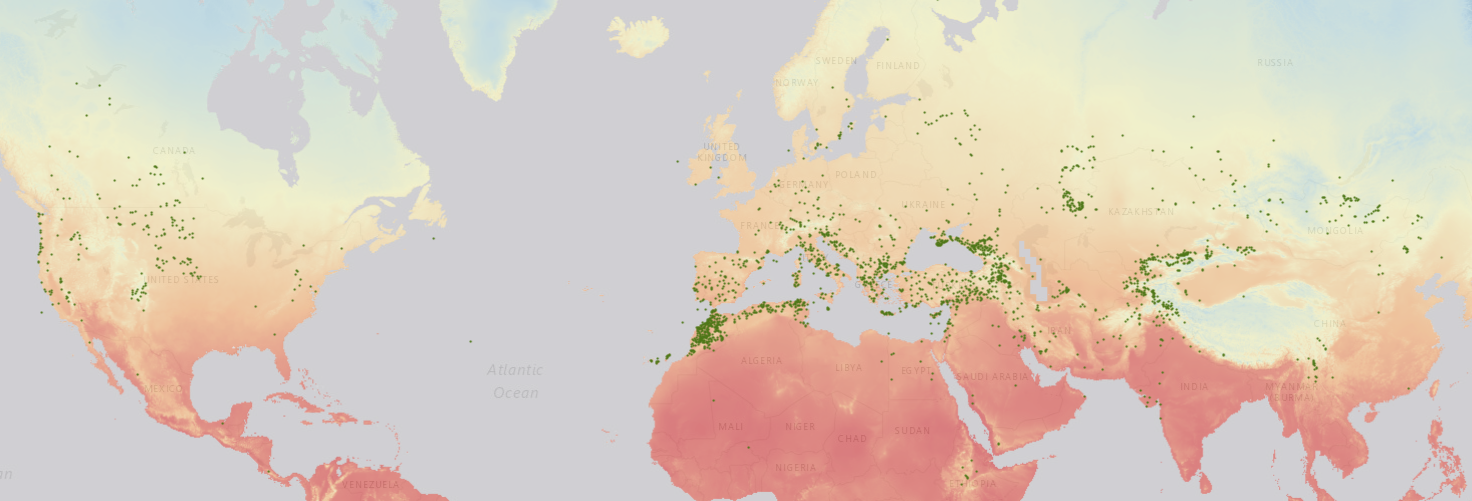
The colours show annual mean temperature.
Brainfood: Diversification, Wheat genomics, Historical tom, Crop mapping, African crops & CC, Trans CWR, Fish nutrition, Seed storage, Indian rice, Food Neighbourhoods, Diet sustainability, Onion evaluation, Aussie wild rice, Rice evaluation
- To diversify or not to diversify, that is the question. Pursuing agricultural development for smallholder farmers in marginal areas of Ghana. Diversify.
- Improving grain yield, stress resilience and quality of bread wheat using large-scale genomics. A genotype –> phenotype map at last. I guess that means breeders are superfluous.
- The earliest recorded tomato in Britain, in Wales. In 1590, no less.
- Biotechnology of the sweetpotato: ensuring global food and nutrition security in the face of climate change. A whole special issue. Our troubles are over.
- Probabilistic global maps of crop-specific areas from 1961 to 2014. A new, different, cooler algorithm provides somewhat different results to older, less cool algorithms.
- Potential adaptive strategies for 29 sub-Saharan crops under future climate change. Climatic conditions not currently experienced by these crops will spread, but CWRs and diversity from outside Africa might help.
- Trans Situ Conservation of Crop Wild Relatives. Just means properly integrated in and ex situ.
- Criar y Dejarse Criar: Trans-Situ Crop Conservation and Indigenous Landscape Management through a Network of Global Food Neighborhoods. See what it means? Scaling up the Parque de la Papa.
- Harnessing global fisheries to tackle micronutrient deficiencies. Small fish from the tropics could be really good for nutrition in some countries. Namibia, I’m looking at you.
- Artificial seed aging reveals the invisible fraction: Implications for evolution experiments using the resurrection approach. Store your seeds properly.
- Status of Rice (Oryza sativa L.) Genepool Collected from Western Ghats Region of India: Gap Analysis and Diversity Distribution Mapping using GIS Tools. Out of 678 rice landraces from this region, 43 have been used in crop improvement.
- Advancing an Integrative Framework to Evaluate Sustainability in National Dietary Guidelines. In 32 sub-dimensions, no less. Important.
- Assembly and characterisation of a unique onion diversity set identifies resistance to Fusarium basal rot and improved seedling vigour. Group according to local daylength.
- Australian wild rice populations: a key resource for global food security. Because they’ve been isolated from the crop.
- Novel method for evaluation of anaerobic germination in rice and its application to diverse genetic collections. No word on whether it’s applicable to Aussie wild species, but I bet it is.
Nibbles: Forages, Zimbabwe policy, Kyrgyz nuts, Warwick vegetables, Asparagus breeder
- Brachiaria is the new Napier grass.
- Zimbabwe has a new seed conservation strategy.
- Agroforestry in Kyrgyzstan.
- Podcast on the Warwick University veggies genebank.
- Award for asparagus breeding. Somebody has to do it…