- Single-gene resolution of locally adaptive genetic variation in Mexican maize. Let the gene editing begin.
- From landraces to improved cultivars: Assessment of genetic diversity and population structure of Mediterranean wheat using SNP markers. Landraces cluster geographically, modern varieties by breeding programme.
- Global evidence of positive biodiversity effects on spatial ecosystem stability in natural grasslands. Higher species richness increases productivity in low-productivity communities, decreases it in high-productivity.
- Understanding the consequences of changes in the production frontiers for roots, tubers and bananas. Forget marketing, focus research on productivity.
- Gendered agrobiodiversity management and adaptation to climate change: differentiated strategies in two marginal rural areas of India. Women exercise more public control over agrobiodiversity in the Himalayas than in the Indo-Gangetic Plain.
- Historical Ecologies of Pastoralist Overgrazing in Kenya: Long-Term Perspectives on Cause and Effect. Let pastoralists move around.
- Mortality impact of low annual crop yields in a subsistence farming population of Burkina Faso under the current and a 1.5°C warmer climate in 2100. Low production in any given year responsible for considerable child mortality, which is likely to double because of climate change. If nothing is done.
- Historical phenotypic data from seven decades of seed regeneration in a wheat ex situ collection. Don’t throw any data away.
- Mapping drought-induced changes in rice area in India. 16% less rice area in a drought year compared to a normal year.
- Development of a Multi-parent Population for Genetic Mapping and Allele Discovery in Six-Row Barley. Asian material has flowering time variants found nowhere else.
- Ex situ collections and their potential for the restoration of extinct plants. There’s no excuse for not trying in situ.
- Assessing the remarkable morphological diversity and transcriptomic basis of leaf shape in Ipomoea batatas (sweetpotato). Mainly genetic, at least as currently measured.
- An Improved Phenotyping Protocol for Panama Disease in Banana. A single person can now inoculate 250 plants per hour.
- Dichotomous keys to the species of Solanum L. (Solanaceae) in continental Africa, Madagascar (incl. the Indian Ocean islands), Macaronesia and the Cape Verde Islands. Monumental.
Brainfood: Mineral history, Tomato nutrients, Tomato breeding, Phenotyping plants, Restoration genomics, Green Revolution, Banana B, SPAM2005, Ancient Chinese wheat, Late blight, Sorghum seed size, N & stability, African cannabis, Brazil wheat, Wild safflower
- Mineral nutrient composition of vegetables, fruits and grains: The context of reports of apparent historical declines. Apparent being the operative word. This is a couple of years old but always worth recycling. (There’s also this Politico piece from a couple of years back on the “nutrient collapse.”)
- Phenolic composition and antioxidant properties of ex-situ conserved tomato (Solanum lycopersicum L.) germplasm. But there’s always room for improvement.
- Genetic Diversity and Population Structure of Tomato (Solanum lycopersicum) Germplasm Developed by Texas A&M Breeding Programs. Plenty of diversity out there for it.
- Crop productivity as related to single-plant traits at key phenological stages in durum wheat. On isolated plants, only specific leaf weight and spike partitioning at anthesis were correlated with population yield.
- The potential of genomics for restoring ecosystems and biodiversity. From improved seed sourcing to gene editing for funky genotypes.
- Was the Green Revolution intended to maximise food production? No, apparently it was to encourage a move to commercial production in specific areas.
- Musa balbisiana genome reveals subgenome evolution and functional divergence. The starch synthesis pathway is more active than in the A-subgenome. There’s probably more, but that’s all I could understand.
- Pixelating crop production: Consequences of methodological choices. Crop prices and market access had little effect on the robustness of the SPAM2005 spatial production allocation model.
- Phylogenetic and population structural inference from genomic ancestry maintained in present‐day common wheat Chinese landraces. 3000 old wheat not dissimilar to current landraces in W China.
- Stacking three late blight resistance genes from wild species directly into African highland potato varieties confers complete field resistance to local blight races. But it’s GM so it doesn’t count, right?
- Genomic signatures of seed mass adaptation to global precipitation gradients in sorghum. Drought stress led to bigger grains.
- Nitrogen addition reduced ecosystem stability regardless of its impacts on plant diversity. Stability depends on more than just diversity. In grasslands.
- A brief agricultural history of cannabis in Africa, from prehistory to canna-colony. Decolonise the weed.
- Genetic Gain Over 30 Years of Spring Wheat Breeding in Brazil. 1.3% per year. Is it enough? Can it be sustained?
- The Use of Wild Relatives of Safflower to Increase Genetic Diversity for Fatty Acid Composition and Drought Tolerance. So transgressive.
Nibbles: Mango diversity, Feral hogs, OFSP, Synthetic kava, Linen, Posters, Pigeonpea pre-breeding, Breeding, Ancient yeast, European seeds
- Nevis has 44 kinds of mango, including Amory Polly, which could actually be Amrapali आम्रपाली.
- A twitter thread on “hogs, ferality, and race in American history.” If that doesn’t make you click nothing will.
- “Can sweet potatoes reduce widespread vitamin A deficiency in Africa?” Guess.
- The end of kava as we know it?
- Making linen.
- Better scientific posters? Here’s hoping.
- Pigenonpea pre-breeding lines hit the bigtime.
- Mapping fires from space. Part of an early warning system for crop wild relatives?
- Roundup of how some breeders are preparing crops for climate change.
- No expiration date on yeast.
- A couple of European crop diversity projects: DYNAVERSITY and ReSEED.
Rapid calculation of threat status online
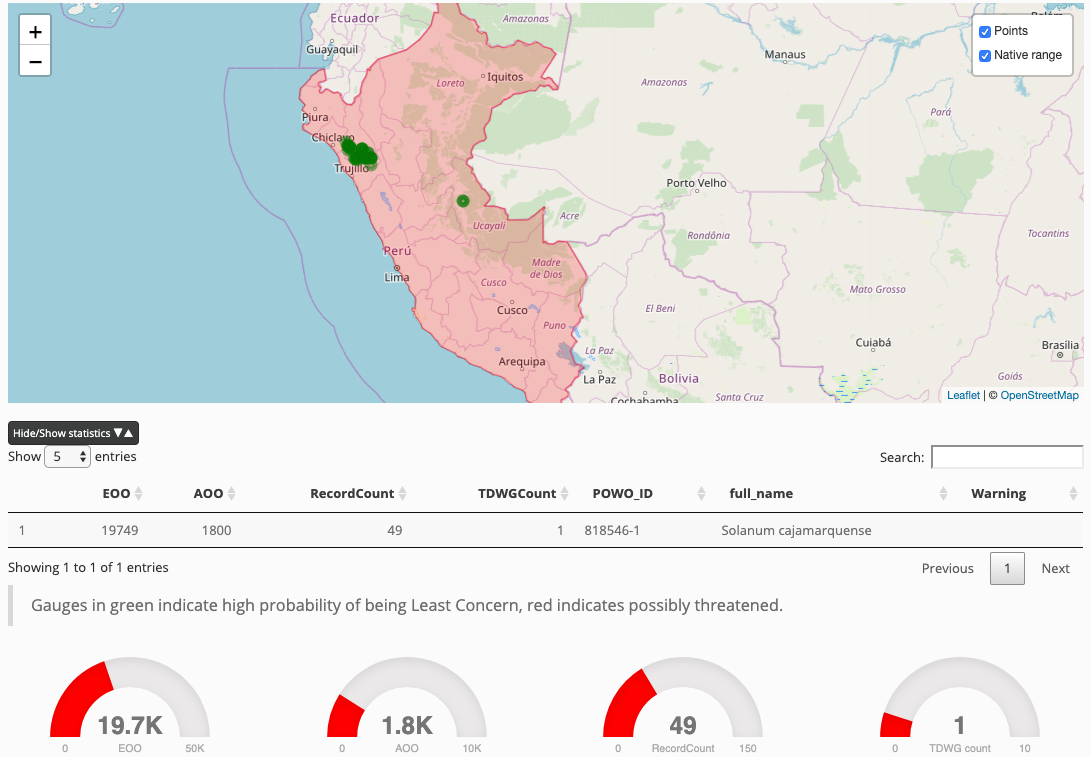
Do you need to get a quick idea of the threat status of a species in the wild? Well, there’s now an online tool that does it for you in a jiffy: Rapid Least Concern. You just type in a species name or import a batch of names, and the thing goes off to GBIF and returns with a bunch of records which it then uses to calculate 4 different indicators, including Area of Occupancy (AOO) and Extent of Occurrence (EOO). It also gives you a map. Here’s the result for Solanum cajamarquense, a wild potato relative. Looks like it could be in trouble…