- FoodTank does crop wild relatives.
- “The inveterate collector who understand the poetics of diversity had left behind a new plant unknown to science.”
- That “inveterate collector” would probably approve of this.
- A VERY tasty grass.
- Chew on that spinifex while burning this stuff for the full botanical multi-sensory experience..
- Pacific people told to cultivate their gardens for health and nutrition. And climate change adaptation.
- Progress on Farmers’ Rights. Incremental, but still.
- The unsung heroes of germplasm distribution get together.
- Reviving the fortunes of NY hops through fancy breeding.
- Too much plant protein is going to animals, so let’s give them insects instead.
- Because animals are bad for equality anyway.
Seeds in motion
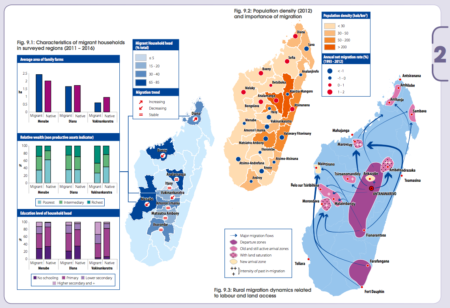
I guess it’s an occupational hazard, but whenever I see such maps, as in the new atlas Rural Africa in motion. Dynamics and drivers of migration south of the Sahara from FAO, my first question is: how many of those people are carrying seeds?
A modicum of Indian rice diversity
https://twitter.com/RiceResearch/status/930374790480723968
Always good to see a politician visiting a genebank.
And that 18,161 should be 18,163 now I guess.
Brainfood: Landrace adaptation, Scarascia Mugnozza, Scuba rice, Pineapple pollen, Wild French carrots, Saudi chickens, Fava diversity, Banana ripening, Wild wheat, Bavarian vetch
- Towards the Genomic Basis of Local Adaptation in Landraces. Genomic scans for adaptation will solve everything.
- International Instruments for Conservation and Sustainable Use of Plant Genetic Resources for Food and Agriculture: An Historical Appraisal. The Italian connection.
- Genetic potentiality of indigenous rice genotypes from Eastern India with reference to submergence tolerance and deepwater traits. There’s much polymorphism at Sub1 linked microsatellite loci.
- Cryopreservation of pollen of wild pineapple accessions. Complementarity rules!
- Genetic diversity and taxonomic aspects of wild carrot in France. Someone’s a splitter.
- Characterisation of Saudi native chicken breeds: a case study of morphological and productive traits. All like it hot.
- SSR analysis of genetic diversity and structure of the germplasm of faba bean (Vicia faba L.). Separate Middle Eastern and N+E African groups. Pass the chianti.
- Natural variation in banana varieties highlights the role of melatonin in postharvest ripening and quality. So does that mean that you could market some varieties as a jetlag cure?
- Genetic Characterization of Genetic Resources of Aegilops tauschii, Wheat D Genome Donor, Newly Collected in North Caucasia. Confirmation of two genepools within the species.
- Do seed transfer zones for ecological restoration reflect the spatial genetic variation of the common grassland species Lathyrus pratensis? Not in Bavaria.
Malagasy yams win internet
Dioscorea bako (EN, IUCN) #OviGasy the most yam apprecieted by Menabe #Madagascar people and cultivated and conserved through the KMCC project @TeamKMCC pic.twitter.com/kmCRruuXlK
— Mamy Tiana Rajaonah (@RajaonahMamy) November 10, 2017
Seeing this amazing yam on Twitter reminded me that it’s about time I gave a shout-out to the project “Conserving Madagascar’s yams through cultivation for livelihoods and food security,” being coordinated by Kew with funding from the Darwin Initiative. It’s really active on Twitter, as you can see, but has also been churning out scientific publications. What I can’t quite figure out is whether there’s a formal ex situ conservation component, and perhaps even some linkages to breeders of cultivated yams.
LATER: The best way to follow the exploits of the yam team in Madagascar is to use the hashtags #AprilTrust and #OviGasy.