- Dutch lettuce collection to be sequenced.
- Ah yes, the Dutch are real seed visionaries.
- Durian next?
- Maybe jackfruit?
- We should never have given up being hunter-gatherers.
- But then we wouldn’t have watermelons. Or, later in the year, pumpkins.
- Or wine.
Reports galore for the CFS
It’s the time of year for major reports, I guess. Here’s what’s on the table:
- HLPE. 2017. Nutrition and food systems. A report by the High Level Panel of Experts on Food Security and Nutrition of the Committee on World Food Security, Rome.
- FAO. 2017. The State of Food and Agriculture 2017 — Leveraging food systems for inclusive rural transformation. FAO, Rome.
- IPES-Food. 2017. Unravelling the Food–Health Nexus: Addressing practices, political economy, and power relations to build healthier food systems. The Global Alliance for the Future of Food and IPES-Food.
You can follow the discussion on all these and more on the webcast of the 44th session of the Committee on World Food Security.
Maybe we should just have stayed hunters and gatherers?
Brainfood: Antioxidant adzuki, Sorghum gaps, Natural rubber diversity, Non-flying geese
- Phytochemical distribution and antioxidant activities of Korean adzuki bean (Vigna angularis) landraces. A cluster of about 10% of 200 Korean landraces have higher antioxidant activity, and smaller seeds. Watch them take over the world.
- Sorghum germplasm from West and Central Africa maintained in the ICRISAT genebank: Status, gaps, and diversity. Lots of gaps, but Nigeria isn’t one of them.
- A century of guayule: Comprehensive genetic characterization of the US national guayule (Parthenium argentatum A. Gray) germplasm collection. The future of natural rubber is in Texas.
- Contribution of both positive selection and relaxation of selective constraints to degeneration of flyability during geese domestication. Wild geese chased no longer due to strong selection on mitochondrial respiratory chain genes.
Brainfood: Hot seeds, Diet diversity double, Finger millet GxE, Botanical gardens, CWR prebreeding double, Pathogen spread, Dog genomics, Cryo calculations, Biodiversity & productivity double, Movies & conservation
- High-temperature stress during drying improves subsequent rice (Oryza sativa L.) seed longevity. Up to 45°C, because it triggers a stress protection mechanism.
- Agricultural diversification and dietary diversity: A feminist political ecology of the everyday experiences of landless and smallholder households in northern Ghana. Production diversity at the farm level is necessary for dietary diversity, but not sufficient.
- Critical review of the emerging research evidence on agricultural biodiversity, diet diversity, and nutritional status in low- and middle-income countries. Production diversity at the farm level has a small but consistent positive association with dietary diversity.
- Exploiting Genetic Diversity for Adaptation and Mitigation of Climate Change: A Case of Finger Millet in East Africa. Some varieties are good everywhere, others only good in some places.
- Ex situ conservation of plant diversity in the world’s botanic gardens. A third of all known plants, and half of endangered ones, are to be found in botanic gardens, but the tropics are under-represented.
- Prebreeding Using Wild Species for Genetic Enhancement of Grain Legumes at ICRISAT. It’s a drag, but someone has to do it.
- Wide crosses of durum wheat (Triticum durum Desf.) reveal good disease resistance, yield stability, and industrial quality across Mediterranean sites. Not such a drag after all.
- Quantifying airborne dispersal routes of pathogens over continents to safeguard global wheat supply. Incredibly fancy maths says Yemen is the key.
- Demographic history, selection and functional diversity of the canine genome. There’s a lot here, in particular the genes that were involved in early phenotypic differentiation from wolves, and evidence of continuous geneflow with wilds canids. But the thing that really got me is that humans and dogs show parallel evolution in the ability to process complex carbohydrates, associated with agriculture.
- Probabilistic viability calculations for cryopreserving vegetatively propagated collections in genebanks. One Excel spreadsheet to rule all cryo.
- Biodiversity effects in the wild are common and as strong as key drivers of productivity. Meta-analysis of observations in nature supports results of experimental work.
- Biodiversity promotes primary productivity and growing season lengthening at the landscape scale. “…a large species pool is important for adaption to climate change.” An example of the above.
- Considering connections between Hollywood and biodiversity conservation. Conservationists need to get out more.
Massive expectations for MOOC on climate change adaptation
UNDP, FAO and UNITAR have just announced a Massive Open Online Course (MOOC) on National Adaptation Plans Building Climate Resilience in Agriculture. It starts 13 November.
If you want to learn from development professionals currently engaged in national adaptation planning and agriculture, then this 6-week course is for you.
I opened the syllabus with trepidation, but it does look like the role of agricultural biodiversity will be addressed.
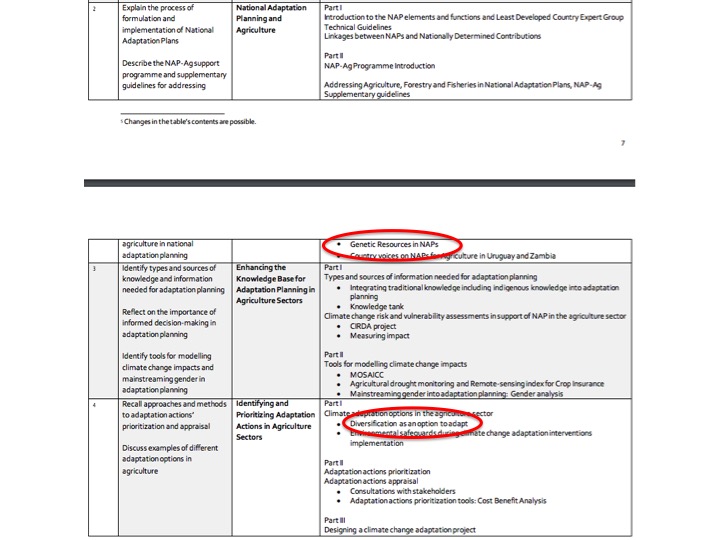
If any of our readers decides to take the course, we’d be happy to help them share their experiences here.