- Pinning down transposable elements across the whole maize genome.
- Wine and weed in Lebanon. Not as mellow as it sounds.
- Yields and Land Use in Agriculture: The Website.
- The effect of all those yields times 12,000 years on C sequestration is about as much as that of deforestation.
- Ancient Roman 1% responsible for introducing the citron and lemon to the Mediterranean.
- Flowering duration and pod numbers are they keys to heat tolerance in peas.
- 94% of US dairy cows are Holsteins. How boring is that?
Nibbles: Genomic taxonomy, AI taxonomy, Apple history, Polo on sago, Quinoa cooking, Super-crap, Funding conservation, Coffee conservation
- Boffins sequence plant in field for real-time identification.
- Boffins decide machines do identification better.
- Boffins trace apple domestication to Silk Road.
- Famous Silk Road traveller on sago.
- Thinking up fun ways of cooking another pretty tasteless staple.
- Did someone mention super-foodszzzzzzz.
- Mongabay: Africa needs creative conservation funding approaches.
- Emily Garthwaite: Hold my latte.
When do people search for coconut?
Or any other food, for that matter, at least in the US. Well, now there’s The Rhythm of Food for all the answers, in nice visualizations to boot.
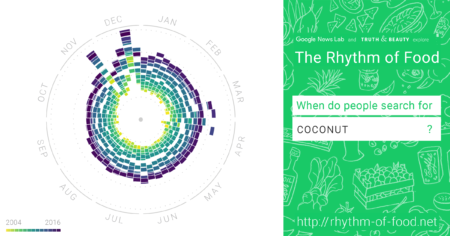
And if anyone knows why Americans do more searching for coconut during the winter holidays, and then again in spring, do tell us.
Brainfood: Temperate maize, Pre-Neolithic Revolution, Social media, European maize
- Genomic estimation of complex traits reveals ancient maize adaptation to temperate North America. “The diversity needed for high altitudes was there, but getting it in the right combination took 2,000 years,” says ancient maize DNA.
- The deep human prehistory of global tropical forests and its relevance for modern conservation. There were “garden cities” in the tropical forests of equatorial Africa, South Asia, and Southeast Asia starting 45,000 years ago.
- An Introduction to Social Media for Scientists. Choose wisely.
- Is there an optimum level of diversity in utilization of genetic resources? It depends.
Brainfood: Sustainability index, Beet wild relative, Participatory goats, Sarma, Wild wheat & drought, Ahipa conservation, Saving genebanks, Chinese cattle, Bolivia & CC, Seed systems, Cereal residues
- Sustainability assessment of agricultural systems: The validity of expert opinion and robustness of a multi-criteria analysis. Experts know their stuff.
- Genetic diversity of Patellifolia patellaris from the Iberian Peninsula, a crop wild relative of cultivated beets. 271 individuals, 10 sites, maybe 3 genetic groupings?
- Production system and participatory identification of breeding objective traits for indigenous goat breeds of Uganda. Resistance to biotic and abiotic stresses are the priority.
- Plant diversity for sarma in Turkey: nature, garden and traditional cuisine in the modernity. 73, including 3 endemics.
- Identification of ecogeographical gaps in the Spanish Aegilops collections with potential tolerance to drought and salinity. Evaluation avant la lettre.
- Trends and drivers of on-farm conservation of the root legume ahipa (Pachyrhizus ahipa) in Bolivia over the period 1994/96–2012. Price is too low.
- The Vulnerability of Plant Genetic Resources Conserved Ex Situ. The problem: “…genebanks around the world are generally under stress, largely from inadequate public investment, weakened political support, and insufficient stakeholder engagement.” The solution: privatization, commodification, consolidation, prioritization, communication.
- Species composition and environmental adaptation of indigenous Chinese cattle. Taurine-indicine cline N-S, with traces of banteng, gayal and yak.
- Climate change and crop diversity: farmers’ perceptions and adaptation on the Bolivian Altiplano. Maintaining multiple varieties still done, despite not seen as climate adaptation.
- A Risk Assessment Framework for Seed Degeneration: Informing an Integrated Seed Health Strategy for Vegetatively Propagated Crops. Actually not seed, but rather what to do about pathogen build-up in vegetative planting material. Turns out farmers can be quite good at producing clean material if they can choose healthy plants.
- New criteria for the molecular identification of cereal grains associated with archaeological artefacts. Alkylresorcinols, basically.