- A new, better apple genome. I thought once it was done, it was done. Clearly not.
- An FBI agent on the tracks of old apples. No need for high quality genomes.
- Getting to the bottom of the Honeycrisp.
- It’s the rootstocks, stupid.
- What made Milwaukee famous is not heirloom apples, but still.
- Let’s not forget the crab apple, shall we?
Genetic erosion statistic in the dock
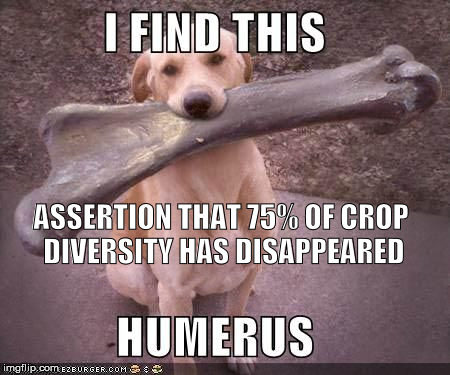
Colin is pissed:
Or, to put it more succinctly, stop complaining and propose something better!
Something better than
“In the past century, the number of crops and their varieties, and the genetic diversity within them, has declined as a general trend in farmers’ fields around the world.”
to be precise. Which is in turn supposed to be better than the 75% genetic erosion number, which is a fake statistic whose origin Cary Fowler points out in another comment.
Ok, I’m game, give me a few days.
And meantime, thanks for the meme.
Who moved my rice?
In reply to our plea for a definitive crop distribution dataset, Andy Nelson, who used to work at IRRI and is now at the University of Twente, had this to say in a comment.
Well, this may be one way to go.
Compiling the best expert information with subnational statistics as a first cut and then using that to guide further detailed mapping with remote sensing/big data.
I’d like to see more efforts in crowdsourcing for crop mapping as well.
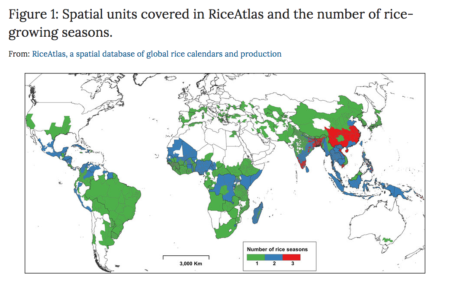
“This” is “RiceAtlas, a spatial database of global rice calendars and production.” 1
Because of the need to develop a spatially explicit global database of rice calendars that includes detailed information on rice areas with more than one rice crop in a year, we compiled the most detailed available datasets of rice planting and harvesting dates by growing season in all rice-producing countries, and linked the database to subnational production data. ‘RiceAtlas’ provides a spatial and seasonal distribution of the world’s rice production. RiceAtlas contributes to the GEOGLAM (Group on Earth Observations Global Agricultural Monitoring) initiative and regional partnerships, such as the Asian Rice Crop Estimation and Monitoring initiative (Asia-RiCE), by providing information for agricultural monitoring requirements, satellite data acquisition plans, and global crop outlook.
Here’s what it looks like.
With regards to crowdsourcing, there are various initiatives out there that could be relevant, including Geo-Wiki‘s Field Size Campaign.
Anyway, no doubt the RiceAtlas will eventually end up on the website of the CGIAR’s Consortium for Spatial Information. One bit of this, the SRTM 90m Digital Elevation Data, made a recent list of Top 15 Free GIS Data Sources.
Brainfood: CWR prioritization, CWR data, Yam core redux, Traditional landscape value, African rice domestication, Digital conservation, First farmers, Revived breed, Mitigation targets, Zoonoses, Population, JEB on legumes
- Broadening the Base, Narrowing the Task: Prioritizing Crop Wild Relative Taxa for Conservation Action. Use socioeconomic value of crop, and potential usefulness and threat status of relative.
- Germinate 3: Development of a Common Platform to Support the Distribution of Experimental Data on Crop Wild Relatives. Useful in determining the second of the above.
- Re-defining the yam (Dioscorea spp.) core collection using morphological traits. Cleaning up the core.
- “Things are different now”: Farmer perceptions of cultural ecosystem services of traditional rice landscapes in Vietnam and the Philippines. 73 indicators for the contribution of landscapes to culture, aesthetics, and local knowledge.
- A single-nucleotide polymorphism causes smaller grain size and loss of seed shattering during African rice domestication. You want no shattering? You also get smaller seeds. Like it or edit it.
- Digital conservation: An introduction. Brave new world… Special issue of Ambio.
- The Genomic History Of Southeastern Europe. Souther Greek Neolithic farmers not same as other European Neolithic farmers.
- Genomics of a revived breed: Case study of the Belgian campine cattle. Racial impurities are confined to a few farms.
- Reducing emissions from agriculture to meet the 2 °C target. We’re doomed.
- Conservation of biodiversity as a strategy for improving human health and well-being. By keeping animals and their nasty diseases away from people, we’re not talking communing with Nature here.
- The interaction of human population, food production, and biodiversity protection. Minimise the interaction.
- Nature’s pulse power: legumes, food security and climate change. Special issue of Journal of Experimental Botany on legumes. Eat up your beans!
Good question?
Why can't @DeccanChronicle and @cnni get the right photo of crops? Originals: https://t.co/Rnk2PueDwi and https://t.co/yu3kDLhYqB pic.twitter.com/npPx0zVEXN
— AgroBioDiverse (@AgroBioDiverse) May 30, 2017