- Iron beans in Rwanda: crop development and delivery experience. 800,000 households, discontinuation rate 11%. But the health outcomes? Too early, I guess.
- Phylogenetic origin of limes and lemons revealed by cytoplasmic and nuclear markers. It’s so VERY complicated.
- Seed producer cooperatives in the Ethiopian seed sector and their role in seed supply improvement: A review. Sitting between the formal and informal seed systems, they “play a key role in meeting seed demand and contribute greatly to seed supply improvement through high-volume production of seed, crop, and variety diversification, and seed delivery to farmers.”
- Gamification of farmer-participatory priority setting in plant breeding: Design and validation of “AgroDuos”. Based on pairwise ranking. I remember doing it by hand, but it’s nice to have the app. And there’s more.
- Emerging Avenues for Utilization of Exotic Germplasm. It comes down to the collections being better characterized and understood.
- Genetic resource policies in international collaborative research for food and agriculture: A study of USAID-funded innovation labs. Transaction costs are rising. Well, yeah.
- Plums: A Brief Introduction. Will keep you regular.
- Characterization and phylogenetic analysis of ancient Italian landraces of pear. Some synonyms found, some unknown things identified. All very worthy.
- Genetic diversity and a population structure analysis of accessions in the Chinese cowpea [Vigna unguiculata (L.) Walp.] germplasm collection. The Chinese stuff is different to the African stuff.
- Out of Borneo: biogeography, phylogeny and divergence date estimates of Artocarpus (Moraceae). Yeah but how many can you eat?
- Effective seed harvesting strategies for the ex situ genetic diversity conservation of rare tropical tree populations. “…fewer seeds from each of a larger number of trees, … from peripheral subdivided regions of the population.”
Victory declared in Strawberry Wars
A federal jury has ruled in favor of the University of California in its lawsuit with two former UC Davis strawberry breeders and the private breeding company they created with UC-owned plants. A separate jury is expected to decide issues related to damages at a later time.
About time. It’s been quite a ride.
Featured: Mexican beans
Paul Gepts, who should know, says that the bit of Mexico featured yesterday is pretty important:
This particular area of the state of Jalisco is part of the proposed Mesoamerican center of domestication of common bean (Kwak et al. 2009 Crop Sci.).
Here’s the relevant quote from that paper:
In the Mesoamerican gene pool, a single cluster groups most of the domesticated type, which confirms previous observations suggesting a single domestication located in the state of Jalisco form this gene pool (Gepts et al. 1986; Papa and Gepts 2003; Kwak et al. 2009).
Nibbles: Participatory research, Plant breeding 101, Seed systems webinar, Hot pepper, Heritage Breed Week, Girardinia fibre, Chocolate high, Avocado history, Pollinator heist
- Participate!
- In plant breeding, that is.
- And seed systems too, natch.
- And you too could come up with the world’s hottest pepper.
- Or help save a heritage breed.
- Or sustainably harvest Himalayan nettle.
- But careful not to get high on this chocolate hack.
- Though binging on avocado is perfectly acceptable.
- And for goodness’ sake, watch out for those Russians.
Mexican PGR from the air
The Atlantic had a feature last week on the Human Landscapes of Mexico showing Google Maps shots of different parts of the country. This kind of thing:
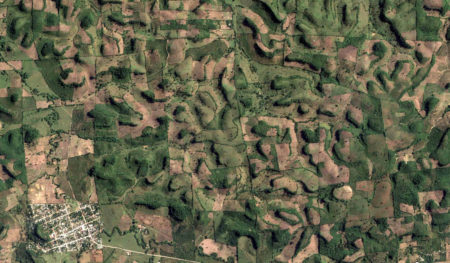
I mashed them up in Google Earth with the distribution of crop wild relatives, downloaded from Genesys. This is what I got for the environs of Guadalajara. The yellow dot is the site of the photo in The Atlantic‘s photo essay, the red circles collecting sites, mostly of wild beans.
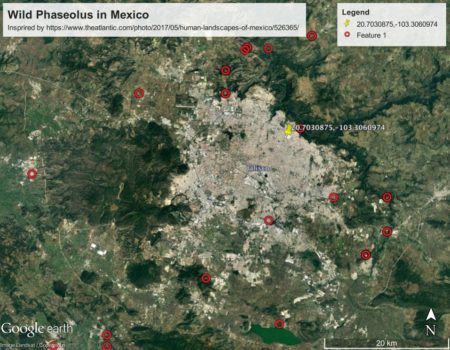
Good thing those populations are in genebanks.