Brainfood: CWR use, Mainstreaming, Duplicates, Phaseolus model, Cherimoya diversity, Legume mixtures, ICRISAT pearl millet, Taste breeding, Rhubarb rhubarb, Plasticity, Seed dispersal
- The Use of Crop Wild Relatives in Maize and Sunflower Breeding. In maize, unlike sunflower, it just hasn’t been worth it. Yet.
- Securing sustainable and nutritious food systems through mainstreaming agricultural biodiversity: an interdisciplinary study. What works in Brazil won’t necessarily fly in India.
- Duplication assessments in Brassica vegetable accessions. Half of 13 accession pairs/triplets with identical names from VIR and NordGen turned out to be morphologically identical.
- Beans (Phaseolus ssp.) as a Model for Understanding Crop Evolution. 7 independent domestication “events” spread across 5 species and 2 continents makes for some interesting natural experiments.
- A Mesoamerican origin of cherimoya (Annona cherimola Mill.). Implications for the conservation of plant genetic resources. Compare and contrast with above.
- Highly productive forage legume stands show no positive biodiversity effect on yield and N2-fixation. Sometimes diversity doesn’t add much.
- Genetic Resources of Pearl Millet: Status and Utilization. 22,888 accessions from 51 countries. Indian landraces: earliness, high tillering, high harvest index and local adaptation; African: bigger panicles, large seed size, and disease resistance.
- Use of natural diversity and biotechnology to increase the quality and nutritional content of tomato and grape. Both are needed.
- Rhubarb (Rheum species): the role of Edinburgh in its cultivation and development. From China, via Russia, with love.
- Will phenotypic plasticity affecting flowering phenology keep pace with climate change? If the change is smaller than about 13 days.
- Seed dispersers help plants to escape global warming. Because they move seed >35 m per decade uphill.
Alright already

You see a grumpy plant biologist. Ask them what stomata? #PlantDay @RoyalSocBio pic.twitter.com/hM7MRyx9my
— Mr C (@mintchemistry) May 17, 2017
Nibbles: Wheat-barley hybrid, Father of Wheat Revolution, Medieval bread, Tomato history, SOWP2, Domestication, Red Data, Taro benefits, Hummus!, Textile book, Healthy rice, Avocado Wars
- Tritodendrum hits the market.
- DS Athwal would have approved. RIP.
- Medieval bakers too, I bet.
- Want some cherry tomatoes on your bread? No? Try these then.
- Lots of crop wild relatives among newly discovered plants. See (some of) them on the new State of the World’s Plants report from Kew. And no, Kew, none of them are “miserable.”
- Early farmers unintentionally produced vegetables with larger seeds simply by cultivating them. And cereals too.
- Head of IUCN Red Data List Unit in impassioned plea for IUCN Red Data List process.
- What is taro good for? I’m glad you asked.
- I missed International Hummus Day? How could this happen?
- Textilia Linnaeana! What do you mean I’ve just had my birthday?
- Lowering the glycemic index of rice for the Chinese market.
- Fighting for avocados. Literally.
Indian nutrition and crop diversity link ready to be explored
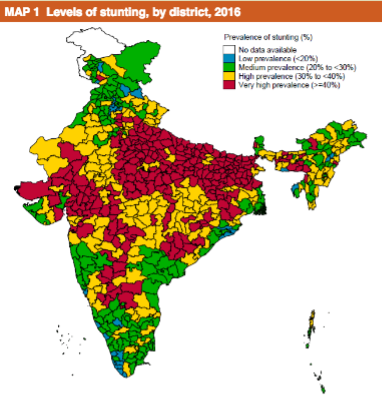
Is there a relationship between levels of stunting in Indian districts…
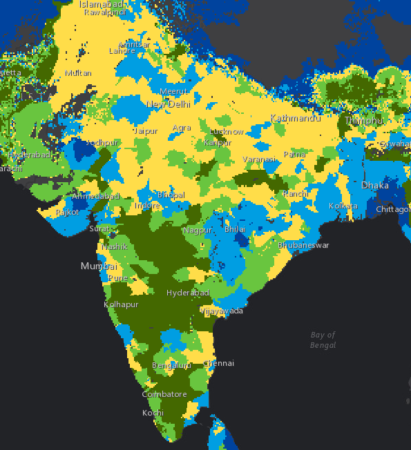
…and crop diversity in their farming systems (blue low, green high)?
I have no idea. But I think we should be told.