- Multiple origins and a narrow genepool characterise the African tea germplasm: concordant patterns revealed by nuclear and plastid DNA markers. It’s a “potpourri,” but kinda missing Chinese Assam stuff.
- The eastern part of the Fertile Crescent concealed an unexpected route of olive (Olea europaea L.) differentiation. It was in Iran before domestication.
- Identifiers for the 21st century: How to design, provision, and reuse persistent identifiers to maximize utility and impact of life science data. Why DOIs succeeded, and why something like them needs to be applied to biological specimens, including genebank accessions, to combat “desultory citation practices”. But we knew that.
- Speed breeding: a powerful tool to accelerate crop research and breeding. Can double the number of generations per unit time with fully-enclosed controlled-environment growth chambers.
- Evidence for two domestication events of hyacinth bean (Lablab purpureus (L.) Sweet): a comparative analysis of population genetic data. With the 2-seeded group domesticated in Ethiopia, the 4-seeded somewhere else in Africa.
- Refinement of the collection of wild peas (Pisum L.) and search for the area of pea domestication with a deletion in the plastidic psbA-trnH spacer. Maybe not Turkey.
- The effectiveness of celebrities in conservation marketing. Use carefully, and evaluate.
- Cannabis in Eurasia: origin of human use and Bronze Age trans-continental connections. Proto-Indo-Europeans were real stoners.
- Analysis of Three Sugarcane Homo/Homeologous Regions Suggests Independent Polyploidization Events of Saccharum officinarum and Saccharum spontaneum. It’s really complicated, not least because of plant breeders.
- Genomic Comparison of Indigenous African and Northern European Chickens Reveals Putative Mechanisms of Stress Tolerance Related to Environmental Selection Pressure. African chickens able to withstand high temperatures due to a region on chromosome 27 and European chickens low temperatures due to region on chromosome 2.
CILY in cassava: not so fast
So it turns out the article the previous post on the possibility of Côte d’Ivoire lethal yellowing phytoplasma (CILY) attacking cassava in that country may have been a bit premature. Dr Lava Kumar, virologist and Head of Germplasm Health Unit at IITA, left the following comment on my Facebook page:
Misleading! The symptoms on these leaves are typical cassava mosaic. Authors of this study happened to detect CILY in CMD infected plants and left it loose for interpretation. Reports of this kind can create needless phytosanitary bottlenecks. Wish NDR editorial review was better.
Time to wheel on Koch’s Postulates?
CILY jumps to cassava?
You know that disease that we said about a year ago was threatening coconut plantations (and, incidentally, a coconut genebank) in Côte d’Ivoire? Yeah, Côte d’Ivoire lethal yellowing phytoplasma (CILY) that’s the one, well remembered.
Well, it looks like it may be affecting cassava as well.
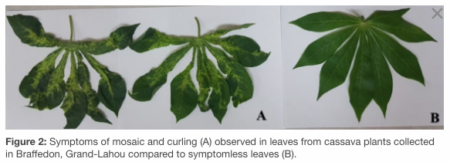
That’s not good. Not good at all.
To our knowledge this is the first report of a phytoplasma affecting cassava in Côte d’Ivoire. The findings suggest that cassava may be a potential alternative host for the CILY phytoplasma, which poses a serious threat for the food security of the smallholder coconut and cassava farmers, especially women in Grand-Lahou, Côte d’Ivoire.
Nibbles: Dwarf rice, Ricestoration, Tarostoration, Biorepositories, Sustainable coffee, Cactus wars, Goaty portraits, Spandrels, Potato genebank, Forests and nutrition
- The long and short of Green Revolution rice.
- Restoring historical slave-worked rice fields in North Carolina.
- Kinda similar, but taro in Hawaii.
- There’s a bank for milk diversity.
- Nice review of sustainable coffee production.
- Opuntia: tasty but deadly (to some).
- Handsome goat pix.
- Festoons of fruits at the Farnesina: Jeremy is incensed.
- Great new webpages for the CIP genebank.
- Another report on a report that living close to forests is good for nutritional security, up to a point. But bushmeat?
Nibbles: Visionary edition
- New guy in charge Peter Wenzl gives us his vision for the CIAT genebank.
- Agriculture and Irrigation Minister of Peru gives us his vision for the Peruvian genebank.
- CIMMYT’s annual report gives us a vision of conserving maize in Guatemala.
- Farmer Somashekhara gives us his vision for finger millet farming in India. And two makes a trend…
- Retired agriculture expert Malcolm Hazelman gives us his vision for Samoan gardens.
- A Tagorean vision of radical relocalization involving perennial edimentals.
- Lots of people give us their vision for saving the wild apple.
- IFPRI gives us their vision for the future of food in a changing world. With infographic goodness.
- Natalie Mueller et al. give us their vision for reviving the forgotten crops of the Eastern Agricultural Complex.
- A vision of a planet protected in situ, in multiple ways. Yes, even pigeons. And yes, even cities, though agrobiodiversity neglected as usual.
- A vision of permanent identifiers everywhere.
- DNA gives us a vision of domestication explained. Yes, even sugarcane.