Jay Bost has an interesting question on American coconuts:
Anyone ever explore possibility of dispersal of coconut to Americas by Polynesians? Given movement of sweet potato and chickens, any chance they brought coconut?
Anyone?
Agricultural Biodiversity Weblog
Agrobiodiversity is crops, livestock, foodways, microbes, pollinators, wild relatives …
Jay Bost has an interesting question on American coconuts:
Anyone ever explore possibility of dispersal of coconut to Americas by Polynesians? Given movement of sweet potato and chickens, any chance they brought coconut?
Anyone?
Congratulations to all concerned for the launch of the catalogue of Philippine Traditional Rice Varieties. I’m reliably informed it will be available online soon. In the meantime, I’ve had the privilege of consulting a PDF, and I can confirm that it is really as cool as it sounds.
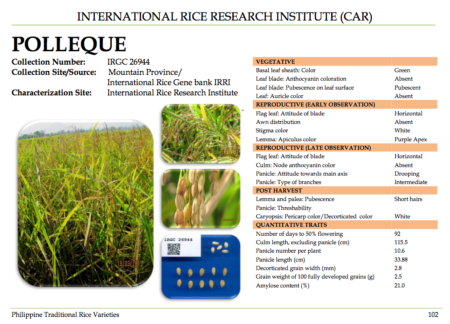
https://twitter.com/may_gun/status/824704129142370304
Yesterday’ post by Hugh Harries on the recent article in AramcoWord entitled Cracking Coconut’s History, by Ramin Ganeshram, elicited this response from another coconut expert, Luc Baudouin, on the coconut google group.
I enjoyed reading the [article], especially the picture from Dioscorides’s Tractatus De Herbis, a 15th Century manuscript. Congratulations to the author. While I share several of Hugh’s comments, I beg to differ as regards the presence of coconut on the Pacific coast of America. Several travellers mention its presence and provide multiple evidence. I will mention only two diagnostic traits.
The first one is simply that coconut has huge fruits, unparalleled among palms (except for Lodoicea maldivica, known as… the sea coconut). That the coconut fruit is as big as a human head was mentioned in virtually all accounts of coconut before AD 1500 and can thus be considered as part of the definition of coconut at that time. It is thus unreasonable to suppose that palms such as Attalea, Bactris or Elaeis were misidentified as coconut. In fact, palms of these and other genera were described as distinct ‘kinds’ by Oviedo, and their nuts were described as comparable to a coconut, but “the size of a walnut”, or “of a Seville olive” etc.
The second one is seed dissemination by oceanic currents, which is unique to coconut among palms. It was observed in the mouth of the Santa Maria river, southern from the old Spanish town of Nata. This used to be a bay which was converted into a salt works. The original population still exists in Aguadulce.
When and where was coconut first brought to America clearly remains an open question. BC 150 in the Bahia de Caraquez? AD 800 in the Gulf of Guayaquil? Or some other unidentified landing? We really don’t know but it was clearly before the Spaniards arrived. One may hesitate to admit it because of the extremely long distance from the Philippines to the American coasts, but it’s a fact. Hugh mentioned the presence of coconuts of the San Ramon type in Guam and this could contribute to ease the problem. It would be a two-leg journey.
In this context, the question of survival should be taken in the opposite way. While the Panama Tall can be described as an ‘incipient domesticate’, it did thrive at a small number of locations on the Pacific coasts of America. This shows that it did not lose its ability to propagate itself without human help (but in the absence of competitors that are more adapted to long distance dissemination).
I am talking of the Pacific coast of Panama. As regards Mexico and the Caribbean, I agree with Hugh.