- The great Tim Johnson, (soon to be) formerly of the Seed Savers Exchange, on conserving heritage seeds.
- “Peppy professor ponders a peck of pepper possibilities.”
- Kelp will save us.
- David Spooner: “Ever since I could remember all I ever wanted to be was a botanist.” From potatoes to carrots…
- Veterans help save livestock breeds.
- Agroforestry is a big hit in Vietnam.
Mapping wheat diversity in Turkey
 No sooner did I blog about a paper which mapped diversity in a crop in Mexico across time, that I came across one mapping diversity in another crop in Turkey. 1
The authors — a truly international bunch from the Bahri Dagdas International Agricultural Research Institute, the Vavilov Institute, CIMMYT, ICARDA, FAO, and UC Davis — describe a huge effort to collect and describe wheat from all over the country during 2009-2014. They then compare the resulting socioeconomic and geographic patterns of diversity with a previous survey done by the Vavilov Institute in the 1920s, the results of which were published in 1935-9 by Mirza Gökgöl, a Turkish scientist who accompanied that expedition. 2
As in the Mexican maize study, diversity in the crop was measured in terms of distinct morphological types, and was unevenly distributed around the country, but unlike in that work, diversity was calculated for each administrative province, rather than in each square in a grid. As provinces vary widely in size, and in the extent to which wheat is grown in them, this approach is not ideal.
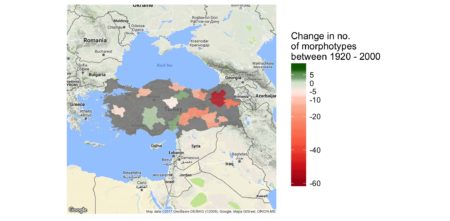
Nevertheless, it was possible to make direct comparisons between the two study periods for about 17 provinces. Discounting some very rare and very minor morphological variants, it seems fairly safe to say that for these provinces, the number of distinct wheat types went down about 59% overall, though with large differences among provinces. There is no map showing this in the paper, but, thanks to my colleague Nora Castañeda, I can help you with that. Red is down, green is up.
What explains wheat landraces still thriving in some places, and not in others?
Socioeconomic data indicated that landrace farmers are found mostly in remote mountainous subsistence communities with very little grain trade, small areas planted to wheat, and relatively simple production technologies. The key reasons famers continue to grow landraces are their grain qualities and adaptation to abiotic stresses.
Nibbles: Celebrity chef, Brazilian meeting & dessert, Citizen experiment, Phenotyping course, Fonio, Milpa, Broccoli nutrients, Biodiversity $$, Soybean history
- Alexis Soyer was apparently the first celebrity chef.
- EMBRAPA gets to grips with crop wild relatives, with a little help from their friends.
- Did they serve brigaidero, though?
- Take part in a crowd-sourced experiment on plant adaptation.
- And then go and find out how the experts do it.
- Will fonio‘s day ever come?
- Celebrating the milpa.
- Gotta eat your broccoli fresh for the full nutrient monty.
- Putting (yet another) value on biodiversity. This one by adding or subtracting a species to a grassland plot and seeing what happens to C sequestration.
- What price soybeans?
Animate the apocalypse
You know that paper entitled Biodiversity redistribution under climate change: Impacts on ecosystems and human well-being, that we included in Brainfood a couple of weeks back?. The money quote was: “The indirect effects of climate change on food webs are also expected to compound the direct effects on crops.” Ok, well, you don’t have to read it. All you have to do is watch a 1.5 minute video.
Brainfood: Slow Food, Runner bean diversity, Bamboo diversity, Istrian grapes, Smelly cheeses, Wild pseudocereals, Diversity & phenology, VAM diversity, Oases apocalypse, Wild wheat physiology, PepperHub, Bactrian camel diversity, Swiss livestock, CWR conservation, Tree database
- Developing radically-new meanings through the collaboration with radical circles: Slow Food as a platform for envisioning innovative meanings. Companies should collaborate with radicals. Presumably in order to turn them. #resist
- Unraveling agronomic and genetic aspects of runner bean (Phaseolus coccineus L.). At least we know what we don’t know.
- Total leaf crude protein, amino acid composition and elemental content in the USDA-ARS bamboo germplasm collections. If you want to use bamboo as feed, you need to choose among the 100-odd species very carefully.
- The Gene Collection of Autochthonous Wine Grape Varieties at the Institute as a Contribution to the Sustainable Development of Wine Growing and Viticulture in Istria. 3591 seems a hell of a lot, but wow.
- Phage Biodiversity in Artisanal Cheese Wheys Reflects the Complexity of the Fermentation Process. Modern methods kill a lot of phages.
- Setting conservation priorities for Argentina’s pseudocereal crop wild relatives. Go north, young CWR researcher!
- Flowering phenology shifts in response to biodiversity loss. Experimentally decreasing diversity in a California grassland advanced phenology.
- Activity, diversity and function of arbuscular mycorrhizae vary with changes in agricultural management intensity. No-till helps VAM, helps soils.
- Oases in Southern Tunisia: The End or the Renewal of a Clever Human Invention? I’m not hopeful.
- Physiological responses to drought stress in wild relatives of wheat: implications for wheat improvement. 4 species show promise.
- PepperHub, a Pepper Informatics Hub for the chilli pepper research community. Hot off the presses.
- Molecular diversity and phylogenetic analysis of domestic and wild Bactrian camel populations based on the mitochondrial ATP8 and ATP6 genes. The wild species is not the ancestor, and the domesticated species is a geographic mess.
- GenMon-CH: a Web-GIS application for the monitoring of Farm Animal Genetic Resources (FAnGR) in Switzerland. Upload data on your herd or flock, end up with a map of where the breed is most endangered.
- Stealing into the wild: conservation science, plant breeding and the makings of new seed enclosures. Ouch!
- GlobalTreeSearch – the first complete global database of tree species and country distributions. 60,065, about 10% crop wild relatives.