- Tracking crop varieties using genotyping-by-sequencing markers: a case study using cassava (Manihot esculenta Crantz). A third of cassavas found on Ghanaian farms are released varieties, though you’d never know it from just looking at the names.
- Interspecific hybrids between Paspalum plicatulum and P. oteroi: a key tool for forage breeding. P. oteroi is promising, but asexual. But there’s a way around that…
- Phylogenetic position of two endemic Carthamus species in Algeria and their potential as sources of genes for water use efficiency improvement of safflower. They’re actually in a different genus, but could still be useful.
- Genomic Prediction of Gene Bank Wheat Landraces. “…for the two populations of landraces included in this study [Mexican & Iranian], genomic predictions were generally of a magnitude that could be very useful for predicting the value of other accessions in the gene bank and that could be useful in breeding.”
Nibbles: Maize domestication, Seaweed as food, Holy plants, Pre-Columbian Amazon, Pulses, Myanmar rice, Ghana cassava, Chocolate festivities, Tobacco biofuel, Evidence base, Brazilian agrobiodiversity
- Maize domestication video from CONABIO.
- Why has a seaweed never been domesticated?
- Any seaweeds mentioned in the Bible?
- Series of talks on ancient Amazonia.
- Africa needs pulses.
- Myanmar needs salinity tolerant rice.
- 30% of Ghanaian cassavas are improved varieties, but you wouldn’t know it from their names.
- Wait, what, we missed World Chocolate Day?
- Tobacco for airplanes, no warning label required.
- Latest list of conservation interventions that work tackles forests.
- Brazil lists nutritious native species.
One for the birds
There’s a great set of photographs on the Facebook page of Leo Sebastian, Regional Program Leader, Southeast Asia at CGIAR Research Program on Climate Change, Agriculture and Food Security, based in Los Baños, Philippines. It’s entitled Birds in Rice Selection, and the idea behind it is pretty simple:
How about using birds to select for new rice varieties? Observing the birds in the field, they prefer certain varieties to feed on. Such observation can give us a clue of certain grain quality characteristics.
Here’s an example.
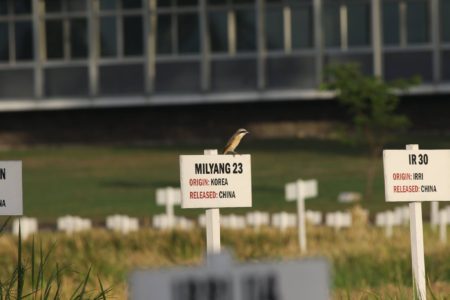
Milyang 23 is apparently a popular Korean rice variety. I wonder how they record the results in the database.
Brainfood: African land use, Sorghum double, NUS trifecta, Grape hybrids, Sunflower genome, Fungi, Tree dispersal
- Africa’s Land System Trajectories 1980–2005. Biomass harvest increase has mainly come from expansion, save in the north and south.
- Status, genetic diversity and gaps in sorghum germplasm from South Asia conserved at ICRISAT genebank. Still a lot of work to do.
- Indirect estimates reveal the potential of transgene flow in the crop–wild–weed Sorghum bicolor complex in its centre of origin, Ethiopia. Could be relevant if transgenic sorghum were ever to be developed, and deployed in Ethiopia.
- Are Neglected Plants the Food for the Future? The latest hope is the SDGs.
- Potential of Kersting’s groundnut [Macrotyloma geocarpum (Harms) Maréchal & Baudet] and prospects for its promotion. Not enough mutations, apparently. Hope that won’t be an issue for the SDGs.
- Back to the Future – Tapping into Ancient Grains for Food Diversity. They need to pay their way. Enough mutations, though, I guess.
- Genomic ancestry estimation quantifies use of wild species in grape breeding. 11-76% cultivated ancestry across 60-odd hybrids, one third 50%. More back-crosses to cultivated needed.
- Genome scans reveal candidate domestication and improvement genes in cultivated sunflower, as well as post-domestication introgression with wild relatives. Wild introgressions cover 10% of cultivated genome, and there is some in every modern cultivar tested.
- MycoDB, a global database of plant response to mycorrhizal fungi. Monumental.
- Contrasting effects of defaunation on aboveground carbon storage across the global tropics. Loss of dispersal animals bad for C sequestration, but only in African, American and South Asian forests.
Nibbles: Indian ag, West African rice, Interdependence day, Animal cryo, NASA, Biopiracy?
- “…nor could they survive during inclement phases of a seasonal climate with a cheery hardiness the way our traditional varieties could.
- “How does the centrality of rice production mediate social reality among the Jola?”
- “When we say, ‘As American as apple pie,’ we think of baseball and hot dogs without ever considering not one ingredient in apple pie originates from what we call the United States.”
- “The absolute minimum we should do is preserve tissues from these animals in such a way they can be thawed and grown again.”
- “We’re botanists; we’re plant experts. Plus we had this humongous network of students, citizen scientists who were eager to do so much research that scientists at Kennedy simply didn’t have time to do.”
- “It is essential that all countries join and ratify the Convention on Biological Diversity and the Nagoya Protocol.”