- It’s not the science, stupid.
- More kelp, sir?
- New genome promises
world dominationnon-allergenic peanut. - The diet of Roman soldiers in Glasgow could have been worse. But did they have take-out?
- There is no more Nature, capital N.
Mythbusters edition
No, mobile phones did not improve the economic welfare of fishermen in Kerala by allowing them to track market prices in different ports. And no, it has not been the antics of environmental activists to stall the adoption of Golden Rice by the world’s poor. Whatever next? The figure for worldwide crop genetic erosion is not 75%? Now, that would be something.
Talking PGR at Brum
The plant genetic resources conference at the University of Birmingham is now over, and the presentations are online, including from Mike Jackson, who I feel sure will say something about it all on his blog soon. And it looks like Svalbard may be in for some British deposits…
Thanks to all speakers and participants at the PGR conf. @unibirmingham Now lets get our UK PGR into Svalbard! pic.twitter.com/2rhbcylS48
— PlantGeneticResource (@PGRBham) June 6, 2016
Hawaiian crop diversity festival
The Indigenous Crop Biodiversity Festival, in Maui, Hawaii, August 24-30, 2016 is a recognized parallel event to the IUCN World Conservation Congress. It offers an opportunity to explore the role of indigenous crop biodiversity conservation in food security and in reducing agricultural impacts to natural ecosystems from practitioners perspectives, as well as a look into island biodiversity conservation, in advance of the Congress. To find out more and to register for any of the many events and site visits of the week, some of which are rarely open to the public, please visit.
You still here?
The road to agroecology
The International Panel of Experts on Sustainable Food Systems (IPES-Food), led by Olivier De Schutter, former UN Special Rapporteur on the right to food, released its findings today in a report entitled ‘From Uniformity to Diversity: A paradigm shift from industrial agriculture to diversified agroecological systems.’ The report was launched at the Trondheim Biodiversity Conference (Norway) by lead author Emile Frison, former Director General of Bioversity International.
I guess you all saw that last week. There’s an executive summary. And key messages. If you don’t have the time to wade through the 100 pages of the full report. But actually the message can be summarized even further: agroecology, everywhere. And there’s a handy diagram for how to get us there:
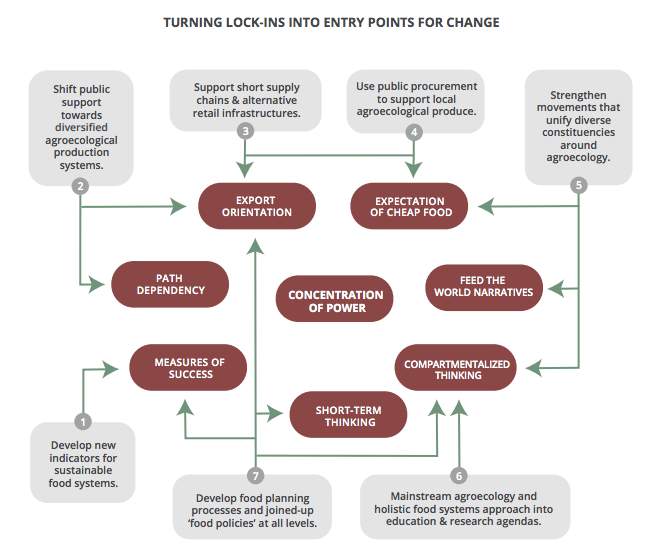
And even that can be summarized. It’s all down to the right indicators, getting away from the tyranny of kilograms of cereals per unit land area. Measure things that are more important to people, and in ways that take proper account of sustainability, and you can’t help but produce a shift to agroecological production, the report seems to suggest.
Which is of course something we have occasionally suggested here. Well, at least the first part of that statement is something we’ve said. Not least in the context of the Sustainable Development Goals. Which reminds me to link to CIAT’s latest policy brief on progress towards defining indicators for Target 2.5, also out last week.
As the SDGs, CBD Strategic Plan for Biodiversity, and other global agreements struggle to find tangible indicators for achieving their stated targets, we propose that the results of our global analysis of crop wild relatives can be directly used to assess the current state of conservation of these wild species ex situ. Moreover, the methods used in the “gap analysis” can be adapted for assessments of crop landraces and livestock breeds. Furthermore, the tools can be used iteratively to assess progress over time.
There’s nothing in the IPES report on the SDGs in general (which I found strange, but anyway), let alone Target 2.5 specifically, but I am somewhat heartened by this passage (p. 71):
Support for diversity fairs, community genebanks and seed banks is likely to be a crucial element in strengthening social movements and unifying them around diversified, agroecological systems.
It could, I suppose be read as excluding “formal” genebanks from the equation, but I choose to interpret it as saying that national and international genebanks need to work together with community-level efforts to conserve and use crop diversity. Which I’d buy even if the calculus did not lead inexorably to agroecology, everywhere.