- China’s largest genebank just got a little bit larger. And some context.
- Small Pennsylvania genebank may get a lot smaller.
- Denmark shows the way on seed saving in Europe.
- Chocolate really got around.
- Coffee didn’t do too badly either. But home is where the heart is.
- More pix of wheat wild relatives than you can shake a stick at.
Good question
Workshop7: Natural Resources & Climate Change #TFFsummit2016 #uprootingassumptions pic.twitter.com/BmMHUpMq55
— Thought For Food (@thoughtforfood_) April 1, 2016
That’s Hannes Dempewolf doing his bit to uproot assumptions about crop diversity and genebanks at the Thought for Food Summit in Zurich. We’ll let you know if the assembled youth bought it.
Global Food Policy Report the usual downer
IFPRI’s 2016 Global Food Policy Report: How We Feed the World is Unsustainable is out and it makes for sobering reading. The press release doesn’t pull any punches either.
Land area the size of Nicaragua is lost due to drought and desertification every year, putting 200 million small-scale farmers in Africa south of the Sahara at high risk of climate change
The Western diet is unsustainable—feeding just one Westerner for one year emits as much greenhouse gas as seven round trip drives from New York to Los Angeles
Thankfully, some solutions are also suggested:
The development of climate-ready crops, which can lead to more efficient water use and improve yields, are key to feeding a growing population and adapting and mitigating against climate change.
Though you’ll look in vain for a mention of genebanks as underpinning efforts to roll out what I believe should properly be called climate-smart crops. “Climate-ready” was supposed to have been quietly deep-sized some time back, I’m reliably informed, as being too reminiscent of the draeded “Roundup-ready.”
Measuring the elements of sorghum
There’s a great photo on the cover of Plant Physiology this month.
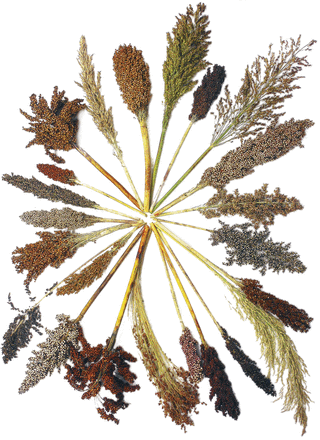
The paper in question looks at the “ionome” of sorghum seeds. That’s a new one on me too. It’s the genes responsible for the accumulation of different elements in whatever tissue. The authors measured the levels of a whole suite of elements in the seeds of a carefully chosen set of very diverse, and equally carefully genotyped, sorghum accessions representing all races. By comparing phenotype with genoptype, they identified gene variants associated with high levels of zinc, manganese, nickel, calcium, and cadmium. Now breeders interested in biofortification know what to include in their crossing programs.
Nibbles: BananaGuard, Wheat has a blast, Grow your own antibiotic, Bhutanese cypress, Natural history collections, Genebanks big & small, Better grasslands, Local foodways
- Who needs resistant banana varieties when you have synthetic biology? And more.
- More trouble for wheat, and climate change is to blame. Maybe Vavilov can help there too?
- DIY penicillin.
- Saving the sacred cypress. Try saying that quickly.
- What have herbaria ever done for us? Apart from giving us endless joy, you mean?
- The Indian and other genebanks securing the future of food. But see also our earlier post on Dr Tyagi’s paper.
- Aboriginal community gets a genebank.
- We need better grass. No, not that kind of grass. Well, not only that kind of grass.
- A pean for African food cultures. And Pacific ones too.