- Catastrophic Declines in Wilderness Areas Undermine Global Environment Targets. 10% of supposedly remote wilderness areas gone since the early 1990s.
- Genetic diversity trend in Indian rice varieties: an analysis using SSR markers. The diversity of rice varieties released in India has been decreasing, but only of late.
- Genotypic and phenotypic changes in wild barley (Hordeum vulgare subsp. spontaneum) during a period of climate change in Jordan. There were changes in climate on one side and phenotype and genotype on the other, but it was difficult to find a connection between the two.
- EST-SSR Based Genetic Diversity and Population Structure among Korean Landraces of Foxtail Millet (Setaria italica L.). As is often the case, there’s no geographic structure, unless there is.
- Domestication of jute mallow (Corchorus olitorius L.): ethnobotany, production constraints and phenomics of local cultivars in Ghana. Let the breeding begin.
- Similar estimates of temperature impacts on global wheat yield by three independent methods. Down by about 5% for a 1°C global temperature increase, no matter how you slice it.
- Genome-wide association mapping of provitamin A carotenoid content in cassava. SNPs associated with carotenoid content in cassava roots found in vicinity of known gene responsible for increase in accumulation of provitamin A carotenoids in cassava roots.
Nibbles: Plant blindness, Grape breeding, Mixed farming, Genebank crowdfunding, CGN collecting, Science comms
- Who needs plants anyway?
- Who needs seedless grapes anyway?
- Who needs livestock anyway?
- Who needs the CIMMYT genebank anyway?
- Who needs information on germplasm collecting missions anyway?
- Who needs science communications anyway?
Strategizing about forages
My latest over at the work blog is about forages, their genebanks, and my mother-in-law.
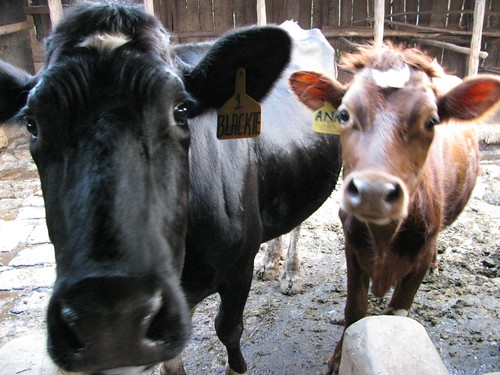
Cows get a lot of bad press these days. They are blamed for climate change and deforestation and even unhealthy diets, as if it’s their fault that people like to scoff down cheeseburgers. In fact, the widely repeated assertion that “animal agriculture and eating meat are the biggest causes of global warming” is nothing but a myth. Livestock production is a significant contributor to carbon emissions, to be sure, but the real problem is how the production is done in rich countries. For a billion mostly poor farmers in developing countries, cattle and other livestock are not a problem: they’re a solution.
Nibbles: Yeast phylogeny, Jurassic beer, Welsh drink, Italian fruits, Vinegar museum, Lethal yellowing, Wilderness loss
- Beer yeast was domesticated in the 1600s. Or maybe not.
- I see that and raise you 65 million years.
- If you don’t like beer, try Lurvill’s Delight, but it’s only about 100 years old, I warn you.
- Preserving ancient fruits in an Italian orchard.
- And how many different types of vinegar do you think the vinegar museum has?
- The Caribbean coconut is under attack.
- We’ve been such bastards to the environment.
Brainfood: Eurisco, Saline barley, ICRISAT sorghum, Hardy kiwi, Pepper diversity, Pakistani dates, W Africa & climate change
- EURISCO: The European search catalogue for plant genetic resources. 43 countries, 400 institutes, 1.8 million accessions, and a vital part of Genesys!
- Yield-related salinity tolerance traits identified in a nested association mapping (NAM) population of wild barley. Salinity allele found in wild barley.
- Geographical distribution of traits and diversity in the world collection of pearl millet [Pennisetum glaucum (L.) R. Br., synonym: Cenchrus americanus (L.) Morrone] landraces conserved at the ICRISAT genebank. Plant height in Burkina Faso ranges from 80 to 490cm.
- Hardy Kiwifruit Genetic Resources. They’re wild.
- Deciphering Genetic Diversity in the Origins of Pepper (Capsicum spp.) and Comparison with Worldwide Variability. Diversity is decreasing in Ecuador.
- Simple Sequence Repeat (SSR) markers show greater similarity among morphologically diverse Date palm (Phoenix dactylifera L.) cultivars grown in Pakistan. Morphologically diverse varieties show little genetic diversity.
- Assessing climate adaptation options and uncertainties for cereal systems in West Africa. About the only thing that’s going to work is increased temperature resilience during flowering.