- “È curioso che il grano Cappelli, ora diventato un simbolo della “pasta da gourmet”, fosse una volta il comune grano della pasta di tutti i giorni, e che venga da alcuni considerato “autoctono” quando in realtà è una varietà tunisina.” Curious indeed.
- A woman’s crop? Not as straightforward as it may sound.
- State of the World’s Plants symposium, 11-12 May.
- Above will no doubt consider crop wild relatives such as the peanut’s.
- More on the urban vegetable gardens of Istanbul.
- Tree DGs in the garden getting coffee. On International Forest Day.
- The “Bernie Sanders” vision of biofortification.
- Cowpea to get a genome.
- Q&A with John Torgrimson of Seed Savers Exchange.
- The resilience of rice: “You never find a crop that can span this latitude and altitude.” Really? Wheat?
- Cacao and coffee have a microbial terroir.
- Crop mixes are geographically stable.
- Prof. Kathy Willis of Kew on Feeding the World, including using crop wild relatives. IRRI Kew genebanks featured.
- Denmark interprets EU law to allow seed saving.
The long and winding road to crop wild relative conservation priorities
Those who follow these things will probably have noticed a certain frisson in the press over a paper in Nature Plants on setting conservation priorities for crop wild relatives. Lead authors are Nora Castañeda and Colin Khoury of CIAT, both of whom have featured here before. Good to see Nora celebrating the occasion on Twitter. She really deserves that beer.
Our paper on conservation of CropWildRelatives is published #cwrgap cheers @AgroBioDiverse https://t.co/W7B0VgG0mg pic.twitter.com/OXS25FvrnI
— Nora Castañeda (@np_castaneda) March 21, 2016
Well, I think it’s a beer.
Anyway, I won’t go into the details of the findings here. As I say, it’s all over the news (well, relatively speaking), and you can always explore the results for yourself on the project’s website. But I did want to strike a historical note.
This whole thing started when a small group of us decided it would be kinda fun to apply fancy spatial analysis methods to data from herbaria and genebanks on the distribution of wild Phaseolus species in the Americas. Just to see if it could be done. And whether the results would make any sense.
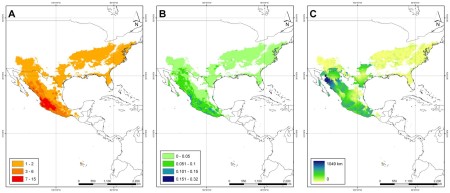
Well, it could, and they sort of did. And many years, a major international project, two PhDs and a lot of blood, sweat and tears later, we have a global analysis across dozens of genepools and hundreds of species. It was totally worth it, but there should be easier, faster and less expensive ways to get this kind of thing done.
Mapping crop words online
Do you remember the post a few weeks ago about Jack Grieve and his method for mapping words used in tweets? He helped us to investigate to what extent it could be used to map crops in the USA.
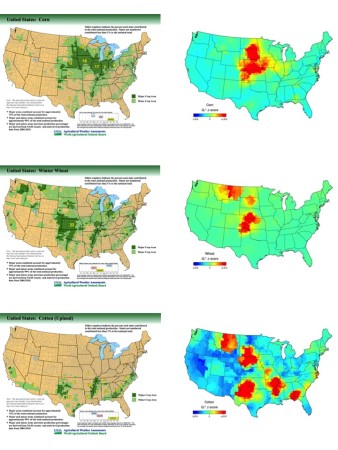
The answer was: it depends. Anyway, now you can try it for yourself. Go crazy.
Nibbles: Coffee taxonomy, Agarwood trade, Apios promotion, Dog species concept, Seed collecting, Kudzu control, ICARDA chickpeas, Ancient maize beer, Quinoa landscapes, History of domestication, Breeding mistakes, EU breeding value, Priming, Wild flower ecotypes, Vitellaria use
- Coffee botany resources.
- Uncovering the illegal agarwood trade.
- Developing the potato bean. First step: find a new name.
- Dog taxonomy explained.
- Project Baseline sets a, ahem, baseline, for studying plant diversity under climate change.
- Ok, random shout-out for my niece Francesca’s work on kudzu bug natural control. Because I can. And she’s fabulous.
- Blooming chickpeas!
- The inhabitants of Casas Grandes brewed maize beer in the 14th century. Well of course they did.
- Peruvian quinoa landscapes have a name: aynokas.
- Crop domestication 101.
- Where (commercial) breeders go wrong.
- Presumably none of above mistakes are made by EU plant breeding companies.
- Stimulating plant defences for faster response to pest and disease attack.
- Germany told to go for local meadow seeds.
- Use of shea butter trees goes way back.
Brainfood: Aquaculture food, Pacific bananas, Tepary genome, Mexican wheat, Legume pollinators, Brazilian coconuts, Soybean herbivory
- Environmental health impacts of feeding crops to farmed fish. Wild fish is being replaced by plant-based food, which is both good and bad.
- Traditional Banana Diversity in Oceania: An Endangered Heritage. Pacific starchy bananas are all AAB, but fall into 2 genetic subgroups and 3 morphotypes. Persistence of diversity is linked to persistence of traditions.
- Gene-based SNP discovery in tepary bean (Phaseolus acutifolius) and common bean (P. vulgaris) for diversity analysis and comparative mapping. Two groups in domesticated teparies, plus the even more distinct wild. Close similarity with common bean means genes could be moved between the two species.
- Unlocking the genetic diversity of Creole wheats. Wheat has had long enough to adapt to different Mexican environments.
- Enhancing Legume Ecosystem Services through an Understanding of Plant–Pollinator Interplay. Legume breeders should consider functional floral traits.
- Genetic Relationships among Tall Coconut Palm (Cocos nucifera L.) Accessions of the International Coconut Genebank for Latin America and the Caribbean (ICG-LAC), Evaluated Using Microsatellite Markers (SSRs). The Brazilian material came from Africa.
- Characterization of Natural and Simulated Herbivory on Wild Soybean (Glycine soja Seib. et Zucc.) for Use in Ecological Risk Assessment of Insect Protected Soybean. If transgenes conferring insect protection were to escape to the wild soybean in Japan, it would probably not have any effect on its weediness.