- A Molecular Phylogenetic Framework for Timothy (Phleum pratense L.) Improvement. We have the tools, and the instruction manual, but lack the raw materials.
- Open access resources for genome-wide association mapping in rice. Tools, manual AND raw materials, all on one handy platform.
- Why do US Corn Yields Increase? The Contributions of Genetics, Agronomy, and Policy Instruments. Pioneer “era” hybrids released 2000-2009 were more diverse than landraces cultivated in central Iowa during the late 19th century.
- Barriers to Eating Traditional Foods Vary by Age Group in Ecuador With Biodiversity Loss as a Key Issue. Young people liked traditional foods for their health benefits and good taste; adults for the money they brought in.
- Do Smallholder, Mixed Crop-Livestock Livelihoods Encourage Sustainable Agricultural Practices? A Meta-Analysis. Size doesn’t matter.
- Evolutionary dynamics and biogeography of Musaceae reveal a correlation between the diversification of the banana family and the geological and climatic history of Southeast Asia. We have geology and climate to thank for bananas.
- High variability in flavonoid contents and composition between different North-European currant (Ribes spp.) varieties. Smaller is better in redcurrants, but not in blackcurrants.
- Origins of cattle on Chirikof Island, Alaska, elucidated from genome-wide SNP genotypes. A unique mixture of East Asian and European breeds, plus strong selection.
Vulnerability of crop wild relatives kinda sorta mapped
There’s a nice paper in Nature on how sensitive vegetation around the world is expected to be to climate change. Here’s the money map.
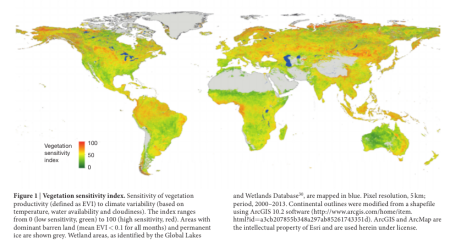
Cries to be mashed up with crop wild relative distributions and gap analysis.
Looking for a good potato picture
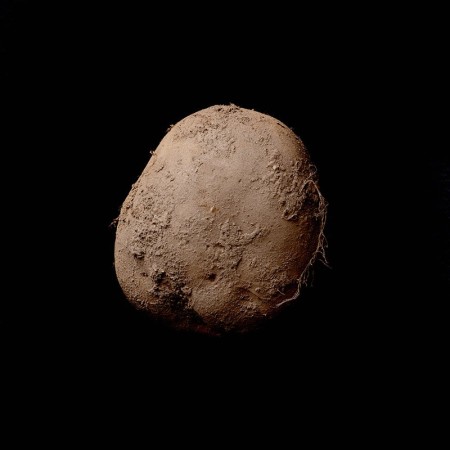
Well, Kevin Abosch takes a pretty decent picture of a potato. I’m not sure it’s worth the million dollar price tag, but it’s definitely not bad, as far as I’m concerned. Not everybody agrees, though, and this has spurred an interesting discussion at The Online Photographer, which Jeremy alerted me to.
Mike Johnston, who runs that site, threw out a challenge:
…is a good potato picture a thing that just doesn’t exist?
Commenters point to a number of plausible candidates, including the series by Andrzej Maciejewski, which I like a lot but I agree with Jeremy is spoiled by the lack of variety names.
Any more suggestions?
American vs European taste
Julia Belluz has a long article over at Vox on Why fruits and vegetables taste better in Europe. Compared to the US, that is. Here’s the bottom line. Or lines:
- American farmers put an emphasis on yield and durability, not flavour
- American shoppers favour access over seasonality
- The US government regulates for safety — but not quality
- Finding flavourful food is a matter of priorities
I’m really not sure whether like is being compared with like here, and, if it is, whether one can generalize to this extent anyway about American or European farmers, shoppers and governments. Ms Belluz seems to agree, in a tweet, that she might be winging it a bit:
I know, I know. No systematic reviews on this one. More a matter of perception and lowly anecdote
But read the whole thing for yourself, and join in on the discussion on Twitter.
Hey, @juliaoftoronto! Let's talk. Is there evidence that Euro produce actually does taste better? https://t.co/Ds0ZVcOAv3
— Tamar Haspel (@TamarHaspel) February 12, 2016
Autonomous potato innovation in the Andes?
I have nothing against jua kali. In fact, I love the informal sector, without which life would be a lot more expensive, and less interesting, back home in Kenya. But a piece in The Guardian extolling its virtues, by Aditya Bahadur and Julian Doczi, researchers at the Overseas Development Institute, says some funny things about “frugal”, “bottom-up” and “autonomous innovation” in potato cultivation in Peru.
Some organisations already recognise the value of autonomous innovations for resilience. Practical Action supported indigenous communities in the Peruvian Andes to find a local solution to food shortages caused by bouts of extremely cold weather.
An externally led response might have led to these communities importing food or relocating. Instead, Practical Action helped them to rediscover an ancient process of cultivating native potato varieties that can survive temperatures as low as -35°C. In this way, communities have found a solution that is aligned with their culture and diet to survive extreme weather.
At first I thought this was something to do with chuño, the freeze-dried potato of the Andes. But the link to the Practical Action website doesn’t mention anything like that.
There are 256 varieties of potato that can survive the harsh conditions of the high Andes. Practical Action is helping families living at altitudes of 3800ft to maintain this crucial biodiversity by developing varieties of local potatoes, as well as improve technical aspects of production. These methods ensure people are able to get enough to eat, as well as an income at local markets.
A revolving fund for accessing native potato seeds and seeders for local production has been set up. Ongoing technical assistance is being established through the training of 40 Quechuan farmers, chosen by the community themselves, as technological leaders.
So, help with conserving and accessing adapted local varieties, and technical advice and training on production methods. Worthy, no doubt, but hardly “autonomous innovation,” nor can either really be described as “rediscover[ing] an ancient process of cultivating native potato varieties.” I’m sure there’s some cool jua kali going on to do with potatoes in the mountains of Peru. But this isn’t it.
And 256 hardy Andean varieties? Really? Not 257, perhaps?