- Crowdfunding the Zero Tree Extinctions project.
- Seed fairs for climate change adaptation in Zimbabwe.
- Make mine a baobab smoothie.
- Another great review of Simran Sethi’s new book Bread, Wine, Chocolate: The Slow Loss of Foods We Love.
- Blessed are the cheesemakers.
- Big Food taking fright?
- Breeding the organic breeders of the future.
Model livestock information systems
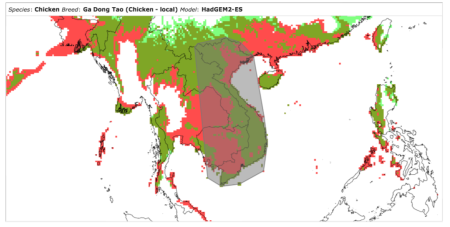
Attentive readers will know I occasionally take swipes at the state of genetic resources information systems, both in the crops and domestic livestock areas. But as far as the latter is concerned it’s getting more and more difficult to do so, a twinge of jealousy being the more usual reaction. Take for example the fact that you can now download the results of distribution modelling, under various climate change scenarios, for 8800 livestock breeds, as recorded in the Domestic Animal Diversity Information system (DAD-IS). Here they are for Vietnam’s Ga Dong Tao chicken. Light green is the area currently suitable, red is the area suitable in 2050, dark green is the area suitable under both current and future conditions. The grey polygon is the reported distribution of the breed.
I suspect it will be some time before we’re able to do something similar for crops.
Nibbles: Ancient faba, Ampelography double, S. African cattle, CIMMYT in Ethiopia, Seed pix, Heirloom pix, Trifolium genome
- Faba beans came before cereals in Galilee.
- Wine is not quite so old in Georgia, but still pretty old. But will they be able to genotype it?
- South Africa is a cattle melting pot.
- Getting improved wheat out there in Ethiopia.
- These seeds are definitely ready for their close-ups.
- Speaking of close-ups: Amy Goldman has a new book out.
- First forage clover genome. More and more difficult to think of firsts.
Brainfood: Honeybee miscegenation, Cowpea shoots & leaves, Iberian goats, CIP fingerprinting, Seed networks, Early rice, Date palm genome, Pollinator services, Bananapocalypse
- Population structure of honey bees in the Carpathian Basin (Hungary) confirms introgression from surrounding subspecies. The Hungarian honeybee is holding its own. For now.
- Genetic Variability and Heritability Estimates of Nutritional Composition in the Leaves of Selected Cowpea Genotypes [Vigna unguiculata (L.) Walp.]. Something else you can breed for.
- The Southwestern fringe of Europe as an important reservoir of caprine biodiversity. Local goat breeds in Spain and Portugal have few numbers, but much diversity, though in general weakly structured.
- Are you getting what you ordered from your genebank? Fingerprinting of the clonal potato and sweetpotato collections at the International Potato Center. Ahem. Maybe not.
- Seed exchange networks and food system resilience in the United States. Let my seeds go!
- Barnyard grasses were processed with rice around 10000 years ago. Rice had to fight it out with other wetland grasses to get domesticated.
- Whole genome re-sequencing of date palms yields insights into diversification of a fruit tree crop. Independent history in North Africa and the Middle East, but unclear if because of separate domestications or migration westward and introgression with local wild populations. Fruit colour genes the same as in oil palm.
- Pollinator conservation — The difference between managing for pollination services and preserving pollinator diversity. The point is that there’s a difference.
- Worse Comes to Worst: Bananas and Panama Disease—When Plant and Pathogen Clones Meet. TR4 is a single clone.
A sweet pea for charity
Thrive, the charity operating in the field of disability and gardening, has been named Thompson & Morgan’s Charity of the Year.
To start the partnership, a new sweet pea has been launched for 2016, with money generated from sales going towards Thrive training programs at the charity’s four regional centres and local community venues. The sale of the sweet pea aims to generate £10,000+. Alongside this Thompson & Morgan is also supplying £1,000 of flower and vegetable seeds to be grown at the charity’s three garden project sites at Gateshead, Reading and London’s Battersea Park, plus 2,400 litres of incredicompost and also incredibloom fertiliser for use in the planting displays.
What a great idea. And a beautiful crop wild relative too.