- Genetic Resources of Cannabis sativa L. in the Collection of the Gene Bank at INF&MP in Poznan. I’d pay money to see this in the field at evaluation time.
- Specific median flour particle size distribution of Japanese common wheats; Comparison with Chinese common wheats. Japanese diversity is a small fraction of Chinese diversity. Also, can you really have semicolons in titles?
- Association and Validation of Yield-Favored Alleles in Chinese Cultivars of Common Wheat (Triticum aestivum L.). And among Chinese wheats, the modern cultivars are a small subset of the diversity in the mini core collection.
- Diversity among maize landraces in North West Himalayan region of India assessed by agro-morphological and quality traits. I like it when specific accessions are highlighted as being special in some way. But will breeders around the world have access to them?
- Genetic Diversity and Population Structure in Aromatic and Quality Rice (Oryza sativa L.) Landraces from North-Eastern India. More than just basmati. But will breeders around the world have access to them?
- African Indigenous Cattle: Unique Genetic Resources in a Rapidly Changing World. At least 150 breeds, many endangered, all important.
- Sustainable Sourcing of Global Agricultural Raw Materials: Assessing Gaps in Key Impact and Vulnerability Issues and Indicators. We don’t know the vulnerabilities well enough.
- Can the sustainable development goals reduce the burden of nutrition-related non-communicable diseases without truly addressing major food system reforms? No.
- Suitable Days for Plant Growth Disappear under Projected Climate Change: Potential Human and Biotic Vulnerability. Tropical areas are screwed.
- A versatile phenotyping system and analytics platform reveals diverse temporal responses to water availability in Setaria. Fancy equipment picks out differences among genotypes.
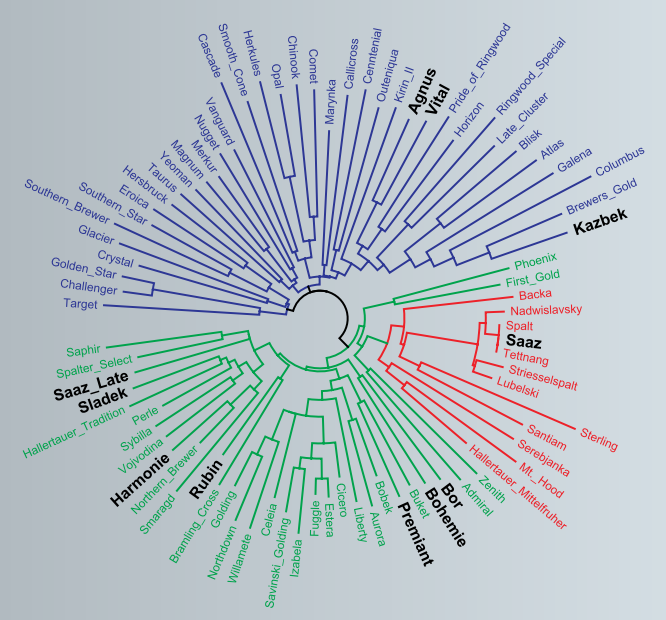
The phylogeny of Czech hops
Long breeding work aimed at fine aroma hops results in high quality aroma aspects, which are used to produce the best beer. Czech hops are the security of the highest brewing quality in many breweries all over the world. Saaz hops are considered as the standard of high brewing quality not only in Czech Republic but in other countries as well. Saaz hops are a very important raw material for the best quality beer. All Czech hop varieties, which have been developed recently, have in their origin Saaz and therefore they show excellent brewing characteristics.
You had me at beer.
Secretary Vilsack highlights diversity at Milan EXPO on Independence Day
Speaking on intriguing tweets, try this one:
Tom Vilsack: "#Expo2015 puts the challenge to feed the world to every nation. Diversity is the key" #UsaDay pic.twitter.com/onbaGAMG1c
— Expo Milano 2015 (@Expo2015Milano) July 4, 2015
Did Secretary Vilsack mean crop diversity, by any chance? You know, as in genebanks, among other things. His remarks do not seem to be online yet. Were any of our readers there?
Quadruple diversification
Sometimes, a tweet says it all.
@agrobiodiverse Quadruple diversification: diversify production 4 sustainability, resilience & choice, diversify consumption for health.
— Lawrence Haddad (@l_haddad) July 3, 2015
But read the long version of the argument in a blog post on obesity by Uma Lele, Co-chair of the Food Security Information Network (FSIN) Technical Working Group on Measuring Food and Nutrition Security.
World Bank plays hardball with agricultural research, maybe
…the future of the institution responsible for the Green Revolution – a consortium of 15 research centers around the world called the Consultative Group on International Agricultural Research (CGIAR) — is under threat. The World Bank, one of its primary funders, is considering withdrawing its financial support.
Well, thank goodness the genebanks at least are safe, eh?
For the CGIAR, the proposed cuts, though painful, would not be devastating; in 2013, the group spent $984 million to fund its activities… Still, the World Bank — the preeminent global development institution — is essentially declaring that agricultural research is not a development priority.
No word from CGIAR. Yet. But then again, adapting agriculture is not that big a deal, is it? Well, Mark Cackler is manager for agriculture and food security at the World Bank, and he seems to think it may be, and that CGIAR have it more or less right:
The Copenhagen Consensus concludes that agricultural research is one of the single most effective investments we could make to fight malnourishment. Therefore, we need more support for bodies like the Consultative Group on International Agricultural Research that focus on crops and cropping systems that are of greatest importance to poor farmers and poor countries. Such research is a global public good that the private sector cannot be expected to deliver alone.
What in tarnation is going on at the World Bank?