- Promoting food security and enhancing Nigeria’s small farmers’ income through value-added processing of lesser-known and under-utilized indigenous fruits and vegetables. It’s the infrastructure, stupid.
- The role of wild vegetables in household food security in South Africa: A review. No, it’s the information, stupid.
- Indigenous wild food plants in home gardens: improving health and income — with the assistance of agricultural extension. Nope, it’s the extension, stupid.
- Towards recommendations for metadata and data handling in plant phenotyping. It’s the standardization, stupid.
- Cytoplasmic diversity in potato breeding: case study from the International Potato Center. It’s a genetic bottleneck, stupid.
- Towards breeding of triploid chamomile (Matricaria recutita L.) — Ploidy variation within German chamomile of various origins. It’s the triploids, stupid.
- Making a chocolate chip: development and evaluation of a 6K SNP array for Theobroma cacao. Oh, very clever, now everybody and their uncle will be able to breed cacao, stupid.
- Arbuscular mycorrhiza differentially affects synthesis of essential oils in coriander and dill. It’s not just genetics, stupid.
- Comparative transcriptional profiling analysis of developing melon (Cucumis melo L.) fruit from climacteric and non-climacteric varieties. It’s the sugar metabolism, stupid.
- Climate-driven diversity loss in a grassland community. It’s the increasing aridity, stupid.
One rare lettuce
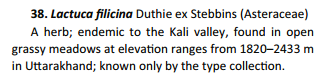 Speaking of crop wild relatives, there’s one in India which is known only from its type locality. I wonder how many around the world?
Crop wild relative in the mainstream
Isn’t it amazing that the internet is going crazy over the blooming of a crop wild relative?
Saluting Edmond Albius
By the late 18th century, a ton of Mexican vanilla was worth … “its weight in silver.”
That’s just one of the fun facts I learned from Robert Krulwich’s rendering of the bittersweet story of the slave boy on the Indian Ocean island of Réunion who discovered how to manually pollinate vanilla. Or did he? Well, that’s the point of the story. If you read the whole thing over at National Geographic’s blogs, you also get the benefit of some really charming drawings.
Genebanks are valuable, even without climate change
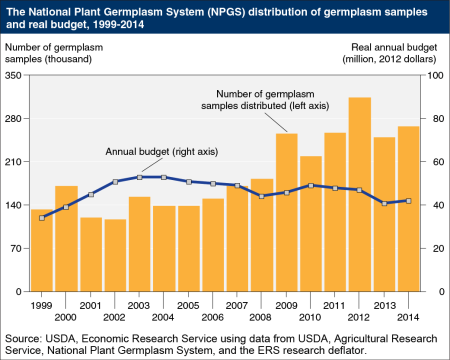
As agriculture adapts to climate change, crop genetic resources can be used to develop new plant varieties that are more tolerant of changing environmental conditions. Crop genetic resources (or germplasm) consist of seeds, plants, or plant parts that can be used in crop breeding, research, or conservation. The public sector plays an important role in collecting, conserving, and distributing crop genetic resources because private-sector incentives for crucial parts of these activities are limited. The U.S. National Plant Germplasm System (NPGS) is the primary network that manages publicly held crop germplasm in the United States. Since 2003, demand for crop genetic resources from the NPGS has increased rapidly even as the NPGS budget has declined in real dollars. By way of comparison, the NPGS budget of approximately $47 million in 2012 was well under one-half of 1 percent of the U.S. seed market (measured as the value of farmers’ purchased seed) which exceeded $20 billion for the same year.
Couldn’t have put it better myself, though admittedly I’m more likely to have done it for the CGIAR genebanks than for the NPGS. The diagram, and the sentiment, derive from a USDA publication that came out back in April: Using Crop Genetic Resources to Help Agriculture Adapt to Climate Change: Economics and Policy. We did blog about it at the time, but USDA seem to be plugging it again, and I see no reason why we shouldn’t too.