Nibbles: Pope, CGIAR, Agroecology, ABS, Food shortage, World flora, Nutella, Bees, GMOs, CC & wheat, CC & legumes, EU satellite, Seed saving, Wheat breeding, Strawberry breeding, Adopt-a-crop, Organic tea, Malagasy yams, Seed app, Ebola seeds, Sorghum spoons

And we’re back! While we were away…

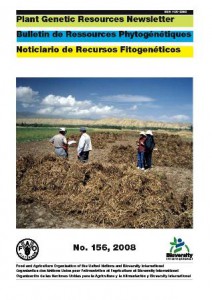
PGR Newsletter finds a home

It’s been five years since Robert Koebner and Theo van Hintum published the following call to action on our blog:

There has not been an issue of the Plant Genetic Resources Newsletter (PGRN) for a year. Its loss means that there is no longer a sensible outlet for “grey” literature on PRG -– such as reports of collecting expeditions, genebank updates, preliminary testing of new characterization protocols etc. A new intiative is currently being launched by Robert Koebner and Theo van Hintum (WUR) to bring PGRN back from the dead. The idea is to resume publication as a web-only English language journal housed at WUR, and to provide authors with linguistic support if needed. We are currently looking for the necessary financial sponsorship, and to achieve this we need to demonstrate that there is appreciable community support for the revival of PGRN.

So if you think that this is a worthwhile goal and that you would like to see PGRN back as a freely available, web-based journal, please email a message of support to Robert Koebner at mockbeggars(at)gmail.com, and leave a comment here.

We hope to hear from as many of you as possible!

There was an outpouring of support for the idea of bringing back a new PGR Newsletter — over 50 comments! — but the necessary financial sponsorship has not, alas, materialized. What has just materialized, however, is a new and hopefully fairly robust archiving arrangement for the old PGR Newsletter, courtesy of Bioversity. 1 Which is better than nothing, and we should all be grateful for.

…the Bioversity International Library felt it was important to make the full set of the Newsletter from its inception in 1957 to the last issue, no. 156 in 2008, available to all. We began the project in late 2014 and we are extremely proud to have been an integral part in making the Plant Genetic Resources Newsletter available to the plant genetic resource research community.

You can browse — though not, I believe, search — all the back issues from Bioversity’s e-Library pages.

Marketing baobab

Just back from two weeks in Kenya, where I was too taken up with work and family to blog much, but not nearly enough to neglect Twitter. And of course Jeremy has been busy over at Eat This Podcast, so I’m sure you didn’t miss me. Much.

I did manage to score some neglected species goodness in Nairobi. This is baobab fruit pulp. You soak it in boiling water, strain it, and mix it with milk (and maybe sugar) for a really tasty, pleasantly tart, drink. Some ladies from West Africa taught us the process. And also procured the raw material, which can apparently only be had in a Somali suburb of Nairobi called Eastleigh. But I see no reason why the juice shouldn’t be sold at Java, Art Cafe or other trendy eateries in more mainstream, let us say, neighbourhoods. Then all those factsheets might actually have been worth it.

You can get nice #baobab #fruit pulp (with embedded #seeds) in Eastleigh, apparently #Nairobi #kenya

A photo posted by Luigi Guarino (@ggguarino) on

Brainfood: Eastern promise, Biodiversity databases, Pulse carotenoids, Castor oil breeding, Maya beans, NUS and water, Chinese Vitis

Fun ePhyto facts

I really look forward to receiving Fresh, the AVRDC Newsletter, every month. There’s always at least one thing of interest, which is all you can ask for in a newsletter. I would prefer that clicking on a link in the email alert took me to the full online version of the article I want to read, rather than to a big pdf to download and wade through, but I won’t quibble.

Screen Shot 2015-06-05 at 9.21.09 AM

The article that caught my eye on this occasion was this one:

The creation of a new global electronic certification system that will help curb the spread of plant pests and diseases through international trade in a more secure and cost-effective way has been approved by representatives from 181 countries.

The Commission on Phytosanitary Measures (CPM), the governing body of the International Plant Protection Convention (IPPC), agreed in March 2015 to develop a global system of electronic phytosanitary certificates, known as ePhyto. The complex, bureaucratic process whereby millions of paper phytosanitary certificates are created, printed, and exchanged between countries each year will eventually be replaced by this online system. The current paper certificates serve to reassure importers that plant products, including food, have been inspected and found to be free of pests that could devastate local economies by harming agriculture or the environment.

ePhyto is expected to simplify and reduce the cost of global trade, increase the ability of countries to identify items that pose a high risk, and reduce the potential for fraud. The CPM endorsed a request to the Standards and Trade Development Facility of the World Trade Organization (WTO) to provide funds for the initial establishment of ePhyto.

The IPPC is also planning a pilot project to build capacity in developing countries to enable them to join ePhyto on a gradual basis. Several countries are already using some form of electronic certification, including Australia, Canada, Kenya, the Republic of Korea, the Netherlands, New Zealand and the United States.

Will be interesting to see if this makes life any easier for genebanks distributing germplasm. And I wonder whether we’ll eventually see integration of this system with that of the SMTA.

But anyway, don’t let me stop you reading the whole newsletter. There’s other fun stuff in there, for example a story about a new African eggplant variety that’s making quite a splash.