I’ve been hoping I could get away with not mentioning Expo Milano 2015, with its ugly logo and eccentric website content. But it’s about feeding the world, it says here. And everybody’s going. So here goes, I’ve succumbed. But I’m not proud of it.
Cary Fowler receives William L. Brown Award
Congratulations to Cary Fowler for receiving the 7th William L. Brown Award for Excellence in Genetic Resource Conservation.
The William L. Brown Award recognizes the outstanding contributions of an individual in the field of genetic resource conservation and use. It is administered by the William L. Brown Center (WLBC) at the Missouri Botanical Garden and is made possible through a generous endowment from the Sehgal Family Foundation, in cooperation with the family of Dr. Brown.
Dr. Brown was a distinguished, internationally-recognized scientist, businessman, and humanitarian. Over the course of five decades, he devoted himself to the collection, preservation, understanding, and sharing of plant genetic resources in order to help meet the global demand for food. The William L. Brown Award recognizes an individual whose efforts and achievements reflect a concern for those issues that were so important to Dr. Brown.
Cary was presented with the award yesterday during his keynote lecture at the 9th BGCI International Congress on Education in Botanic Gardens, hosted by the Missouri Botanical Garden.
award to Dr Cary Fowler for his contribution to conserving world 's crop diversity #BGCI21015EDU pic.twitter.com/lvb1SXugeL
— Botanic Gardens Conservation International (@bgci) April 30, 2015
Richly deserved.
Genebanks are NOT morgues, and you know it
Are we going to stand for this? Unless of course the point was to say that they’re not, and here’s why :)
Seedbanks = morgues? Collections only useful if can be mobilised tells David Marshall @JamesHuttonInst #monogram2015 pic.twitter.com/vkPi02gHWL
— Jemima Brinton (@JemimaBrinton) April 30, 2015
Promoting the sweet potato in Africa
Good to see the March edition of Hortinews magazine focusing on the sweetpotato in Africa. 1 I found it a little difficult to navigate the feature online, although you can also just download the whole issue as a pdf, so let me link directly to two stories on orange-fleshed sweetpotatoes (OFSP):
- Shaping up the orange-fleshed sweetpotato: Shamba Shape Up programme aired 8 episodes about the orange-fleshed sweetpotato, focusing on planting, diseases, storage, cuttings, vine health and cooking on Citizen TV.
- Nutritional analysis is critical to the development of OFSP in SSA: CIP advocated for increased nutrition related research at BecA-ILRI to meet the growing demand for quality nutritional analysis.
Now, a lot of effort has gone into developing and disseminating OFSP in parts of Africa, and their potential importance in addressing vitamin A deficiency is not disputed. However, not everything has gone totally smoothly. As an IDS report, coincidentally also just out, points out:
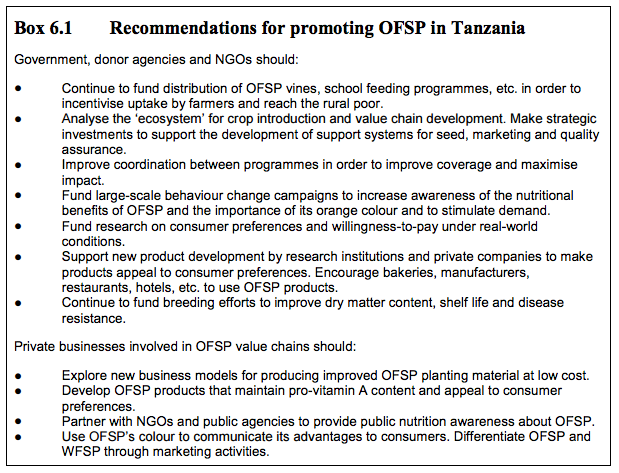
Donor-funded initiatives have played a central role in developing all stages of the OFSP value chain, with a particular focus on breeding new varieties that appeal to the preferences of both producers and consumers. Development projects have also supported the dissemination of planting materials and funded public awareness campaigns. However, information collected for this case study suggests that, so far, interventions have not achieved widespread uptake of OFSP. Only a small minority of farming households in intervention districts grow OFSP. 2 Commercial farmers who supplied OFSP planting materials to project distribution systems have found that, after project funding ended, the local market was not viable, and have ceased production. Meanwhile, awareness of and demand for the crop among consumers have been very limited; one survey conducted in an intervention district found that only 2 per cent of households consumed OFSP. Traders and food processors report that there is little demand, and dealing with the crop is not profitable. This state is perhaps unsurprising given that the introduction of OFSP is still relatively recent, that project efforts have been relatively scattered and uncoordinated, and that there has been little focus on commercially viable value chains. Yet the challenges encountered in Tanzania provide important lessons for other agriculture-nutrition initiatives.
But no need to panic, all is not lost. It’s still relatively early days yet, and the report also makes some sensible recommendations to turbo-charge adoption:
I think it would have been useful, as well as fair, for Hortinews to point out what still needs to be done, as well as what has been achieved. But maybe that doesn’t sell glossy magazines.
Setting genebank data free
There’s a strange little article on SciDevNet about the petition lodged with the UN by Norman Warthmann, of the Australian National University, and Claudio Chiarolla, of the Institute for Sustainable Development and International Relations in France, “to create a legal framework requiring governments to make data from the genetic sequencing of plants freely available.”
Strange for three reasons. One, why not make more of an explicit connection with DivSeek, which is trying to work through exactly these issues and was the subject of another article on the same website a few months ago?
Two, why link to a pdf of the text of the International Treaty on Plant Genetic Resources for Food and Agriculture, when said instrument has a perfectly nice website?
And three, somebody should really have checked this chart of germplasm transfers under the International Treaty, because most of the “countries” listed are not countries at all, but in fact the international centres housed by Mexico (CIMMYT), the Philippines (IRRI) etc.
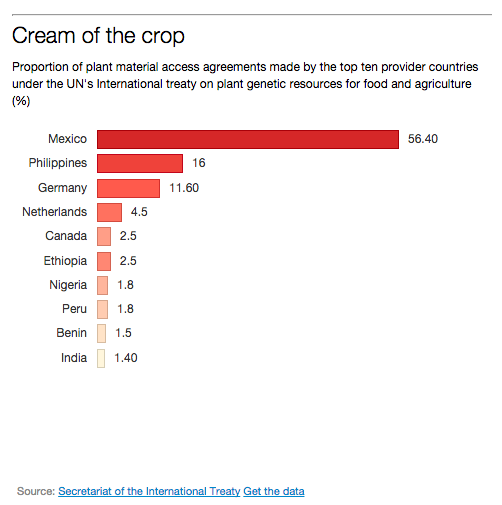
The international genebanks managed by the CGIAR Centres are by far the largest contributors to germplasm flows under the International Treaty, which is not something you’d be able to gather from this without a lot more background and context.