- Professor wants to copyright the name biltong, should be forced to eat nothing else until he takes it back.
- Getting to the bottom of coco de mer.
- PGRFA course at Wageningen. Expensive, but worth it, and you can apply for a NFP/MENA Fellowship, check on the course overview PDF.
- The IRRI genebank manager has seen the future of genebanks: “…we need to work on building the system to estimate breeding value from genotype, and then we will be able to feed more detailed knowledge to the breeders.” He probably means DivSeek. Now IRRI really need to get a different stock image of him and his genebank.
- The UK now has a National Black Poplar Clone Bank. Not quite as big as the above.
- A different take on Bill’s Big Bet. And more along the same lines.
- Hybrid Kuroiler chickens a big hit in Uganda. Bill may be onto something after all.
- “As American as apple pie” is just the beginning. I want to see Kuroilers at KFC.
There’s more to kiwi fruit diversity than you think
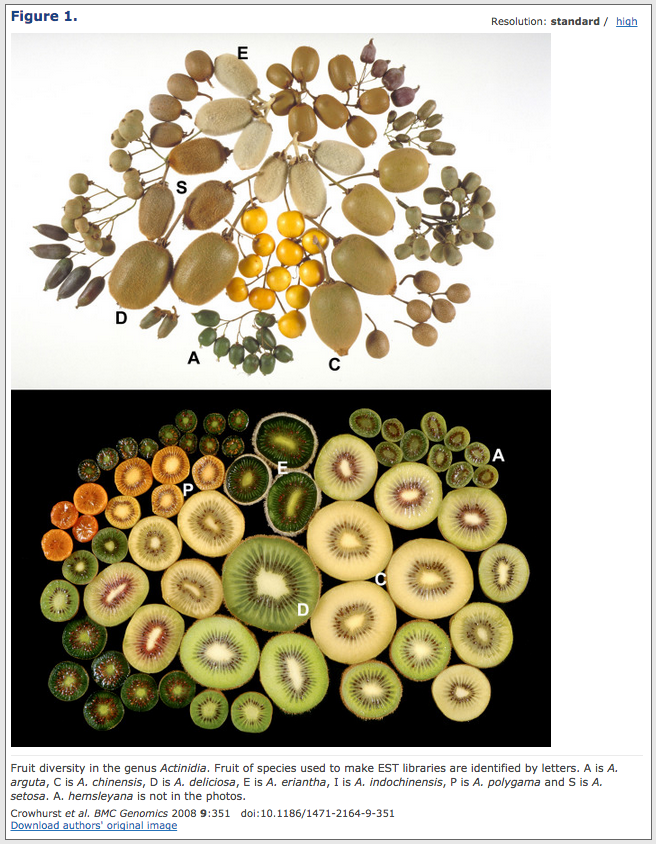 I love photos of weird plants, and the Facebook group Rare Fruit-Rare Edible Plants is a great place to find them. Once in a while, you even get a photo of diversity in a weird plant, which is even better. Case in point is this great visual summary of diversity in Actinidia. Except of course the Facebook version had no caption, which was annoying as hell. Fortunately, thanks to Google Image Search, I was able to track down the original source, a 2008 paper in BMC Genomics. Now, where can I get some of these to taste?
Bottleneck slides
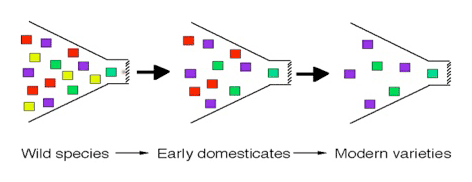
Try and find an illustration of the domestication bottleneck — to put in a slide for a presentation, say — and likely as not you end up with some variation on a classic theme, this particular version being from the great Teacher-Friendly Guide to the Evolution of Maize:
That’s fine for some purposes, but sometimes you want real data, and then you might use this:
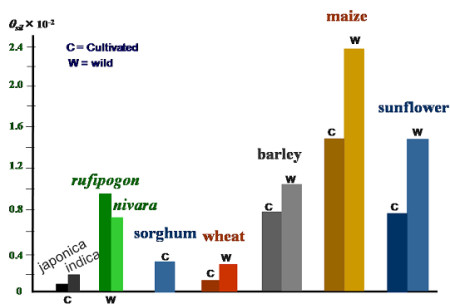
But I don’t really find that particularly striking, do you? And that’s why I really got excited about Fig. 1c in a recent paper about patterns of genomic diversity in a bunch of soybean accessions, ranging from wild populations to modern varieties. It’s really tiny in the paper, so I’ve blown it up here, at the expense of some quality:
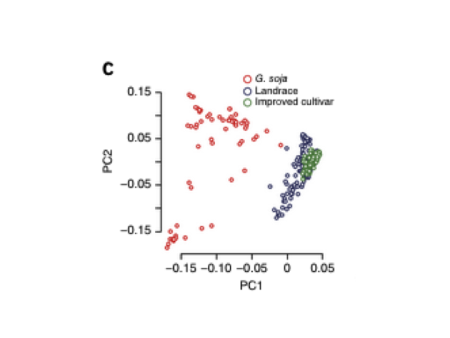
I think this really shows very compellingly how the genetic diversity space shrinks and shifts as you move from wild soya to modern varieties. You don’t even really need to know that the axes are principal component scores or indeed how diversity was measured. But is this kind of diagram common out there? I can’t remember seeing anything quite this clear, and some rapid googling drew a blank too. Well, perhaps I read the wrong journals.
So here’s a question for you: what’s your favourite illustration of the domestication bottleneck, using real data? If we get a decent number of examples, I’ll try to put them all together in a post, and maybe even organize a vote.
Nibbles: Conservation course history, Language and DNA, Entomophagy blog, IPBES help, Phenomics methods database, Sustainable Nestlé, Got other milk?, NCYC
- University of Birmingham conservation course alumnus/a? This one’s for you.
- Phonemes follow human genomes. Kinda. No word on crop and livestock genomes. Yet.
- A whole blog on eating insects.
- Interesting: “Each IPBES assessment must include reference citations to indigenous knowledge, and every review panel must include experts in this.”
- Curated list of methods in Plant Phenotyping and Phenomics.
- Nestlé’s sustainable agriculture guy visits CIAT, plants coconut, talks supply chains.
- Camelcino, anyone?
- UK yeast genebank reaches totally arbitrary milestone.
Featured: You say konbucha
Julia M. Schumann begs to differ with Jeremy on a point of Japanese linguistics:
In reference to the spelling question of konbucha (or kombucha) vs kobucha, I think that it was not so much a spelling mistake on the part of either author as a case of multiple pronunciations for the same meaning.
Get all the nerdiness.