- Our Hungry Planet: Agriculture, People and Food Security. Free online course from University of Reading.
- What if people in country X ate the same diet as people in country Y?
- The Man wants to fingerprint your stash.
- Or maybe fragrantly hopped beer is your poison?
- A new one on me: Conservatoire des Collections Végétales Spécialisées (CCVS).
- All politics is local. All control of forestry enterprises ought to be.
- Victoria takes to the poppy. Afghanistan unavailable for comment.
- The small farmers of Paraguay holding back the flood of soy. Or trying to.
- The promise — and curse — of CCN 51. And some context on the whole peak chocolate thing.
- Wait, some people think Bhut Jolokia is a cool name?
- The grapevine has gone viral. Millions of years ago.
- Global Panel of Wise Agricultural People says to biofortify your crops.
Mchele ni kila kitu
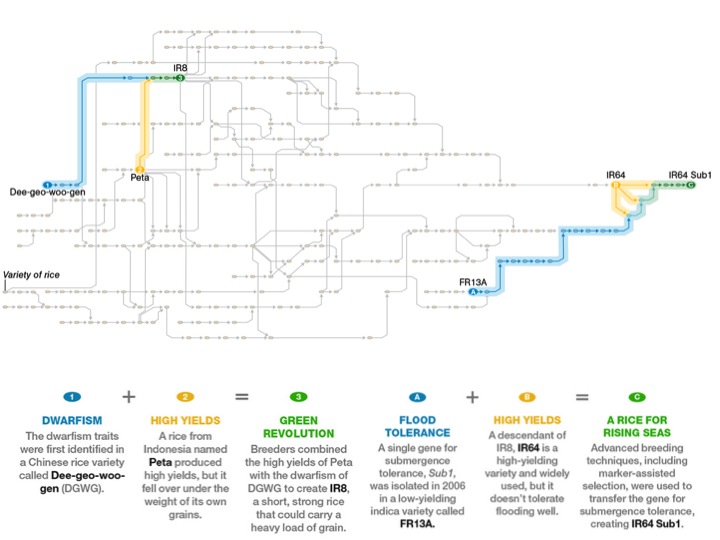
Well, actually the quote in National Geographic’s blockbuster on food — The Next Green Revolution 1 — is “Mihogo ni kila kitu,” which means “cassava is everything” in Kiswahili. I changed it to “rice is everything” because I want to highlight the illustrations in the article that shows the pedigree of IR64 Sub1, IRRI’s famous flood-tolerant rice. There’s also fun stuff in the article about cassava, and other crops, but I’ll leave that to you for now.
You know we’re great fans of pedigree diagrams here on the blog, because they’re so good at showing how important it is for crop breeding programmes to have ready access to the widest possible range of genetic diversity, from as many different places as possible, preferably in a genebank. Anyway, I don’t of course know what it looks like on your screen, but on mine the illustration was disappointing. If you see the whole pedigree, then you don’t see the caption; if you get one of the captions, then you only see part of the pedigree; and you can’t see both captions at once. So I’ve taken the liberty of putting the whole thing together. Here it is. You can click on it to see it better. I hope you like it. And I hope National Geographic doesn’t sue us.
CGIAR to listen — again
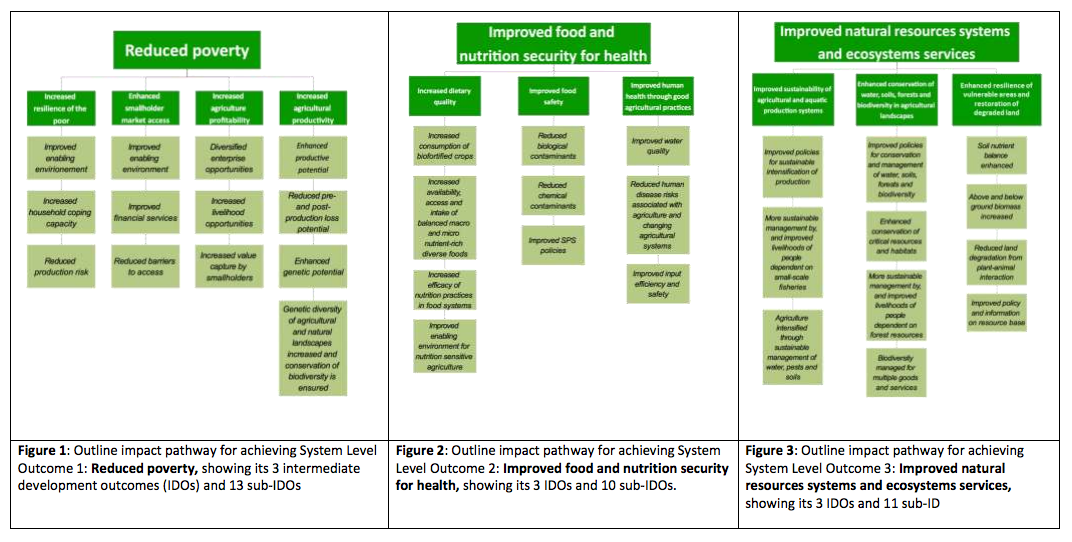
There are “cross-cutting topics of global importance — women and youth; climate change; and capacity development — [that] will systematically strengthen and build coherence in research across all domains and Intermediate Development Outcomes (IDOs).” Should not conservation and sustainable use of agricultural biodiversity be one of these?
We posed that trenchant, though perhaps predictable, question last November, as CGIAR asked all and sundry for input on their new Strategy and Results Framework (SRF). Well, all and sundry have been heard, and the new version of the SRF is out. The answer to our question is, alas, no. The cross-cutting themes — now gender and youth, climate change, policies and institutions, and capacity development — still do not include agrobiodiversity.
But leaving it at that would be unfair. Remember that in the old SRF, as we pointed out last time, “use of genetic diversity … only contribute[s] to the reduced poverty outcome, and then only via increased agricultural productivity.” Here’s the chart to jog your memory, and sorry again for the poor quality. The sub-IDO in question is the one that breaks the symmetry of the left-hand column, click on the image to see it a bit better:
Here’s the new schema, thankfully now more legible:
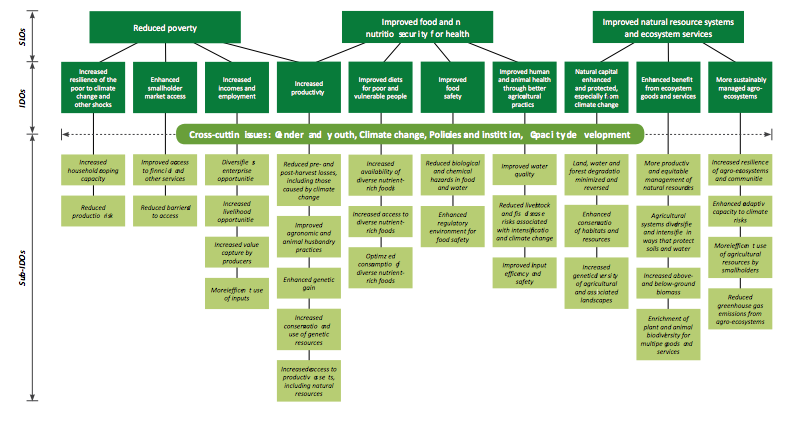
Equally thankfully, conservation of genetic resources now contributes to the System Level Outcome of improved food and nutrition security for health, in addition to that of reduced poverty. See that little extra line going right and up from the IDO of increased productivity? That’s what a small victory, of sorts, looks like. And there are additional sub-IDOs that we can also get behind:
- Increased genetic diversity of agricultural and associated landscapes.
- Agricultural systems diversified and intensified in ways that protect soil and water.
- Optimized consumption of diverse nutrient-rich foods.
So I guess we can say that people saying things very much like those we say here have been heard, at least a little bit. Let the second round of consultations begin! The Consortium Board and then the Funders Council sign off on the SRF in March and April, respectively.
Nibbles: Taro recipes, Pawpaw Kickstarter, Pica, Slow seeds, Forest foods, Pork rises, Landscapes, Best friend, Cooking & CC
- Ok, now you have no excuse not to eat taro.
- Do your bit to help pawpaws (Asimina triloba) go viral. No, wait, that didn’t come out right.
- “Pica is an unexplainable food curiosity—the overwhelming desire to eat the inedible.” Or, as we say in my house, German food.
- Tuscan seed journey.
- Living off forest foods can be fun.
- Pork beats beef.
- Picturing the Earth. Some of it ain’t pretty. But even then it’s pretty.
- Picturing working dogs. All of them pretty.
- Kenyan chef Ali L’artiste tucks into Rwandan bananas and beans before it’s too late.
The US picks…wheat
Nice to see a commercial airing during the Super Bowl that highlighted the importance of biodiversity in general and agricultural biodiversity in particular.
http://youtu.be/pkPZ-xW1DM4
Not so cool that they managed to ascribe the origin of wheat to the wrong continent, and indeed hemisphere, but I guess they were thinking of those amber waves. For me, the US should have picked the cranberry. Complements anything.