- Draft technical guidelines from FAO on conserving crop wild relatives at national level.
- Small farms are beautiful.
- Finding the climate adaptation needle in the genomic haystack. Hint: supercomputers needed. DivSeek alerted?
- Emma Cooper asks: “…have you got a favourite ‘forgotten’ edible plant that you’d like to champion?”
- James Wong talks about that kind of thing too, and much else garden-related besides, on his new website.
- Rejoice, Google Earth Pro is now free!
- Wageningen UR course on Food For All.
- UC Berkeley Graduate School of Journalism is offering ten $10,000 postgraduate Food and Farming Journalism Fellowships. ‘Nuff said.
- Speaking of fellowships: the 2015 call for Bioversity’s Vavilov-Frankel Fellowship is open.
- Possible new Cannabis species from Australia: watch them do the DNA work and spoil it. Gap analysis, anyone? … As you were, didn’t need DNA after all.
India declares crops covered under Seed Treaty exempt from Biodiversity Act
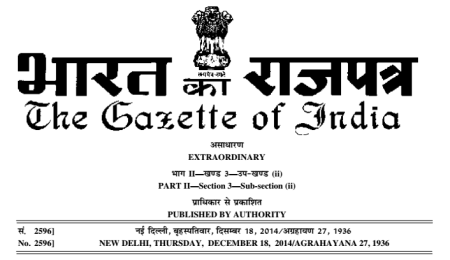
This edition of the Gazette of India, dated 18 December 2014, communicates a very significant decision for all of us who have an interest in the conservation and use of crop diversity. Here’s the exact language:
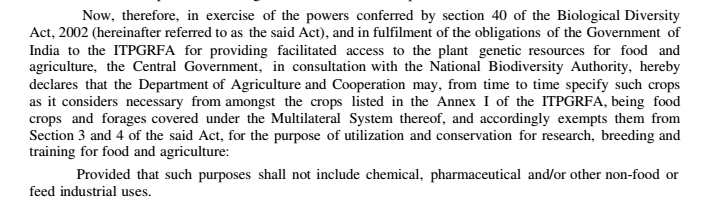
What this means is that genebanks under the management and control of the Government of India now have the formal go-ahead to fully implement the International Treaty on Plant Genetic Resources for Food and Agriculture, which India actually ratified a while back, of course. They won’t need to run every request for access to ex situ germplasm by the biodiversity authorities. Facilitated access indeed.
Nibbles: FAO Commission, Private genebank, DivSeek duo, Biofortified sorghum, African supermarkets, Enset, Health crops, Breadfruit conference, Denison podcast, Saving chocolate, Paramo app, CIMMYT genebank video, Pig milk
- FAO says genes are good for climate.
- India’s first private sector genebank established.
- Well, at least one person is really excited about DivSeek.
- And one major journal.
- DuPont video on increasing sorghum Fe and Zn levels in Africa.
- Will they sell it through local vendors or supermarkets?
- Let them eat enset. Which is not, however, on this list of today’s top healthy crops.
- Neither is breadfruit, but that shouldn’t stop you going to this conference in Trinidad.
- Ford Denison writes about his appearance on Eat This Podcast.
- Enough with the scary chocolate stories already.
- Here, go play with this app about the flora of the paramo from Missouri Botanical Garden.
- The CIMMYT genebank in the news.
- Pig milk in your tea, vicar?
Brainfood: Organic convergence, Wine yeast diversity, Cassava genome, Potato wild relatives, PREDICTS predicts, Seed cryo, Community seedbanks, Maize OPV evolution, Conservation conflict, Biofortification
- Organic and Non-Organic Farming: Is Convergence Possible? Yes, but conversion is more likely.
- The vintage effect overcomes the terroir effect: a three years survey on the wine yeast biodiversity in Franciacorta and Oltrepò Pavese, two Northern Italian vine-growing areas. Year more important than place as determinant of yeast diversity.
- Cassava genome from a wild ancestor to cultivated varieties. The genes that have been selected are the ones you’d think. And here’s the thing actually being used.
- Taxonomy and Genetic Differentiation among Wild and Cultivated Germplasm of Solanum sect. Petota. The genes that have been selected are the ones you’d think. Oh, and the taxonomy is fine.
- The PREDICTS database: a global database of how local terrestrial biodiversity responds to human impacts. Could prove useful. But it doesn’t look like the data is available yet.
- C-2001: Survival of short-lived desiccation tolerant seeds during long-term storage in liquid nitrogen: Implications for the management and conservation of plant germplasm collections. It’s not always great.
- Ensuring food security in the small islands of Maluku: A community genebank approach. Won’t be easy.
- Evaluation of Evolution and Diversity of Maize Open-Pollinated Varieties Cultivated under Contrasted Environmental and Farmers’ Selection Pressures: A Phenotypical Approach. Maize OPVs changed a bit in farmers’ fields over 3 years, but not in how they looked.
- Conservation planning in agricultural landscapes: hotspots of conflict between agriculture and nature. Threatened mammals and cropland areas where yield gap is highest are, not surprisingly, mostly found together in sub-Saharan Africa. I wonder if the same could be said for threatened crop wild relatives?
- Biofortification for Selecting and Developing Crop Cultivars Denser in Iron and Zinc. Current strategy is QTL detection followed by MAS, but much more downstream work on processing, extension and acceptance needed.
Nibbles: Tilapia pros & cons, Cotton history, Potato diversity, Mars sustainability, Forest conservation, Homegardens, Village forests, 14th century gardening, American chestnut, Soil barcoding, Non-cow milk, Conserving Spanish grapes, Biodiversity & poverty
- The truth about tilapia. Well, according to Fox News, anyway.
- “..the greatest industry that ever had or could by possibility have ever existed in any age or country.” Go on, guess. No, not tilapia aquaculture, though it has time.
- Modern Farmer gives us its hipster take on the potato. And bows out?
- Mars unleashes its sustainability policies.
- The Forest Stewardship Council gives examples of community-based conservation success stories.
- Homegardens for nutrition. (No, no pre-cooked bean products here).
- Ok, put the two previous together and you get this: Sumatran village forests.
- Bet those villagers don’t need a gardening manual, unlike Henry VIII of England.
- The American chestnut continues its comeback. Manual probably available.
- After barcoding: metabarcoding.
- Symposium on non-cow milk. Sounds like fun.
- “With more diversity, the more tools we have to fight against problems like climate change.” Yes, even with wine grapes.
- Biodiversity goods and bads: the role of biodiversity in poverty alleviation.