- The Platform for Agrobiodiversity Research breaks down this week’s Fifteenth Regular Session of the Commission on Genetic Resources for Food and Agriculture for ya.
- Kew looking for a crop person! I wonder if the successful candidate is in Rome today.
- Mauricio Bellon on why smallholder farmers need crop diversity to adapt to climate change. He’s in Rome.
- Multi-Parent Advanced Generation Inter Cross (MAGIC) deconstructed. Compare and contrast with above.
- The SDGs in one cool interactive infographic. But where’s nutrition?
- Where is overhunting for bushmeat occurring? Gotta get your nutrition where you can…
- Want to invest in a biofortified crop like iron beans? Here’s how to work out where you should do it. Interesting to cross-reference with that bushmeat thing above?
- Ancient Greek tree preservation order.
- Ethiopian forest dwellers protect wild coffee. No preservation orders needed.
- Tracking honey. Follow the money.
- Could say the same about nutmeg.
- Meat stew with garden eggs. Sounds yummie. Not much used in Kenya these days any more, alas.
- Delving into Armenian Ottoman foods. Because we can. No sign of garden eggs.
ABS on genetic resources straight from the horse’s mouth
Braulio Ferreira de Souza Dias, Executive Secretary of the Secretariat of the Convention on Biological Diversity (CBD), recently gave a very nice, clear answer to a question on the relationship between the Access and Benefit Sharing (ABS) regimes of the CBD and of the International Treaty on Plant Genetic Resources for Food and Agriculture. It was at the Special Event on Food Security and Genetic Diversity at FAO last Friday, which preceded the Fifteenth Regular Session of the FAO Commission on Genetic Resources, which started yesterday. You can hear what he says in a couple of different ways. You can fast forward to about 2:07:30 in the video of the event on the FAO website, and watch for about 3 minutes. Or, if you don’t mind only listening, you can click below. Dr Ferreira de Souza Dias focuses on Annex 1 of the Treaty, but of course the collections listed under Article 15 are in the same boat. The questioner is my old friend Desterio Nyamongo, head of Kenya’s genebank.
European livestock breed conservation assessed
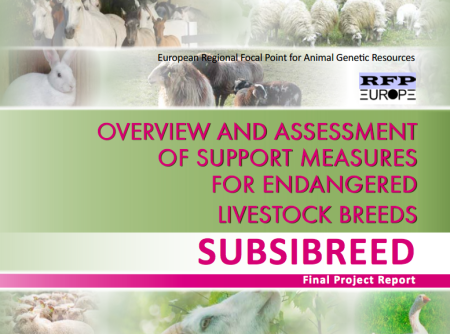
A further addition to the mass of online information on livestock genetic resources around the world. It’s the final report of the SUBSIBREED project, providing and “Overview and assessment of support measures for endangered livestock breeds” in Europe. It was put together by the European Regional Focal Point for Animal Genetic Resources (ERFP), which is hosted by the Information and Coordination Centre for Biological Diversity (IBV) of the Federal Office for Agriculture and Food (BLE)
in Bonn, Germany. I suppose the information will eventually find its way into the relevant databases?
Nibbles: South Sudan livestock, Zanzibar spices, Sustainable fisheries, Wheat heat, Cape Town gardens, Saving chocolate, Camel cheese, Khaaaaaaan!
- South Sudan crisis affecting its livestock too.
- Sugar, spice, and everything nice in Zanzibar.
- The secret to sustainable fisheries: recycling waste.
- Wheat going to be hit by heat.
- The history of growing food in Cape Town.
- More from the University of Reading’s cacao quarantine facility. With video goodness.
- You can get Austrian camel cheese at the Jaipur Literary Festival.
- Khan Academy does biodiversity.
Brainfood: Safflower diversity, Afghan wheat diversity, Cassava diversity, SP drought tolerance, Olive diversity, Community genebanks, Organic yield meta-analysis, On farm success, Standardizing phenotyping, Wild collecting
- Assessment of Genetic Diversity and Population Structure in a Global Reference Collection of 531 Accessions of Carthamus tinctorius L. (Safflower) Using AFLP Markers. Bayesian analysis of genetic diversity of global (43 countries) collection held in India reveals 19 geographic groups, with most diversity in the Near East and Iran–Afghanistan regions.
- Molecular evaluation of orphan Afghan common wheat (Triticum aestivum L.) landraces collected by Dr. Kihara using single nucleotide polymorphic markers. Analysis (Bayesian, natch) of genetic diversity of over 400 wheat landraces collected 1950-1970 and conserved at the Kihara Institute for Biological Research, Japan reveals agroecological patterning and hotspot in Badakhshan province.
- Sources of pest resistance in cassava. Analysis of 89 trials over 25 years involving the CIAT cassava collection identifies 129 landraces with high resistance to thrips, 33 to green mites and 19 to whiteflies.
- Screening sweetpotato genotypes for tolerance to drought stress. Days to permanent wilting point (DPWP) points to 8 promising clones in Kenya.
- Olive domestication and diversification in the Mediterranean Basin. About 400 wild and cultivated accessions divide up into W, central and E groups and show evidence of admixture among them and local domestication events.
- The Multiple Functions and Services of Community Seedbanks. More than just conservation.
- Diversification practices reduce organic to conventional yield gap. More data and fancier maths finds a lower organic yield gap (20%), which is halved by multi-cropping and crop rotations.
- Conserving landraces and improving livelihoods: how to assess the success of on farm conservation projects? All you need is two graphs.
- Finding Our Way through Phenotypes. “We urge all biologists, data managers, and clinicians to actively support the development, evaluation, refinement, and adoption of methodologies, tools, syntaxes, and standards for capturing and computing over phenotypic data and to collaborate in bringing about a coordinated approach.” Amen.
- Wild food in Europe: A synthesis of knowledge and data of terrestrial wild food as an ecosystem service. 65 million people collect, and at least 100 million consume, wild food. But only 81 plants? Thought it would be more. But even so, quite an ecosystem service.